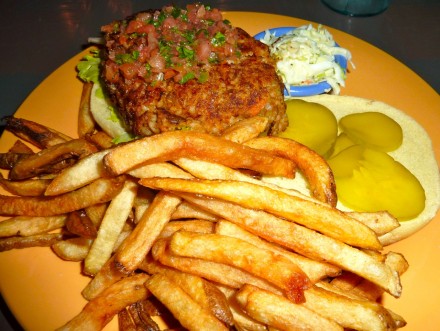
Veggie burger at JW Burger Bar
Even a mediocre french fry can hit the spot, but a real one — made from raw potatoes and deep-fried perfectly — is one of life’s simple pleasures.
The new JW’s Burger Bar has some.
Cut from russets daily, they’re thinish, crispy on the outside and meaty on the inside. But they’re not the only thing that sets JW’s apart from the other new burger places around.
This Scituate eatery is the latest offering from South Shore restaurateur Joanie Wilson and her husband, chef Jimmy Burke, whose first restaurant, Allegro, broke culinary ground in Boston when it opened in 1981.
Since then, Burke has opened a string of great restaurants — currently putting most of his energy into the couple’s outstanding Italian place, Orta, in Pembroke. Although JW’s is largely Wilson’s baby, Burke has designed much of the menu, and his award-winning touch is apparent.
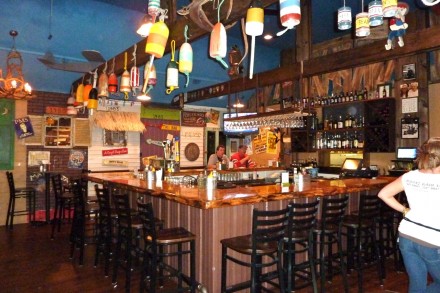 JW’s shares the former Raymond’s paint store building with a dance studio, and the division of space is quirky. A walkway leading to the side rear of the building brings you to JW’s front door and entry into a narrow interior hallway. The high-ceilinged main room houses a shiny, blond wooden bar and extends into a shack-like, side-room dining area.
The whole space is hung with paraphernalia and ephemera with a sort of western, nautical, retro, tropical theme — all of which conveys a lively, wacky vibe. Best of all, there’s a great patio out back.
In case you’re confused about the name: JW’s Burger Bar opened as Backyard Burger Bar in December. Last month, however, the couple was forced to change the name when a chain of Tennessee burger joints with a similar name threatened to sue.
Although this is predominantly a burger place, a close reading of the menu will reward those who don’t want burgers, or want to eat lightly, or are even vegetarians.
The veggie burger ($10) is a truly delicious original, not some frozen cardboard stand-in. Although it’s a bit crumbly, it’s a tasty lentil-, barley-, and vegetable-based patty topped with homemade salsa.
Other lighter options include an excellent grilled Bell & Evans (antibiotic- and hormone-free) chicken breast sandwich ($8) and several salads that can be ordered with various protein add-ons. A Caesar ($7), for instance, with a salmon burger or chicken breast on top (add $8) is a very nice meal.
The peel-and-eat wild shrimp ($9) are beautifully springy and clean-tasting, their dorsal veins cut out through the shell. They come on a small bed of mesclun with lemon and a cocktail sauce with plenty of horseradish kick. The fried shrimp in the appetizer ($8.25) are light and crispy, although I prefer a more savory batter — this one reminds me of beignets. Still, you want to keep biting into another one, and the house-made tartar sauce is a big cut above the average while absolutely delivering the flavor of the condiment so many of us love with fried fish.
Which reminds me: Another tasty departure from burgers is the fried fish sandwich ($12), which is large enough to be, basically, fish and chips with a bun.
And the beef burgers? They’re good. According to John Dewar at meat distributor T.F. Kinnealey Co., in Brockton, the “natural” beef comes from Nebraska from animals that are not administered growth enhancers or antibiotics.
We’ve enjoyed the burger ($10) and the bacon cheeseburger ($13) – half-pounders big enough to have a pink middle (unlike fast-food burgers, which can only come well done). Turkey burgers ($11), which can be stultifyingly bland, are moist and flavorful, too.
The restaurant’s ribs ($14) are pretty spicy, and the hunk of seductive, diner-style grilled cornbread that comes with them is a sweet contrast. Worth mentioning, too, is the cooling house cole slaw. And, if you like barbecue, try the pulled-pork sandwich ($10).
Desserts are confined to a few selections of cupcakes from the superb Pembroke-based JennaCAKES. But on three visits, we were too full to remember to order one.
Next time — out on the patio.
]]>
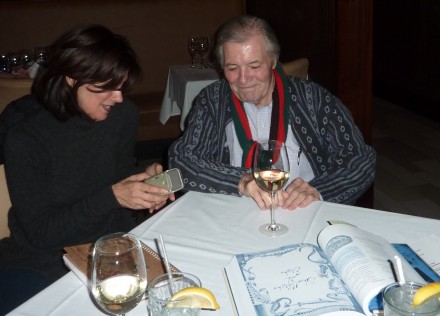 As Jacques Pépin made the rounds of the 120 guests attending the celebrity chef dinner at Hingham’s Summer Shack last Monday, guest after guest embraced the legendary chef – metaphorically or literally.
“We just love you!’’ said a woman as she held Pépin’s hand in both her own.
An exceedingly social creature, Pépin matched this outpouring of affection with the open-heartedness that characterizes all his work: the 21 books; decades of magazine articles; university and culinary school teaching; and the hundreds of PBS cooking shows that began long before anyone had even thought of the Food Network.
Among his vast accomplishments is a decidedly local one. Pépin and longtime friend Julia Child founded the country’s first master of liberal arts in gastronomy degree program at Boston University in 1993. The program combines cultural studies with the university’s Culinary Arts Program, which was founded by Child, Pépin, and Summer Shack owner-chef Jasper White.
“Jacques is the best teacher of technique in this country,’’ said Rebecca Alssid, director of BU’s Food and Wine program.
“I am more a teacher than a chef,’’ said Pépin, as a line of adoring fans waited to have him sign his new book, “Essential Pépin: 700 Recipes From My Life in Food,’’ before being seated for the one-time, $250 prix fixe dinner.
The book is illustrated with 300 of Pépin’s charming drawings – he’s been painting for 50 years. And rather than a simple collection of his greatest hits, many of his recipes have been simplified for this edition.
“I like to simplify,’’ said Pépin, who experiences cooking as an ever-changing pursuit that continually presents in new ways. White expressed a similar sentiment, likening the appeal of cooking’s infinite variety to the limitless music a composer can create with the same 12 notes.
In the process of revisiting decades of recipes for the new book, Pepin saw many of them differently than when he originally wrote them.
“I’d look at a recipe and say, ‘Why did I do that?’ And find a slightly simpler way.’ ’’

Jasper White, owner of Summer Shack, with Jacques Pépin, the first celebrity chef in his winter series.
According to the man many remember from his TV series “Julia and Jacques: Cooking at Home,’’ the freedom to forge new approaches emerges only after a cook has mastered his medium. For this, Pépin knows that repetition is the key.
“For the professional chef, you must repeat, repeat, repeat techniques until they become part of you, part of your DNA, and the knowledge is in your hands. Until then, you can’t concentrate on the texture of the dish, the flavors, the combinations,’’ he said.
Along with this emphasis on technique is Pépin’s equally strong insistence that respect for food and pleasure must accompany any good cooking experience.
“Young chefs who come to me and say they want to write books and create television shows will be disappointed because that is unlikely to happen. You have to love cooking, feel gratified feeding people – and then being a chef can be a nice life.’’
For people who don’t cook but want to learn, Pépin takes a page from Child’s book. “Do you have a friend that cooks? Ask if you can go to their house an hour ahead and watch them cook. By the second glass of wine, even if the chicken is burned a little bit, who cares? It really doesn’t matter that much. Relax. You are creating pleasure, you are supposed to have pleasure yourself. You have to look at cooking as a fun thing, then you get better at it.’’
While Pépin’s hundreds of shows and exquisitely detailed cookbook instructions offer a wealth of technique, technology has put a wondrous tool in the master teacher’s hands: The book comes with the three-hour DVD, “All the Techniques That Cooks Need to Know.’’
“I’m dean of studies at the French Culinary Institute for 25 years in New York and a teacher at BU for 30 years,’’ said Pépin. “All those schools are very expensive, and basically most of the techniques we teach are on this tape,’’ he said.
“With the tape you can watch it again, put it back, put it back, stop it – and then you can see, ‘I think his knife is a little more flat when he scraped the butter.’ This is invaluable.’’
Monday marked the first of Summer Shack’s second season of celebrity chef dinners. The general procedure has the visiting chefs teach their recipes to Summer Shack’s staff and cook the dinner with them.
In this case, White’s staff cooked Pépin’s menu. Over dessert – an ethereal frozen Grand Marnier soufflé – Pépin loudly clinked his glass to get everybody’s attention and praised White and his crew.
“They did it better than I could have,’’ said Pépin, eliciting a cheerful “no’’ from the crowd. White went on to applaud his friend and introduce his kitchen staff. Half the guests were standing and applauding while this warm exchange continued.
The meal began with a lovely amuse-bouche of molasses-glazed salmon and fennel salad on brown bread, accompanied by Grand Brut, Perrier-Jouët.
Next, was Pépin’s tender mushroom-stuffed escargots with a bright frisée salad, an old recipe from his days at Plaza Athénée in Paris. White did a brilliant job with Pépin’s lobster in artichoke hearts – a dish that required cooks to trim six cases of artichokes down to the luscious meat at their cores.
The main course was chicken ballotine with a turnip and potato purée sided with smoky turnip greens. A Pouilly-Fumé and a California pinot noir were poured freely.
Although White and Pépin can’t remember exactly when they met, they were both close friends with Child.
Pépin met her in 1961, when she “was totally unknown.’’
“Julia had sent her manuscript to a friend of mine – Helen McCall, editor of McCall’s in New York. When Helen asked me to look at it, I did, and we thought it was very good.
“Helen said, ‘Well, the woman is from California and she’s coming to New York next week, why don’t we cook for her? It’s a big woman with a terrible voice.’ That was Julia.’’
And that’s Jacques.
]]>
 News of the recent opening of Hingham’s new burger joint exploded this summer in a Hollywood-powered media blitz that was hard to miss. Even before the TV segments, newspaper, US and People magazine blurbs, there was lots of local talk: a deal for a reality show on the place had been signed; a green initiative, somehow linked to the White House, was underway; and plans were being drawn for a nationwide chain.
Whether or not these rumors come to pass, the hilariously and brilliantly named Wahlburgers, lends some of Hollywood’s bright light to the Launch at Hingham Shipyard complex, hopefully helping to anchor its growing presence.
The 80-seat (there are another 40 on the patio) uber fast food restaurant and bar is owned by longtime South Shore chef Paul Wahlberg and his celebrity brothers: TV- and movie stars Donnie and Mark Wahlberg.
In June 2010, when Chef Paul opened his first restaurant, Alma Nove, across the street from the new Wahlburgers, his
brothers were investors, but quietly so.
Now, with Alma Nove’s success, the brothers have put their star power and family story on proud display in a brand with an unforgettable name that could take this bad boy to the stars.
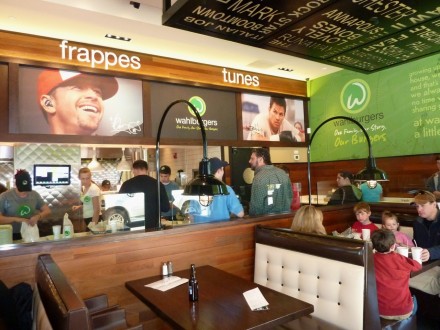
The retro modern diner-inspired décor is filled with movie memorabilia and the family focus is graphically encapsulated in the restaurant’s highly visible logo: Wahlburgers: Our Family, Our Story, Our Burgers. That story — written on the rear wall in large letters — is a familiar Boston tale: nine kids in a triple-decker in Dorchester didn’t have much but each other.
The bright windowed space is a large V-shape (or maybe it’s half a W?) with an open kitchen between the two rectangular wings. One side offers table service with seating either at large communal tables for 10, or at the bar. On the other side, people order at the counter and either sit at a booth or a two-top – or get the food to go. In warm weather, there’s great patio seating.
Housed in the former Pizzapalooza (which, sadly, never drew a crowd), Wahlburgers has been packed (during peak hours at least) daily since it opened last month. On four recent visits, timed to avoid crowds, the place was still crowded. The owners, who also include family friend Ed St. Croix (cq), have created a very clever business by including a full bar and making it the only place around that’s open seven days a week until 1 a.m. The option, too, for self-service nicely removes the cost of a tip, as do the credit card receipts, which offer no line for writing in a tip.
Wahlburgers isn’t really about the food. It’s about fun and filling up on satisfying comforts in a lively, easy environment. Eight flat screens line the walls above the bar – the brothers are big Boston sports fans. Music, too, is important to the lads (Donnie got his start in the ‘80s in the boy group “New Kids on the Block”) so the sound system is great and the play list widely varied.
The menu is small but well thought out. There are nicely seasoned turkey burgers ($6.25) and three main beef burgers – the cheapest being the single decker ($4.50), and the most expensive, the triple decker at $9 (“like the house we grew up in” says the menu). The sandwiches have a grilled toasted bun and can be ordered with a large selection of toppings that includes fresh jalapenos, smoked tomato salsa, and sriracha sauce. A single or double decker with, say, catsup, mayo, mustard, pickles, tomato, and the “government” (American) cheese the Wahlberg’s grew up on, delivers mouthfuls of hard to resist, classic, fast-food burger flavor.
Three burgers with set toppings are offered as specialty choices. The Thanksgiving turkey burger ($7.50) is topped with stuffing, cranberry sauce, roasted squash, and mayo. It is sweet, savory, and gooey — in a good way. The beef is all antibiotic- and hormone-free, a nice boon, and healthier burgers, including salmon and mushroom, are due to debut soon. The kids menu has good Bell & Evans (cq) hormone- and antibiotic-free chicken fingers with fries for $5; a simple grilled cheese on thick white bread with fries ($4), “smahlburgers” with fries ($5), and kid-sized sodas for a buck. There are also tater tots ($3) and sweet potato tots ($3), which are fine but I’d rather have the fries ($3).
I love (God forgive me) Wahlburger’s hot dog ($4), with its snappy bite, the choice of some good sauerkraut, and its grilled roll. (I don’t know where else around here I could get as good a dirty water dog as this one.) We also found the skinny onion rings outstanding, and one hard pull on the thick chocolate frappe ($4.65), made with local ice cream from Nona’s Homemade (cq) ice cream shop, brings on flashes of pure childhood goodness.
The chef’s ingrained hospitality is evident in little touches aimed to please a variety of guests: good French roast coffee; house-made lemonade, locally-sourced Hornstra Farms chocolate milk, and caramelized onions, sautéed mushrooms, and avocado as optional burger add-ons ($1).
Noticeable too are a pair of plain salt and peppershakers on each table (no need for paper packets of S & P at Wahlburgers).
Very retro.
19 Shipyard Drive, Hingham
Daily 11 a.m. to 1 a.m.
781 749-2110
wahlburgers.com
Accessible to the handicapped
Major credit cards accepted
]]>
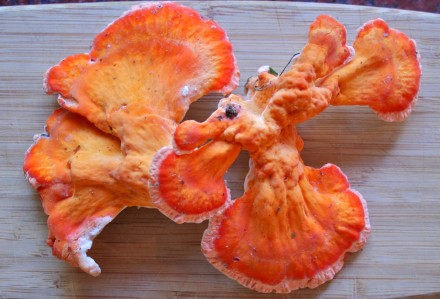 I bumped into Paul Trojano today. He lives in Norwell, has a place in Vermont, owns Caffe Graffiti in Boston’s North End, and loves to forage for food.
Look what he gave me.
They’re called Chicken of the Woods mushrooms. He picked them on Prospect Street in Hingham this morning. He also got oyster mushrooms there and black trumpets in West Chesterfield, N.H., on Saturday, the day before the hurricane (Irene).
Here’s his recipe for Wild Mushroom Risotto
8 oz fresh wild mushrooms such as Chicken of the Woods, Hen of the Woods, Chanterelles, Porcinis, Oysters or Black Trumpets
6 cups chicken or mushroom/vegetable stock
2 tbs. olive oil
1 1/2 tbs. butter
1 oz dry white wine to deglaze
1 medium onion, finely diced
1 1/2 cups arborio, carnaroli or vialone nano rice
S & P to taste
Finish: 2 Tbs. butter, 1/2 cup Parmigiano Reggiano, grated, white truffle oil (optional)
Slice or chop mushrooms depending on size and style of mushroom. Heat oil and butter and slowly saute mushrooms (Wild mushrooms must be cooked for at least 15 minutes), remove from heat and keep warm. Heat stock to a simmer. Heat oil and butter in a large pan and softly fry onion until translucent. Add rice and stir well. Add wine and stir. Slowly add hot stock a little at a time. Add more as the rice absorbs the liquid. This process should take about 20 minutes. Constantly stir to keep rice from sticking. About 15 minutes in, add sauteed mushrooms to rice and stock. The rice is done when it is soft on the outside, yet has a slight crunch at the center. At this point the dish should be creamy and fragrant. Remove from heat, finish by adding butter and cheese. Serve at once.
Serves four.
]]>
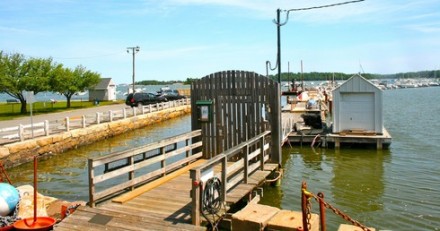 Being a café lover of the first order (there’s not much I enjoy more than hanging at a great café), I am thrilled out of my mind that Hingham resident Bob Weeks, of Redeye Roasters, is planning to open a café in the Bare Cove Marina building, across from Stars Restaurant, on Hingham Harbor.
You may know Weeks from the hand-roasted coffee he sells at several local shops or from the great coffee he serves from his colorful coffee truck at the Hingham Farmers Market. The new café-to-be — Redeye Roasters Coffee and Espresso Lounge — will occupy 1,000 square feet of the side of the marina building toward the Hingham Bathing Beach, while the other side will serve as storage for marine activities. [See the view below] “We’re putting windows on the water side, so very soon you’ll be able to have a coffee and look at the boats and water,” said Weeks, who hopes to open by late August or early September.
Weeks, who launched Redeye Roasters after leaving his advertising job in 2006, plans to offer all types of coffee drinks, teas, pastries, gelato, and affogato. (He may be in the market for a local baker to supply the shop, so if you’re that person, check him out.)
In Plymouth, the historic building where the wonderful Martha’s Stone Soup restaurant (cq) used to be is set to open on June 23 as a restaurant serving classic American fare.
Rye Tavern is the newest baby of partners Christopher Tocchio andKristian Deyesso, owners of Plymouth’s Union Fish Seafood & Raw Bar; Boston’s Church Restaurant & Nightclub; and The Regal Beagle in Brookline.
The owners have gutted the building, known as the Wright Tavern, built in 1792, and created seating for about 50, which includes some patio dining, said Brandon Babiarz, executive chef of Union Fish. The menu will be small and have a farm-to-table, seasonal focus inspired by the garden on the property.
It’s great that these guys are renovating and restoring this special, remote venue at the intersection of Old Tavern Trail and Old Sandwich Road in Pinehills. The restaurant will be open at 5 p.m. daily for dinner.
The former Cafe Ona (and before that Cafe Calabria) at 443 Nantasket Ave. in Hull is now Lynda’s Restaurant – a breakfast and lunch place owned by Joe DiVito, who owns Weinberg’s Bakery just up the road. The restaurant, which is open daily from 7 a.m. to 2 p.m., serves breakfast all the time as well as lunch from 11 a.m. to 2 p.m.
Among the many standard American breakfast and lunch dishes are some Italian favorites. Lynda’s also serves espresso drinks, Hornstra dairy’s local milk and chocolate milk, and soymilk. Daily specials are posted on the restaurant’s Facebook page.
DiVito has been able to secure customer parking in the Knights of Columbus lot across the street from the restaurant, something the site’s former incarnations didn’t have.
Chef Paul Wahlberg and company are planning to open a casual burger, hot dog, and frappe type restaurant adjacent to the chef’s fine dining restaurant, Alma Nove, at the Hingham Shipyard late this summer, according to Wahlberg’s publicist, Mindy Valone, at Boston’s CM Communications.
Although Wahlberg spoke at length to a local paper last month about his plans and inspiration for the new place, he’s now unavailable for comment, so we’ve been unable to confirm anything more than the basics.
Wahlberg opened Alma Nove last summer with partners that include brothers Mark (movie guy) and Donnie (music and movie guy).
A new burger place, Wild Willy’s Burgers, is planning to open later this month at 588 Washington St., not far from the Fore River Bridge. The restaurant is part of a small chain – there are six others spread among Massachusetts, Maine, and New Hampshire.
The new place is owned by husband and wife Paul and Ruth Bennett.According to the restaurant’s Facebook page, Wild Willy’s will be open daily from 11 a.m. (noon on Sundays) until 9 p.m. (8 p.m. on Sundays). For info about possible employment, call 617- 472-9453, or stop by the restaurant.
The Quincy Farmers Market, which opens on June 24, will be selling Massachusetts wines for the first time this season.
According to Janet Little, market manager, state legislation was passed last year that allows the sale of Commonwealth farm wines at farmers markets. The city of Quincy this month licensed the farmers market to hold wine tastings and sales.
The market, which is open from 11:30 a.m. to 5:30 p.m. on Fridays, will feature wines from one of four Commonwealth wineries each week. The participating wineries are Coastal Vineyards of South Dartmouth; Westport Rivers of Westport; Zoll Cellars of Shrewsbury, and Turtle Creek of Lincoln.
]]>


]]>
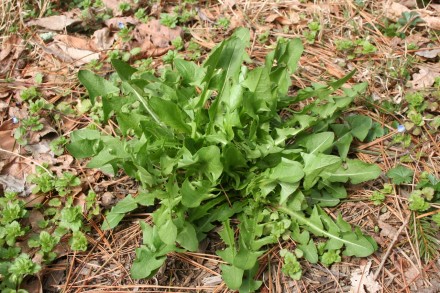 I cannot understand why — what with all the locavores and food bloggers out there going on and on about ramps, fiddleheads, and morels this time of year — nobody’s raving about how great dandelion greens are.
Am I missing something? I think they should top everybody’s list of wild foods: they’re nutritional superstars, widely available, free, organic, and delicious. I love them.
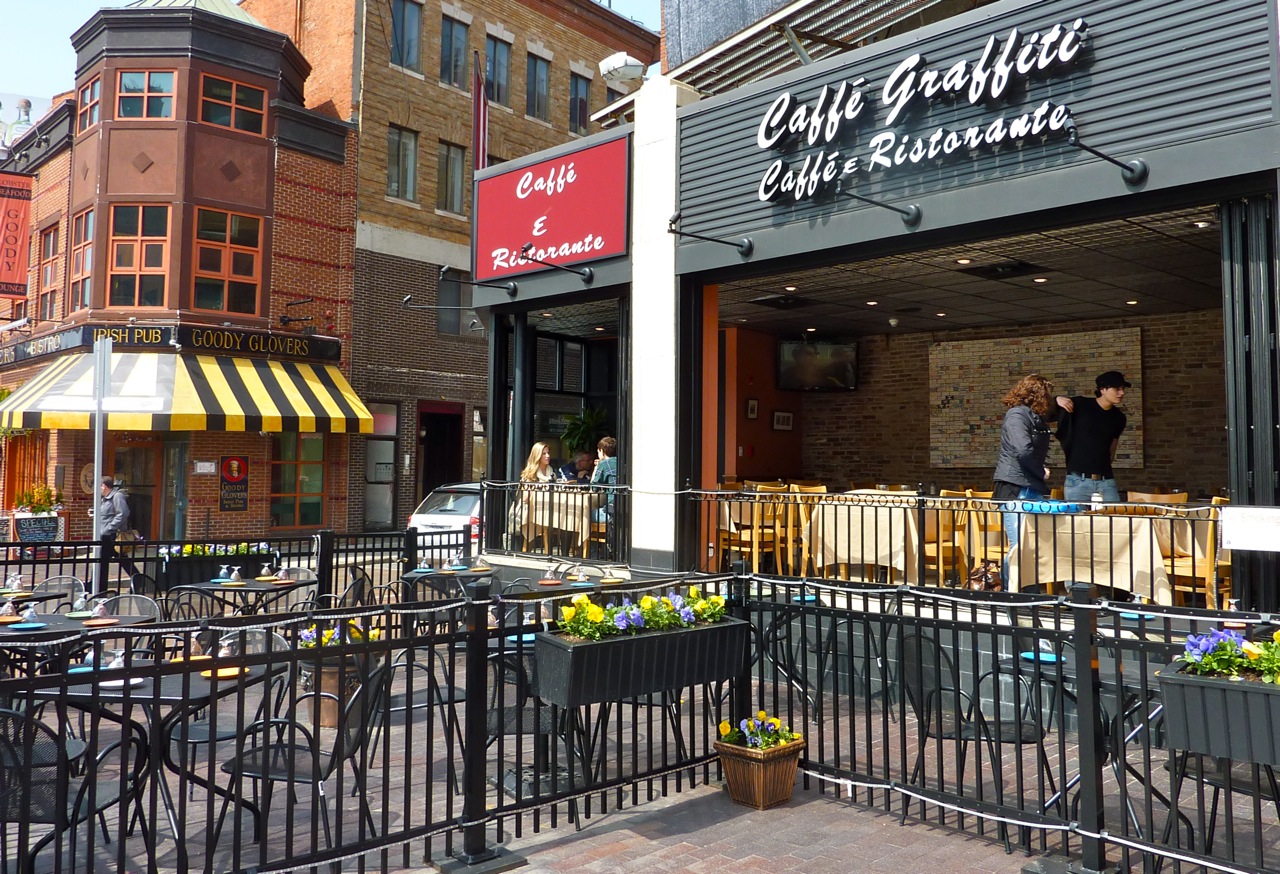 Trojano does most of his foraging in Vermont, but he knows his way around the South Shore, too.
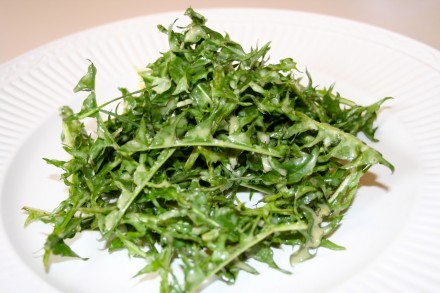 My mother, like many Italians, dressed the dandelions in a more astringent, sharper dressing of four ingredients: olive oil, red wine vinegar, salt, and pepper.
 Living and dining in today’s ubiquitous celebrity chef and foodie culture, anyone could be forgiven for not knowing that the American food scene wasn’t always so. But chef Jasper White [left], who was part of the culinary flowering of the late ’70s that led to the scene as it is today, saw it all unfold.
With White holding a series of one-night Celebrity Chef dinners in March and April at his Summer Shack in Hingham, we thought it was the perfect time to take a quick look at how the whole phenomenon started.
In the beginning (say, the ’50s and ’60s), chefs labored anonymously in restaurant kitchens, with owners either out front or out of sight.
Many Americans, sold on modern convenience foods at home (canned vegetables and Campbell’s soup-based casseroles), didn’t expect much more when they went out. In some circles, it was even considered gauche to talk about food at the table.
You can imagine then, the impact of Julia Child’s first TV cooking show, “The French Chef,’’ which premiered in 1963 and ran for a decade.
The series, shot in Cambridge, played an enormous role in creating a fertile environment for what was to come. Locally, Child was a close friend to many young chefs (including White), serving as both fan and teacher.
As the ’60s gave way to the ’70s, cooking schools, dominated by The Culinary Institute of America, seeded the population with an increasing number of chefs trained in classical French technique.
Out of this mix of influences, in the late 1970s and early 1980s, came the first young Boston-based chefs to open their own restaurants.
This phenomenon — the chef-owned restaurant — was the starting point of what has become today’s celebrity chef culture.
The young chefs, inspired at the time by nouvelle cuisine in France, began producing beautiful dishes with fresh ingredients and simpler, lighter preparations.
Their cooking, and that of their counterparts in other major US cities, came to be known as the new American cuisine, and — for the first time — the chefs’ names began to be known, too.
In 1983, after struggling to raise the money, White opened Jasper’s, one of the first chef-owned restaurants — and one of the first to garner national press. Among Boston’s other pioneers were Moncef Meddeb (L’Espalier, 1978); Bruce Frankel (Panache, 1979); and Jimmy Burke (Allegro, 1981), who now owns Pembroke’s Orta.
Within a few years came Chris Schlesinger’s East Coast Grill (1985); Gordon Hamersley’s Hamersley Bistro (1987); Lydia Shire’s Biba (1989); and Todd English’s Olives (1989).
“In the early ’80s, there was no business model for the chef-owned restaurant,’’ said White. “It took a banker like Jack Sidell of US Trust in Boston to have the foresight to see where our industry was going. . . . Today, it’s hard to finance a restaurant that isn’t attached to a chef.’’
Boston chefs are a tight group, so it was only a matter of a few phone calls for White to get half a dozen of the city’s best to participate in his current series.
“It was the boring middle of winter and I thought it’d be fun to bring some Boston chefs to our South Shore customers,’’ said White, who closed Jasper’s after a 12-year run and subsequently opened the first Summer Shack in Cambridge (now there are four).

The first of the series of dinners was March 2 with Ming Tsai (of TV’s “Simply Ming’’).
A couple of weeks before the event, White and his three top chefs spent the day at Blue Ginger learning how to prepare Tsai’s dishes. Tsai then spent the day of the dinner at Summer Shack cooking with White and his crew. This is how each of the visiting chefs’ menus will be executed.
For the March 2 event, a curtained half-wall in the center of Summer Shack partitioned the restaurant while the front remained open to regular diners.
Dinner began with a beautiful plate of paper-thin hamachi sashimi with a bright salad of vivid microgreens.
 Next up? Thai-spiced mahi mahi [left]. The thick filet was served atop an island of wilted watercress in a sea of delicately flavored lime-coconut broth speckled with perfectly browned garlic slivers. The main course of pan-cooked, cleavered lobster and hanger steak — “surf and turf’’ — was wonderfully delicious with an edamame-speckled jasmine rice.
Together, the three courses were both curiously light and filling, nutrient-rich (proteins and vegetables) and flavor-packed — as balanced a menu as Ming’s famed East-West approach.
By dessert time, we were content enough to enjoy only small bites of the gorgeous bittersweet chocolate cake and cardamom ice cream.
The atmosphere was warm, elegant, and mellow. Servers were wonderful, inviting each table to indicate when they were ready for their next plate. A different wine accompanied each course: a French champagne, a French white, and a California red — poured as you like.

Toward the end of the evening, Chefs White and Tsai – gracious, friendly, happy – visited diners at tables.
“This wasn’t a money maker,” said White. “You can’t go to one of these restaurants and get a four course meal with wine for $75. We’re having fun. We love what we do.”
For information about the other chefs in the series, visit the Summer Shack website.
Photo credits: Spiced mahi mahi by Joan Wilder for the Boston Globe. All others by Steve Sullivan.
 It’s late October and I’m sitting in Drago’s Seafood Restaurant and Oyster Bar in New Orleans on the first night of a five-day family reunion at my brother- and sister-in-law’s house in the French Quarter.
Having relatives in great places is sweet and this is my sixth or seventh trip to the city. And, because the house is vast with room for all and my father-in-law such a good cook, we tend to stay in for dinner.
But Drago’s is a family favorite and we have to eat here. This is where the now popular New Orleans charbroiled oyster originated in the early ‘90s, which is pretty much all we order: platters and platters of the buttery, garlicky, grilled bivalves.
“We’ll have another dozen,” says my husband’s brother, Jamie, to our server.
Chances are, even if you don’t like oysters, you’d like these. They taste like the world’s best garlic bread with a little something more. If you were blindfolded, I don’t think you’d know they were oysters, yet die-hard oyster lovers adore them.
We have so many great oysters on the South Shore, but I’ve never had or seen them grilled the way owner Tommy Cvitanovich does it at Drago’s.
The restaurant was founded in 1969 in Metairie, a suburb of New Orleans, by Tommy’s parents, Drago and “Miss Klara” Cvitanovich, who are still very much a part of its operations. Some 38 years later, in 2007, the family opened a second Drago’s on the Mississippi River, steps from the Quarter. The 360-seat restaurant is inside the Hilton, which was totally renovated after Hurricane Katrina, or the storm, as locals call it.
 As soon as you walk into either Drago’s you see dozens of oysters on the half shell on an enormous grill. Chefs literally throw handfuls of a Parmesan, Romano, and parsley topping over the butter-sauce-filled oysters, causing the fire to flare up and char them.
Tommy came up with the idea of grilling oysters in the shell one bright day at the restaurant in the early ‘90s, after sending out an order of redfish, covered in garlic, butter, and herbs.
“We cooked the redfish with skin and scales that acted like a shell or extra plate that held the juices and basting in,” said Tommy. “I thought ‘there’s no better liquid than oyster juice,’ and put two and two together and won the lottery. It’s one of the coolest things, they’re on a lot of menus in town now. I pinch myself.”
In 2009, Drago’s sold more than 3 million oysters, a dozen at a time.
“We knew it was special right away, but there was a high learning curve for mass-producing them,” said Tommy.
Drago’s is still getting all its oysters from the Gulf and Tommy wants people to know that endless tests have found all the seafood leaving those waters to be free of hydrocarbons and oil. This echoes the findings of a report released from the National Oceanic and Atmospheric Administration and the Food & Drug Administration last week.
Which isn’t to say everything’s good in the Gulf since the BP oil spill. According to Tommy, a large percentage of the oyster beds in the Mississippi Delta region are dead now, due to the influx of fresh water that was diverted into the Gulf to keep oil off the coast.
Tommy was very interested when I told him about Island Creek Oyster’s farming operation in Duxbury. He’s familiar with the general area because he buys some of his lobsters in Bourne.
Five weeks after Katrina, when Jamie and Mary finally returned home to New Orleans, I kept asking them if this place or that place had reopened. It was the only way I could try to gauge the devastation. Hardly any place was open, and those that were, were mostly giving away what food they had.
And Drago’s was first among them.
“I was in Baton Rouge and came back … a few days after the storm hit… but Freddie McKnight our manager stayed in the restaurant during and after the storm,” said Tommy. “We were serving first responders and employees who lived in our neighborhood the day after Katrina.”
In the eight weeks after the storm, Drago’s gave away almost 80,000 free meals, while busily repairing the restaurant. For this generosity, the Washington D.C.-based National Restaurant Association honored Drago’s with its Restaurant Neighbor Award – the first to be given to a restaurant in New Orleans.
In the five years since Katrina, it seems that Drago’s business has about doubled, what with the new restaurant. They don’t take reservations at either location and we waited an hour in the warm night to get our table for 12 (we are 15 in all, but some of us hadn’t arrived yet).
A good thing is a good thing and it’s good to see a family make good – whether that family is mine, the Cvitanovich’s, or the family of people that is the city of New Orleans.
Lisette Dell’Apa’s Drago-inspired grilled oysters
Drago’s recipe is different from the one my sister-in-law (in Pennsylvania) has struck upon after trying many methods for replicating Drago’s oysters. I suspect that’s because Drago’s has a much hotter grill than a home gas grill. Tommy Cvitanovich told me that his butter sauce is a combo of butter and margarine, chopped garlic, Italian seasoning, and black pepper. His cheese is a mixture of half Romano and half Parmesan with some chopped parsley. Drago’s puts the butter sauce on the oysters before they’re set on the grill, then throws the cheese over them. Lisette finds that they burn if she does it that way and has settled on the following recipe.
This is for a dozen oysters: double, triple, or quadruple it for more!
The sauce:
1 stick melted unsalted butter
1 pinch kosher salt
1 teaspoon freshly ground black pepper
1 tablespoon minced garlic
1 pinch cayenne pepper
1 pinch white pepper
1 teaspoon lemon juice
1 teaspoon minced Italian parsley
Blend everything together.
Cheese mixture:
1 1/4 cups grated Romano and Pecorino cheeses, mixed
1/3 cup breadcrumbs
Mix cheese and crumbs together
1. Shuck a dozen oysters
2. Heat a charcoal or gas grill until very, very hot.
3. Place oysters on the hottest part of the grill and let them cook in their own juices for three to four minutes or until they start to bubble and the edges ruffle.
4. Top each with a generous portion of the cheese topping (enough to fill the shell).
5. Sprits with water a few times to get the flames to jump
6. When the topping starts to bubble and brown, which could be as long as five to seven minutes from the time you started cooking them, ladle a little butter sauce on each oyster (using a long ladle and gloves).
7. Cook for another minute or so.
8. Transfer oysters to a serving platter, drizzle with more butter sauce, and serve with hunks of crusty bread, lemon wedges, and hot sauce.
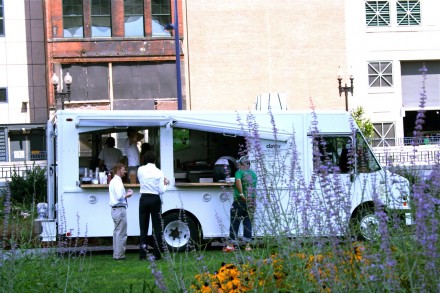 Before biting into an amazing egg and eggplant sandwich from Clover Food Labs in Boston’s Dewey Square a few days ago, I hadn’t truly understood the growing phenomenon of food trucks.
But this was the most wonderfully flavor-packed, unusual, and satisfying sandwich I’ve had in a long time, and it excited me.
I’d been only marginally aware that a great mobile restaurant scene has been sprouting up in several American cities – Austin, L.A., Portland, Seattle – when Clover brought it all home to me with a sandwich, some rosemary fries, and a heady sip of its lavender lemonade.
We’re talking restaurants on wheels with fresh, innovative, inexpensive food.
I’d heard and read raves about several such food trucks in various cities (many have blogs; post menus on Facebook; list their daily whereabouts on Twitter), but I hadn’t eaten at one until last week.
Now, I’m a devotee wishing we had a food truck like Clover on the South Shore.
The flowering of this food movement, if you will, is evolving out of a perfect storm of economics and foody-ism: Food trucks are cheaper to get up and running for a generation of chefs and cooks driven to slice through financial roadblocks and take their beautiful food to the people. And the food is fresh, often local, fast, healthy, tasty, and inexpensive – factors that have become more important to a large segment of the population than the trappings of a restaurant.
“It costs between $80,000 and $100,000 to outfit a truck like this – for everything – and it can cost up to a million for a restaurant,” said Vincenzo Pileggi, as he expedited orders from outside the Clover truck, across from South Station. Pileggi used to work at the Four Seasons and studied under Clover’s Executive Chef, Rolando Robledo, while getting his culinary degree at Johnson & Wales (cq). Clover owner Ayr Muir, who has an MBA from Harvard, has a crew of very enthusiastic food lovers working Clover.
Robledo has cooked with several greats, including the (arguably) most revered chef in America today, Thomas Keller (renowned for his monk-like reverence for cooking).
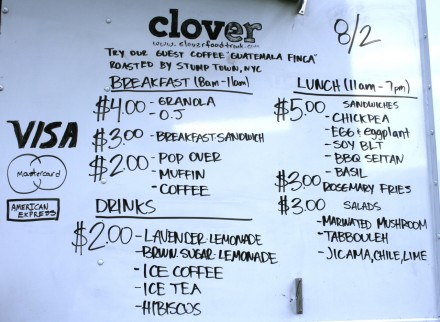 Ayr opened the first of his two food trucks almost two years ago in Cambridge as a test run for a future restaurant. Things went so amazingly that he launched a second truck two months ago; is now building his first (stationary) restaurant in Harvard Square; and plans to launch Clover in other cities.
Boston City Councilman Michael Ross sees all this and wants Boston to be in on the culinary and cultural richness a thriving food truck scene lends a city. Last month he published an order calling for a hearing on simplifying the licensing of food trucks. Ross’s document cites the appeal of food trucks to a large demographic; their economic value; their popularity in many cites; and their potential to create jobs in Boston.
South of Boston we don’t have many food carts – never mind gourmet food trucks – and when a hot dog cart showed up at the Hingham bathing beach in late May, my car veered right into the parking lot: more than once.
“It’s the weather, the ambiance, the quickness that makes people happy,” said Jim Conroy, the hot dog guy, who’s on hiatus now but plans to return. “People seemed to think a toasted roll was the thrill of a lifetime.”
I know I did: his buttered, toasted rolls were great and so were his Sauer kraut, his price ($2), the lack of packaging (he served his dogs on a napkin), and the fun of finding a fast treat in an unexpected place.
But as delicious as Conroy’s hot dogs are, Clover’s sandwiches and salads are better.
And, better for you, I’d venture. Ayr and his team take great pains to find the best products they can (local and organic when available), and put just as much effort into preparation.
Ayr talks at length about all aspects of Clover on his blog.
Recent entries follow his process for developing a new, cold, single-brew, iced coffee method that results in drinks with less caffeine than other methods produce (and a deliciously smooth, rich drink, I can testify). This guy isn’t doing nothing with that MBA of his: his idealistic vision about selling delicious, healthy, fast food is supported by the business acumen to find ways to do that. He’s passionate about Clover’s food – a passion he shares with many of today’s younger restaurateurs, chefs, and eaters.
Enough about Clover Food Lab except to say that if I lived near it I’d eat there everyday and I could, too, since much of the menu changes daily and the highest priced items are $5!
Problem is, it’s 25 miles away.
So, please, somebody, hear my plea: Build a great food truck and come on down to the South Shore. Live your dream and make mine come true.
Click here for an update on the truck scene in Boston.
]]>