The Summer House at Just Right Farm
It’s hard to think of the South Shore without conjuring endless beaches. But a bit inland and south the area opens into vast fields, bogs, and woods that stretch into deep countryside.
How surprising to find fine dining in an area like this, then again, how appropriate to eat where food is grown.
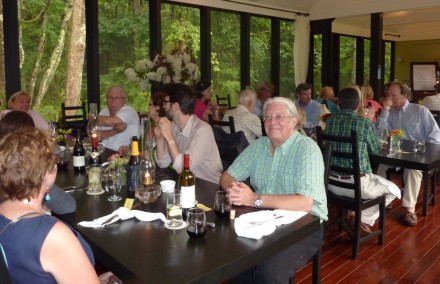
This is the idea behind Kimberly and Mark Russo’s new farm-to-table dinners – staged at their Plympton farm in an elegant, screened-in summerhouse 20 paces from their kitchen.
In case you’ve missed this phenomenon, family farms across the country have been hosting dinners in their fields, barns, and kitchens for a while now. The meals are prix fixe, single seating events that feature locally sourced foods, many of which are grown on the farm.
Since buying the 10-acre Just Right Farm in 2004, the Russo’s have been restoring the old place to reflect their belief in weaving simple rural ways back into contemporary life. They’ve built a large organic garden; a workshop where Kimberly makes furniture; a labyrinth for contemplative walking where Mark holds retreats; a restaurant caliber kitchen; and most recently, the stand-alone screen house.
Mark, a veterinarian, helps host the Friday and Saturday evening dinners but they are clearly Kimberly’s baby. Working with one other cook – caterer Elaine Murphy who this year closed her True Blue BBQ stand in Kingston — Kim devises each week’s menu from her garden and what’s available from area – and regional – farms.
“We don’t go to the grocery store,” says Kimberly, who has owned two small restaurants and worked in the industry all her adult life.
There is nothing in the screened-in dining room that is not both utilitarian and beautiful. Kimberly built the three, 10-foot wooden tables that seat a total of 24 guests for each five-course dinner ($100 per person). Made from ash, they are stained black and set with tall sparkling gas lanterns, flowers, small salt and pepper cellers, and simple white porcelain plate ware. Three handmade sideboards of rough-hewn wood and iron pipe — left over from the kitchen renovation — easily hold towering flower arrangements and various family-style side dishes. Ceiling fans keep the air moving and a rich mahogany floor shines darkly. Only the billowing white drapes gathered in the corners are for show alone: Who would want to block out the surrounding woods?
One side is better than the next
Eating vegetables that Kimberly grew – and cooked – at a table she made, in a building she designed, makes a statement.
Sitting eight to a table promotes a fun communal experience, but the seating is so spacious it’s perfectly comfortable to be private if you’d prefer. The service is marked by a similar balance of availability and reserve. Kimberly greets guests before dinner with a quick talk about the place, introduces the servers thoughtfully, then retreats to her kitchen. Throughout the meal, either a server or Mark introduces every dish, explaining where the foods were sourced.
In this the inaugural season of 16 weekends, Kimberly and company have their act together. Minutes after the 7 p.m. start time and Kimberly’s welcome, the servers deliver a taste from the chef – the tiniest, exquisite amuse bouche: a square of feta cheese (Falls Village, Conn.) from goats at a farm the couple knows well and tiny bites of roasted cherry tomato and eggplant from the garden.
The first course follows effortlessly despite a torrential downpour that only makes things cozier: delicious briny wild blue mussels (Jonesboro, Maine) atop a lovely linguini in cream sauce.
A vividly scarlet chilled beet soup with a dollop of crème fraiche comes next: beautiful and delicious.
It’s a homey touch to offer a pristine white bowl of brightly colored pickled veggies on the sideboard next to loaves of bread from Plymouth’s wood-fired Hearth bakery. I take spoonfuls of sweet onion, uncoiling in small bites, and my neighbor takes turnips. And the simplest thing is to die for: rosemary-flavored butter!
Course three is a composed salad on a narrow plate that makes the most of Just Right’s farm garden: There are long, thin ribbons of cucumber arranged in curls; red, yellow, and roasted tomatoes in all their ripe glory; fingerling potatoes, as small as grapes, sitting on a smear of aioli, and the babiest of carrots, cut lengthwise, looking like perfect candies in the soft light.
“Intermezzo,” says our server, as she comes around with an unexpected scoop of perfumey green tea and mint sorbet to refresh the palate.
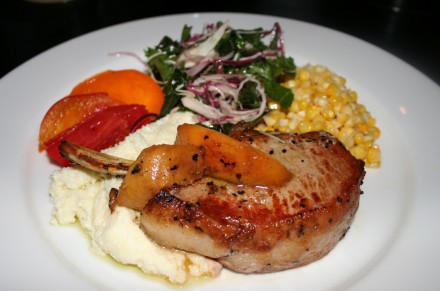
The main course is bountiful. A pan seared pork rib chop (Radham, N.Y.), topped with slices of grilled rosemary peaches (Plympton), lies over a pile of outstanding grits with feta that has people who say they don’t like grits swooning. The plate is full of sides, one better than the next: slices of heirloom tomatoes; a fabulous kale and cabbage slaw dressed with a bit of smoky bacon fat; and sweet corn cut from the cob.
Guests linger over a fluffy, perfectly sweet and sour round of lemon mascarpone topped with candied orange rind and sided with some syrupy blueberries (Dummerston, Vt.) and two of the best shortcake cookies ever. Coffee (Newton) in French presses appears on the sideboards as Kimberly comes into the dining room again. After introducing Murphy as the woman “to blame if you liked the cooking,” she goes from person to person offering slivers of a second dessert: a wonderful dark chocolate tart. Too much!
Don’t miss this place.
140 Palmer Rd., Plympton Friday and Saturday evenings at 7 p.m., from June 15 to Sept. 29, by reservations only 781 936-5330 justrightfarm.com Accessible to the handicapped Major credit cards accepted
]]>
A remarkable old world bread bakery opened on the South Shore a couple months ago and I don’t know which is more amazing – the bread or the oven where it’s baked.
Peter Nyberg’s new wood-fired stone oven in Plymouth is a custom, 60-ton version of the wood-fired stone ovens that have become so popular (mostly for pizza making) in recent years.
But, Nyberg isn’t making pizza.
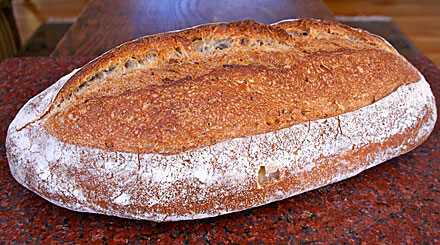
His Hearth bakery is turning out more than 1,000 loaves of a naturally leavened Country French bread daily – the way it was done centuries ago.
The operation and scale of the oven are hard to grasp.
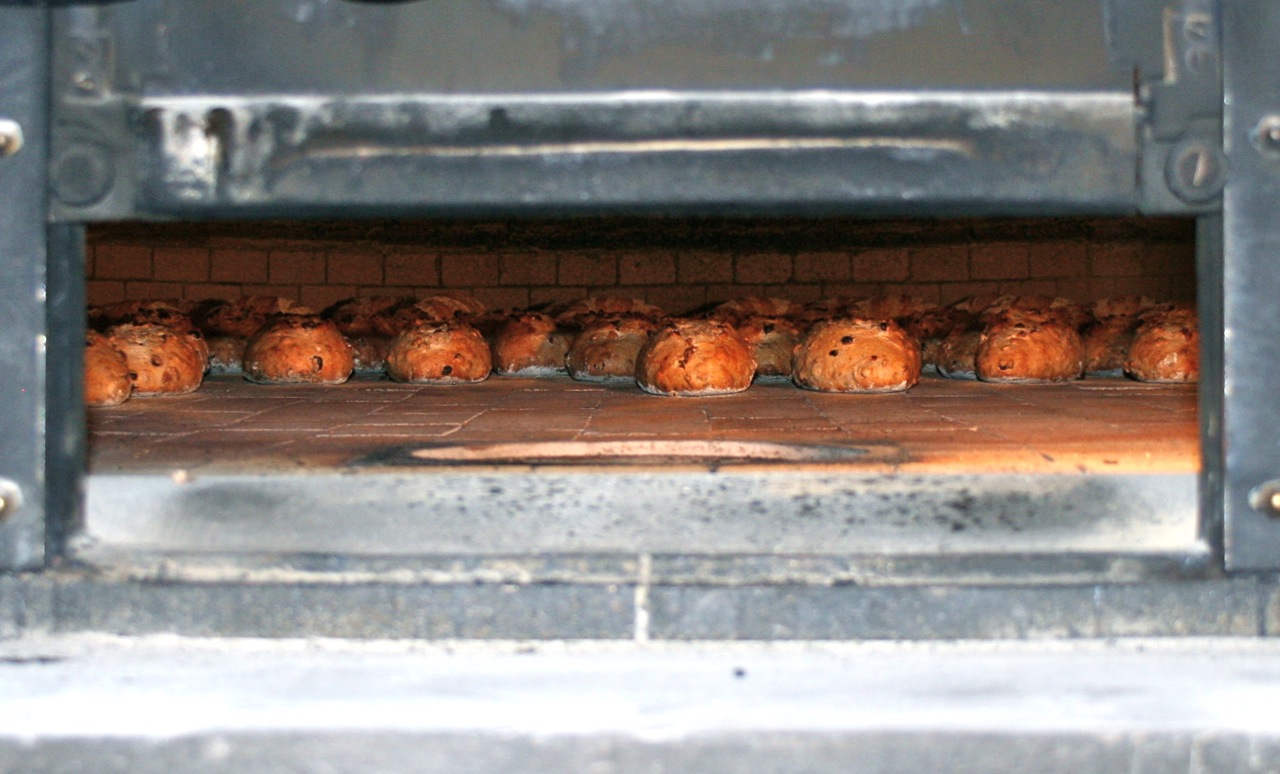 Its interior, cave-like baking chamber is about 12 feet in diameter and can accommodate more than 100 loaves.
An oven-full bakes in about 18-20 minutes at a temperature of 460-490 degrees, one batch after another. It takes one baker about the same amount of time to load a batch of uncooked loaves onto a very long wooden peel, slash their tops, and slide them into the hot cave. And to remove them? That’s faster: maybe eight backbreaking minutes of pulling the (pound and a half) loaves onto the peel and sliding them out of the oven and onto a beautiful wooden rack.
Meanwhile, Nyberg stone grinds his custom blend of mostly organic, heritage grains, mixes, proofs, hand-weighs, and forms doughs in synchronized time, batch after batch.
“We can produce over 2,000 pounds a day, that’s a decent capacity,” said Nyberg, who employs a second full-time baker.
The operation is a unique study in simplicity and precision.
 Nearly every tool and piece of equipment in the bakery – and every procedure — has been custom designed to move an exact volume of dough (enough for one oven’s worth of loaves) through the stages of bread making.
“We’ve finally got it down to a science,” said Nyberg, who broke ground on the mammoth oven in June and baked his first loaf in October.
Every day, sometime around 10 a.m., after a night of baking, Nyberg starts a big wood fire on the floor of the oven. It burns until late afternoon, at which point the embers are spread out, allowing the heat to soak into the oven’s enormous thermal mass. Around 8 p.m., a second fire is built in a firebox chamber beneath the floor of the oven that will be maintained throughout the cooking hours. At midnight, the oven floor is swept clean of its embers, and baking begins.
Nyberg, 41, has been taken with bread baking for more than 20 years. He’s baked at numerous restaurants and bakeries, worked as a consultant, and is an adjunct baking instructor in the College of Culinary Arts at Johnson & Wales University. When he began toying with the idea of opening a bakery last year, he knew what he was after.
“I wanted simplicity and as few mechanicals as possible,” said Nyberg, who has replaced automated techniques (like proof retarders, baguette molders, and bread dividers) with elegantly conceived procedures designed to streamline handmade bread baking.
Eschewing such techniques in favor of small batch baking allows for the daily grinding of heritage grains; long fermentation times; and the use of natural leavening. These processes, and the high heat of the wood-fired oven, result in an alchemy that allows the grains to retain their nutritional values and flavor.
 I visited Nyberg at 7 a.m., on Christmas Eve day, toward the end of a long night of baking.
We talked as he took a batch of loaves out of the oven; put water into an iron bucket that fits into a hole on the oven floor; and loaded up another hundred doughs.
“Feel that? Feel the humidity?” he said, inviting me to touch the wooden handle of the 15-foot bakers peel he’d just pulled from the oven.
And I do, I feel that it’s moist.
Although Nyberg’s main focus is making his Country French bread, customers have convinced him to produce others, so he’s now also making a lovely rosemary loaf and a fruit and nut on Fridays and Saturdays.
 And, I like both those loaves, but I love the Country French. It’s an uncommon bread and satisfies in an uncommon way – almost as though it were a different food than bread. And I don’t mean that it’s heavy, it’s not. It’s actually light, with a very airy, moist crumb, and a crust that bites back: a crust that demands respect! After eating it for a week, other breads began to seem lightweight and lacking to me.
The bakery, which is open everyday for sales, also delivers daily to several South Shore stores, including Hingham’s Fruit Center. Call to see if there’s one near you.
Hearth Wood Fired Bread bakery is open for retail sales Monday through Saturday, 9 a.m. to 6 p.m., and Sundays, 10 a.m. to 3 p.m. The country French is $4.25. 123-2 Camelot Drive, Plymouth, 774-773-9388. www.hearthwfb.com
]]> I can’t tell whether what I did last weekend was clever or ridiculous.
Inspired (obsessed?) by a recent revelatory and mouthwatering encounter cooking pizza in a friend’s wood-fired brick oven, I got to wondering if pizza could be cooked on a gas grill and come out better than what I can make on a pizza stone in my oven.
Hey, I know that gas grills have nothing of the raw, elemental appeal of a wood-fired brick oven. But I don’t have a brick oven, and I do have a gas grill.
So I went to the wizard — Zee In-tair-net — and read postings from several people who grill pizza on gas grills using a two-part method: They cook one side of the dough on the grill, remove it, and cover the cooked side with the topping. They then grill it again, raw side down.
But, I didn’t want to do it that way.
I wanted to grill a pizza, topping and all, in one maneuver to capture some of the magic that happens inside a brick oven.
Meanwhile, the conviction that I could do this was inflamed by what I’d recently learned about the principles of cooking, specifically, the conduction and radiation of heat, from Alton Brown’s great book, “I’m Just Here for the Food.”
So I understood that bricks in a brick oven absorb the heat the fire emits. They suck up such a tremendous amount of heat, in fact, that it can take hours for an oven to reach the desired temperature (usually around 700 degrees). But, once it reaches the target temperature, the stones act as heat sinks, holding and slowly radiating the heat — even though the front of a wood-fired brick oven is always open. Wouldn’t stones work well for holding a high temperature in a gas grill when the lid has to be lifted?
My first thought was to use a pizza stone in my Weber, but I figured that the stone would get so hot, that the pizza’s bottom would burn before the top could get cooked. I also realized that a single pizza stone wouldn’t be large enough to hold the heat once the lid was lifted.
 What I needed, clearly, was a little heat-absorbing, heat-radiating cave inside my grill.
Back to Google for a tenth search, where I found some real inspiration: a guy who did just what I wanted to do! And, although his grill was bigger and had a few key advantages, it was exciting to see how he’d packed it with firebricks and made a gorgeous pizza in just a few minutes. (Check it out here.)
Never mind that his grill has a burner in the rear that heats the box (thus allowing food to be grilled using the indirect method), his example was enough to keep me going. (Indirect grilling is grilling on a surface without flames directly beneath it.)
Again to the web, where I found that Quincy’s TLC Supply, a masonry yard, had firebricks in stock. The guys there were nice, explained that regular bricks and stone crack under high heat, and sold me 10 firebricks for $17.
At home, I assembled a small cave [at left] inside my Weber using firebricks and a pizza stone, and baked a couple 7-inch pizzas. The first was burnt to a crisp when I checked it at after three minutes. The second cooked pretty nicely in 90 seconds, but the oven was too small, so I assembled another.
For this one, I used a metal oven rack to support the top layer of bricks on the next cave [below].

Throughout, I kept notes on temperatures (600 degrees as registered on the Weber’s thermometer); the status of burners on and off; cooking times; and number of lid liftings. I also kept dough weight, size, and toppings the same on seven of the nine pizzas I made.
So, how’d it work?
I couldn’t get a spectacular or consistent result.
Most of the pies came out good [one of the more successful efforts shown here], better than I can make in my oven, but I couldn’t be sure the next one would be the same. And they tended to burn on the bottom before the top could get browned prettily. The best I could do was make a good pizza with a crust that was a tiny bit too tough on the very bottom to be great.
I think that if I had a large gas grill with burners arranged so one side could be turned off and one on (allowing for indirect grilling) I could nail a great pie. I’d build the brick cave on one side; bring the oven to its highest temperature; turn off the burners on the side under the brick cave; and cook the pizza in three to five minutes. (I’d also add a bit of wood to the fire to lend a smoky flavor.)
So.
 I still want a wood-fired brick oven, but don’t want to spend the $3,000, or more, that they cost.
Maybe, I can build one myself with help from edible South Shore Food Editor Paul Marcoux of Plymouth, who made hers for $30 in materials! After this past weekend, I can kind of conceive of it. And, until then, when I really want a pizza, I’ll probably pile the bricks in my Weber and make one.
(For a look at an insane brick oven a guy in California made out of a Weber kettle grill you will never forget, check this out.
And to see the mother of all wood-fired brick ovens, go to Bertucci’s on Derby Street in Hingham or Franklin Street in Braintree. Their ovens are gorgeous and enormous and you can watch pizzas bubble up and cook in minutes.)
]]> Have you ever looked into a wood-fired brick oven for three straight minutes and watched a flat, raw pizza puff up into a bubbling cooked one in seconds?
I just have for the first time, and it’s spectacular! The baking happens so fast, it feels like you’re seeing time-lapse photography instead of live cooking.
You’re watching, watching…and nothing for 20 seconds — it’s still flat.
Then, suddenly, Oh! The edges seem to be thickening, but are they?
Another 15 seconds and OMG, you’re sure: they’re definitely puffing up and then, wow! A couple bread bubbles appear on the edge nearest the burning wood, and in the next moment you realize that, actually, in fact, the whole crust has risen up! And that it’s begun to color and darken irregularly – that the cheese topping is rising and bubbling, too.
Then, after a few turns of the pie – so all edges get direct face-time with the fire — the flat raw dough has turned into a gorgeous pizza.
“It’s a living thing!” said Lisa Corrado [above] of Hingham, excited by my excitement and the fact that this is the first pizza of the season in the beautiful backyard oven her husband Frank, a master mason, built in 2005.
For a while now I’ve been hearing about how great wood-fired brick ovens are – for cooking, definitely, but maybe even more for their ability to create an instant party. Last weekend, I finally saw why.
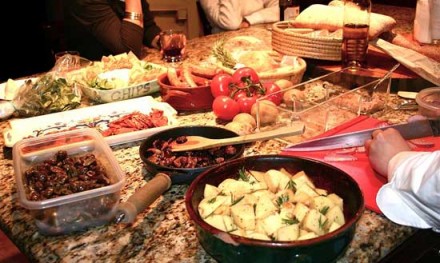
Devotees say that anything that can be baked in a regular oven can be improved by cooking in a wood-burning oven. And I’ve heard, and tasted, enough to believe that’s true. Lisa (an illustrator by day, chef by night) made a casserole full of roasted potatoes with olive oil and rosemary and another of chicken wings that were both delicious.
But I think it’s the ovens’ near-magical prowess at baking pizza and other bread-based goodies that draws crowds like karaoke used to do.
It’s just so much fun to assemble pizzas with different toppings – one after another – and have them come out of the 700-plus degree oven three minutes later, max.
Frank grew up in the village of Palermiti, in the Southern Italian province of Calabria, in a family that cooked in a wood-fired brick oven that his grandfather’s grandfather built 150 years ago. This is a guy who knows wood-fired ovens and a family that loves nothing better than to have a bunch of friends over to eat.
An hour after I called to inquire if the Corrados (former acquaintances, now friends after our bonding by fire experience) had an oven, I was at their house near Hingham Harbor, seeing how the fire was started.
 Four hours later, I went back for their first outdoor party of the season on the first winter day the mercury rose above 50 degrees. Still, it was cold after the sun went down, but you couldn’t drag this group away — pysched as they were to be back around their friends’ oven. And, to be fair, an outdoor fireplace Frank built kept everybody warm enough to stay until after 10 p.m.
“We’ve got about five house pizzas,” said Lisa, as she prepped ingredients in the kitchen wearing a chef’s jacket. Frank had just the evening before returned from visiting his parents in Palermiti, and the kitchen counter was laden with foods he’d brought home: a batch of his mother’s homemade green olives, gallons of her (homemade) olive oil, a hunk of fresh pecorino cheese.
The No. 1-selling Corrado house pizza (except nobody pays) is an adaptation of a pizza from a pizzeria in Palermiti that Frank made up. It’s simple, sounds terrible, and is, I think, the best pizza I’ve ever had. (This could be a sort of love-the-one-you’re-with effect, but I don’t think so.)
This is it: a small amount of (uncooked) tomato sauce (you want to see the white dough beneath the red sauce) and tiny bits of the following three ingredients sprinkled sparingly around the pie: canned Italian tuna in olive oil; Gorgonzola dolce cheese, and thinly sliced red onion. Oh: and a little sprinkle of olive oil all over.
The Corrado’s oven is big (43 inches across), allowing them to keep a fire burning on one side of the floor while cooking at the same time. They are thus able to keep the oven at a pizza-loving 700 degrees endlessly.
The floors of smaller ovens, however, can’t accommodate both a burning fire and cooking food. Because of this, cooks have traditionally planned a series of dishes to bake at various points as the oven’s temperature descends from its 700 degree high.
You can be sure that Frank’s great-great-great grandfather’s family conserved their wood resources by using every stage of the fire’s heat.
Edible South Shore magazine food editor and wood-fired oven enthusiast Paula Marcoux gave me a taste of that dynamic.
Marcoux, who (somehow) made her own small oven out of clay and bricks, starts with pizza after a good long fire has heated the oven to about 700 degrees and she’s swept out the ashes. As the temperature drops, she starts making bread.
“By the time my first batch of large loaves is done, my oven has usually fallen a bit too low for much more of that sort of baking, so I like to move on to other things: a cake, a chicken,” said Marcoux.
A cake sounds good. Chicken’s good, I know that. And pizza, lots of pizza, dessert pizza even, sounds very good. And so does the relative simplicity and communal nature of making pizza when entertaining.
I want a wood-fired oven.
For more on Frank Corrado’s masonry work, visit www.frankcorrado.com
Follow Joan Wilder on Twitter.