The Summer House at Just Right Farm
It’s hard to think of the South Shore without conjuring endless beaches. But a bit inland and south the area opens into vast fields, bogs, and woods that stretch into deep countryside.
How surprising to find fine dining in an area like this, then again, how appropriate to eat where food is grown.
This is the idea behind Kimberly and Mark Russo’s new farm-to-table dinners – staged at their Plympton farm in an elegant, screened-in summerhouse 20 paces from their kitchen.
In case you’ve missed this phenomenon, family farms across the country have been hosting dinners in their fields, barns, and kitchens for a while now. The meals are prix fixe, single seating events that feature locally sourced foods, many of which are grown on the farm.
Since buying the 10-acre Just Right Farm in 2004, the Russo’s have been restoring the old place to reflect their belief in weaving simple rural ways back into contemporary life. They’ve built a large organic garden; a workshop where Kimberly makes furniture; a labyrinth for contemplative walking where Mark holds retreats; a restaurant caliber kitchen; and most recently, the stand-alone screen house.
Mark, a veterinarian, helps host the Friday and Saturday evening dinners but they are clearly Kimberly’s baby. Working with one other cook – caterer Elaine Murphy who this year closed her True Blue BBQ stand in Kingston — Kim devises each week’s menu from her garden and what’s available from area – and regional – farms.
“We don’t go to the grocery store,” says Kimberly, who has owned two small restaurants and worked in the industry all her adult life.
There is nothing in the screened-in dining room that is not both utilitarian and beautiful. Kimberly built the three, 10-foot wooden tables that seat a total of 24 guests for each five-course dinner ($100 per person). Made from ash, they are stained black and set with tall sparkling gas lanterns, flowers, small salt and pepper cellers, and simple white porcelain plate ware. Three handmade sideboards of rough-hewn wood and iron pipe — left over from the kitchen renovation — easily hold towering flower arrangements and various family-style side dishes. Ceiling fans keep the air moving and a rich mahogany floor shines darkly. Only the billowing white drapes gathered in the corners are for show alone: Who would want to block out the surrounding woods?
One side is better than the next
Eating vegetables that Kimberly grew – and cooked – at a table she made, in a building she designed, makes a statement.
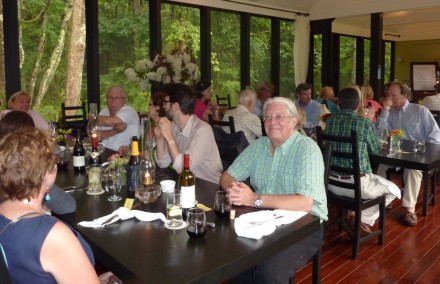
Sitting eight to a table promotes a fun communal experience, but the seating is so spacious it’s perfectly comfortable to be private if you’d prefer. The service is marked by a similar balance of availability and reserve. Kimberly greets guests before dinner with a quick talk about the place, introduces the servers thoughtfully, then retreats to her kitchen. Throughout the meal, either a server or Mark introduces every dish, explaining where the foods were sourced.
In this the inaugural season of 16 weekends, Kimberly and company have their act together. Minutes after the 7 p.m. start time and Kimberly’s welcome, the servers deliver a taste from the chef – the tiniest, exquisite amuse bouche: a square of feta cheese (Falls Village, Conn.) from goats at a farm the couple knows well and tiny bites of roasted cherry tomato and eggplant from the garden.
The first course follows effortlessly despite a torrential downpour that only makes things cozier: delicious briny wild blue mussels (Jonesboro, Maine) atop a lovely linguini in cream sauce.
A vividly scarlet chilled beet soup with a dollop of crème fraiche comes next: beautiful and delicious.
It’s a homey touch to offer a pristine white bowl of brightly colored pickled veggies on the sideboard next to loaves of bread from Plymouth’s wood-fired Hearth bakery. I take spoonfuls of sweet onion, uncoiling in small bites, and my neighbor takes turnips. And the simplest thing is to die for: rosemary-flavored butter!
Course three is a composed salad on a narrow plate that makes the most of Just Right’s farm garden: There are long, thin ribbons of cucumber arranged in curls; red, yellow, and roasted tomatoes in all their ripe glory; fingerling potatoes, as small as grapes, sitting on a smear of aioli, and the babiest of carrots, cut lengthwise, looking like perfect candies in the soft light.
“Intermezzo,” says our server, as she comes around with an unexpected scoop of perfumey green tea and mint sorbet to refresh the palate.
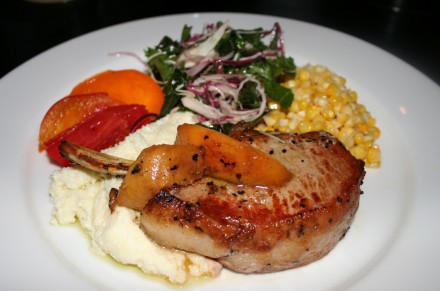
The main course is bountiful. A pan seared pork rib chop (Radham, N.Y.), topped with slices of grilled rosemary peaches (Plympton), lies over a pile of outstanding grits with feta that has people who say they don’t like grits swooning. The plate is full of sides, one better than the next: slices of heirloom tomatoes; a fabulous kale and cabbage slaw dressed with a bit of smoky bacon fat; and sweet corn cut from the cob.
Guests linger over a fluffy, perfectly sweet and sour round of lemon mascarpone topped with candied orange rind and sided with some syrupy blueberries (Dummerston, Vt.) and two of the best shortcake cookies ever. Coffee (Newton) in French presses appears on the sideboards as Kimberly comes into the dining room again. After introducing Murphy as the woman “to blame if you liked the cooking,” she goes from person to person offering slivers of a second dessert: a wonderful dark chocolate tart. Too much!
Don’t miss this place.
140 Palmer Rd., Plympton Friday and Saturday evenings at 7 p.m., from June 15 to Sept. 29, by reservations only 781 936-5330 justrightfarm.com Accessible to the handicapped Major credit cards accepted
]]>
 News of the recent opening of Hingham’s new burger joint exploded this summer in a Hollywood-powered media blitz that was hard to miss. Even before the TV segments, newspaper, US and People magazine blurbs, there was lots of local talk: a deal for a reality show on the place had been signed; a green initiative, somehow linked to the White House, was underway; and plans were being drawn for a nationwide chain.
Whether or not these rumors come to pass, the hilariously and brilliantly named Wahlburgers, lends some of Hollywood’s bright light to the Launch at Hingham Shipyard complex, hopefully helping to anchor its growing presence.
The 80-seat (there are another 40 on the patio) uber fast food restaurant and bar is owned by longtime South Shore chef Paul Wahlberg and his celebrity brothers: TV- and movie stars Donnie and Mark Wahlberg.
In June 2010, when Chef Paul opened his first restaurant, Alma Nove, across the street from the new Wahlburgers, his
brothers were investors, but quietly so.
Now, with Alma Nove’s success, the brothers have put their star power and family story on proud display in a brand with an unforgettable name that could take this bad boy to the stars.
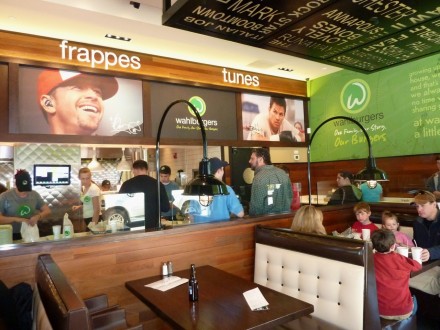
The retro modern diner-inspired décor is filled with movie memorabilia and the family focus is graphically encapsulated in the restaurant’s highly visible logo: Wahlburgers: Our Family, Our Story, Our Burgers. That story — written on the rear wall in large letters — is a familiar Boston tale: nine kids in a triple-decker in Dorchester didn’t have much but each other.
The bright windowed space is a large V-shape (or maybe it’s half a W?) with an open kitchen between the two rectangular wings. One side offers table service with seating either at large communal tables for 10, or at the bar. On the other side, people order at the counter and either sit at a booth or a two-top – or get the food to go. In warm weather, there’s great patio seating.
Housed in the former Pizzapalooza (which, sadly, never drew a crowd), Wahlburgers has been packed (during peak hours at least) daily since it opened last month. On four recent visits, timed to avoid crowds, the place was still crowded. The owners, who also include family friend Ed St. Croix (cq), have created a very clever business by including a full bar and making it the only place around that’s open seven days a week until 1 a.m. The option, too, for self-service nicely removes the cost of a tip, as do the credit card receipts, which offer no line for writing in a tip.
Wahlburgers isn’t really about the food. It’s about fun and filling up on satisfying comforts in a lively, easy environment. Eight flat screens line the walls above the bar – the brothers are big Boston sports fans. Music, too, is important to the lads (Donnie got his start in the ‘80s in the boy group “New Kids on the Block”) so the sound system is great and the play list widely varied.
The menu is small but well thought out. There are nicely seasoned turkey burgers ($6.25) and three main beef burgers – the cheapest being the single decker ($4.50), and the most expensive, the triple decker at $9 (“like the house we grew up in” says the menu). The sandwiches have a grilled toasted bun and can be ordered with a large selection of toppings that includes fresh jalapenos, smoked tomato salsa, and sriracha sauce. A single or double decker with, say, catsup, mayo, mustard, pickles, tomato, and the “government” (American) cheese the Wahlberg’s grew up on, delivers mouthfuls of hard to resist, classic, fast-food burger flavor.
Three burgers with set toppings are offered as specialty choices. The Thanksgiving turkey burger ($7.50) is topped with stuffing, cranberry sauce, roasted squash, and mayo. It is sweet, savory, and gooey — in a good way. The beef is all antibiotic- and hormone-free, a nice boon, and healthier burgers, including salmon and mushroom, are due to debut soon. The kids menu has good Bell & Evans (cq) hormone- and antibiotic-free chicken fingers with fries for $5; a simple grilled cheese on thick white bread with fries ($4), “smahlburgers” with fries ($5), and kid-sized sodas for a buck. There are also tater tots ($3) and sweet potato tots ($3), which are fine but I’d rather have the fries ($3).
I love (God forgive me) Wahlburger’s hot dog ($4), with its snappy bite, the choice of some good sauerkraut, and its grilled roll. (I don’t know where else around here I could get as good a dirty water dog as this one.) We also found the skinny onion rings outstanding, and one hard pull on the thick chocolate frappe ($4.65), made with local ice cream from Nona’s Homemade (cq) ice cream shop, brings on flashes of pure childhood goodness.
The chef’s ingrained hospitality is evident in little touches aimed to please a variety of guests: good French roast coffee; house-made lemonade, locally-sourced Hornstra Farms chocolate milk, and caramelized onions, sautéed mushrooms, and avocado as optional burger add-ons ($1).
Noticeable too are a pair of plain salt and peppershakers on each table (no need for paper packets of S & P at Wahlburgers).
Very retro.
19 Shipyard Drive, Hingham
Daily 11 a.m. to 1 a.m.
781 749-2110
wahlburgers.com
Accessible to the handicapped
Major credit cards accepted
]]>
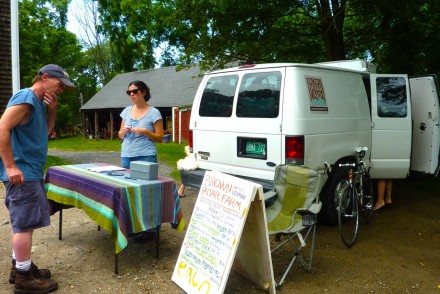 The road that leads to the truck that sells Vermont-raised heritage pork winds along a stretch of Cohasset’s North Atlantic that shames Beverly Hills with its mansions.
One after another, stone castles, Tuscan-inspired villas, ultramodern constructions, and old, wooden, 20-room houses lie like jewels set on a watery edge of sea grass and rock ledge.
Then a right, and another right into Holly Hill Farm, and there, in the barn yard, next to the horse corral and the farm stand, is the Brown Boar Farm truck.
People come from all over to buy Brown Boar’s pork at the farm one Saturday a month: not only because it’s so delicious, but because the pigs are humanely raised on a small, family farm in Wells, Vt.
The farm’s two heritage breeds — Tamworths and Berkshires — spend their time rooting around the 106-acre farm’s fields and woods for acorns, roots, tree stumps, and more. The farmers supplement the hog’s foraged diet with grain and whey.
Although these breeds love being outside, even in cold weather, they have free access to various shelters constructed throughout the farm, but are never constrained from being outside. Fresh spring water is available all over the property (which is fenced so the animals can be rotated among areas), and the pigs can give birth wherever they want: either inside on hay, or outside in nests they build from leaves.
Father and son Peter and Christopher Burrows, originally of Scituate, bought the farm in 2001. Christopher found it while studying farming at Green Mountain College in the next town over. The Burrows decided to start raising Tamworths after having bought a couple to clear overgrowth and seeing how happy they were when allowed to forage freely. Today, they have about 30.
Heritage is the term used to designate breeds of livestock that descend from various original breeds brought to America from Europe by the colonists. Tamworths and Berkshires have evolved to thrive in a climate like Vermont’s and are extremely hearty when allowed to live naturally.
Brown Boar’s South Shore sales are orchestrated by Peter’s daughter and Christopher’s sister, Scituate’s Meaghan Swetish. Swetish makes year-round, monthly deliveries to Holly Hill Farm and Plymouth Farmers Market. In the warmer months, she also sells at the Marshfield and Bridgewater farmers markets.
Swetish sends out mass e-mailings to let people know when the truck will be where — and to take orders. Ordering ahead of time helps the farm know how much of which cuts to bring, but Swetish says there is always extra for spur-of-the-moment shopping.
The taste of Brown Boar’s pork is not lost on the culinary world. Top Boston chef Barbara Lynch buys a whole pig (about 200 pounds) from Brown Boar monthly for use at one of her restaurants — The Butcher Shop. Lynch and company butcher the whole hog in house. Brown Boar also sells to other selected restaurants, including Scituate’s Oro.
The Burrows have their pigs slaughtered (generally two a month) at Eagle Bridge Custom Meat & Smokehouse — a humane facility about an hour by car from the farm. This means that after the farmers drive the animals there, they are treated well.
Experts say that an animal’s consciousness is very focused in the present moment and if given food and water upon arrival in a new place, it will stay calm and contented. The pigs are slaughtered that day with a bolt to the head that kills them instantaneously. As hard as this may be to ponder, it is a fact that humane slaughtering is a far cry more humane than the alternative.
“It’s as stress-free an experience for them as it can be,” said Swetish. “The whole operation at Eagle Bridge is transparent. Farmers are welcome to walk the kill floor and the whole place.”
Eagle Bridge also butchers the pigs, packaging and freezing every part of the animal, and makes the farm’s wonderful sausages.
“I’ve been driving down here for about a year,” said Michael Horan of Stoughton, while buying several different cuts at Holly Hill last month. Among Horan’s purchases were some heart, liver, and trotters — for his dogs.
The farm’s Italian sausage, both sweet and hot, is very popular. They come five to a one-pound package ($8) — one of the more costly items in a product line that is priced very competitively. They’re delicious. I use one or two sausages to add tremendous flavor to a simple marinara.
A little bit of fine meat goes a long way.
To get more information about purchasing locations, a pricelist, or to place an order to be picked locally, contact Swetish at meaghan.Swetish@brownboarfarm.com or 781 545-6065.
]]>
 If Josie the cow cared, she could lift her big speckled head and see Patriots fans, tiny as ants, in the top tiers of Gillette Stadium. But the pretty speckled milk cow only has eyes for the grass.
And I only have eyes for the raw milk and cheeses that Terri Lawton – a tenth generation farmer – produces from Josie and the rest of her herd of about 24 grass-fed Ayrshire cows at the Lawton Family Farm in Foxborough.
Lawton and her crew make two types of cheese. One is a raw Asiago-style, and the other a soft, creamy fromage blanc that comes plain or flavored with chives, lemon honey, and tomato basil.
It’s not that surprising that Lawton could come up with two such successful cheeses (her lemon honey fromage blanc took the silver at the Eastern States Exposition in ‘09) after being in the cheese-making business less than two years. Not when you consider her pedigree.
After growing up on the farm that has been in her family since 1732, she graduated from Purdue University in 2002 with a double major in agribusiness and agricultural communications. Following college, she spent a couple years as a dairy inspector for the Massachusetts Department of Agriculture, and a couple more working with kids. Then, in 2006, it came to her.
“I loved cows and I wanted to work with them,” said Lawton.
But being well-educated on farming — in school, life, and on the job (she’d visit more than 100 farms as a dairy inspector) — she knew she had to find a way out of the “economic slavery” that the expectation of cheap food and government subsidies force on farmers.
“I didn’t want to be a price taker,” said Lawton. “If it cost 2x to make, I didn’t want to have to sell it for 1x. Selling raw milk — then the cheese, was a way around that.”
In Massachusetts, it’s legal to sell raw milk only at certified farms where it’s produced.
But Lawton’s milk and Asiago cheese aren’t outstanding just because they’re delicious and raw (the fromage blanc is heated and thus not raw), but because they’re made from the milk of grass-fed cows free of antibiotics and growth hormones.
A growing number of studies show that milk and meat from cows raised on a diet of grass is rich in a number of super health-giving substances, including CLA (conjugated linoleic acid), beta-carotene, Vitamin E, and Omega-3 essential fatty acids.
Lawton wants her customers to know what they’re getting and holds orientations three mornings a week. At one session last week, mother and daughter Michelle and Krystn Gustafson wanted to know what was different about raw milk.
“The main difference is it has all the enzymes, lactase being one of them,” said Lawton.
Which is why many people who are lactose-intolerant have no problem with raw milk: Lactase is the enzyme that breaks down lactose, or milk sugar, into something digestible.
Pasteurization (which heats milk to high temperatures) kills any harmful bacteria that could grow in milk that was handled carelessly and often comes from sickly cows treated and fed poorly. Unfortunately, it also kills many of the co-occurring nutrients that make it so good for people.
Lawton takes safety seriously. Her certified milking operation – and milk – is inspected monthly by the Department of Agriculture. And she’s well-educated on keeping her herd healthy and running a highly sanitary operation. She milks twice a day, and the white liquid goes directly from her cows into refrigerated vats.
“I’m okay with the regulations – it’s good to hold people accountable,” said Lawton.
Lawton and cheese maker Melissa Gagne make about 100 pounds of cheese each week, with the help of Terri’s parents, Nancy and Ed Lawton. The cheeses are available in the barn refrigerator. Milk, however, has to be ordered a day ahead. The old barn store also sells some frozen grass-fed beef and veal (when it’s available), locally made hot dogs from her meat, organ meats, and bones for stock.
I’ve been gorging on the milk and the two cheeses for the past week, thrilled to be able to buy such delicious food from a farmer I know.
I’ve mixed the fromage blanc into a plate of linguini with pesto, turning it into a quick and good creamy dish. I’ve spread it on toast and used it like mayonnaise to moisten a sandwich.
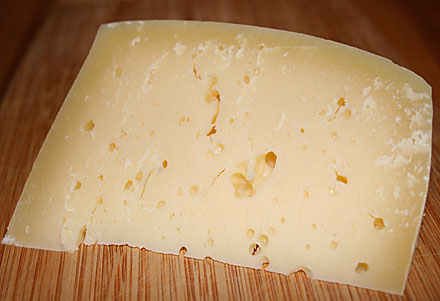
It doesn’t take any imagination to eat the Asiago: just bite into a hunk [at left]. I’ve also grated it on pasta. Delicious, satisfying, proteinous, and filling.
I know science continuously changes its findings, but I believe the studies that show grass-fed, raw milk products to be extremely nutritious – reversing the common belief that whole milk and cheese harden the arteries. They’re whole, natural foods from healthy animals that get to eat grass the way cows have always done – and that seems right to me.
I’m grateful to the Lawtons for doing what they do — theirs is the last dairy farm in Norfolk County — and the only nearby place I know of where I can buy raw milk.
And much appreciation to Josie!
Prices range from $3 for a half-gallon of milk to $8 for 8 ounces of fromage blanc. Foxboro Cheese Co. at Lawton Family Farm, 70 North St., Foxborough. For information on other places to purchase the cheese, call 508-543-6460. www.lawtonsfamilyfarm.com.
]]>But Beaulieu is a local man — from Fairhaven — a livestock and produce farmer who calls his cattle by name and says that when he does, they come.
And I believe that because when he speaks, I trust him.
If you’re trying to find good meat in today’s factory-farm-dominated marketplace, your best bet is to find a farmer you trust who raised the animals you’re eating.
Forget most of the buzzwords, they’re not going to steer you right.
Organic? It doesn’t mean much in reference to meat — certification is too complicated and costly for most small family farms.
Free-range? Not so helpful either: Factory chickens raised in football field-sized quarters can be labeled free-range if there’s a single small yard off the vast building they’re packed into. Even the important terms pasture- and grass-fed can be misleading since meat from animals designated as grass-fed can be fed grass most of their lives then stuffed with grains for the last few months to fatten them up.
Best, then, to find farms and farmers you can visit, talk to, name, call, or otherwise reach.
Which is exactly what motivated about 70 people to brave the heat of an old meeting hall in Kingston late last month to hear from several speakers, including four area livestock farmers.
“Local Meat: Benefits, Choices, Challenges, and Cooking” was the sixth in a series of programs on the phenomenon of eating locally sponsored by edible South Shore magazine and the Kingston Public Library. The series has been so popular it has outgrown the library and moved to the larger Beal Building.
The gathering felt a bit like an underground group of black marketeers organizing the procurement of an illegal substance. But meat from humanely raised, locally grown, well-fed animals isn’t illegal, of course; it’s just hard to find anymore.
A bit of background: Cows are ruminants and have evolved to eat a diet of at least 90 percent grass and a little grain. Factory farms, where most of our meat has been raised since the ‘60s, reverse that equation, feeding cattle about 90 percent grain, corn mostly, which makes them both fat (the goal for big business) and often sick, requiring that they be treated with antibiotics.
A growing number of studies show that the meat from cattle raised on a natural, predominantly grass diet is high in a number of very nutritious substances, including beta-carotene, vitamin E, and omega-3 essential fatty acids. Because of all this (and much, much more), a growing number of people want to support and eat meat from local farms.
Beaulieu’s operation is small — he raises about 40 animals at a time on his 27 acres, but not as small as Patrick Roll’s 5-acre West Elm Farm in Pembroke, where he raises rabbit, chicken, and lamb.
All the farmers who addressed the crowd raise their animals without the use of antibiotics or growth hormones in free-range or other comfortable, natural environments.
“Our pigs are doing what pigs should be doing, they’re sniffling around in the woods, eating chestnuts and acorns,” said Meaghan Swetish, who lives in Scituate but works with her father and brother who run Brown Boar Farm in Wells, Vt.
Like the vast majority of small farmers today, Swetish uses e-mail to take orders from people for Brown Boar Farm’s once-monthly delivery to Cohasset. And, like most local farmers, Swetish sells her pork and beef at farmers markets (in Vermont).
I was amazed at the crowd. They were a group who, for the most part, consume meat differently than main stream America has for the past 50 years – preferring to eat smaller amounts but of the highest quality.
I admired their knowledge and will to question issues surrounding even the hardest challenges to local livestock farmers — including the dearth of small-scale, humane, regional slaughterhouses in New England. Most farmers drive their animals an hour or more when the time has come.
“I spend half my life in my truck,” said Beaulieu, who takes a couple cows at a time to slaughter.
Experts say that transporting animals with others they know greatly relieves their stress. As does a nice holding pen, with water and food, upon arrival at the slaughterhouse.
Many say animals are adaptable and very in the moment. So humane slaughter is paramount. Slaughter isn’t just slaughter: It can be accomplished with minimum pain – or not.
“We go to Eagle Bridge slaughter house in New York,” said Swetish. “It’s a humane slaughter house and it makes a big difference to the animals and to the taste of the meat.”
Funny?
Not really.
Hard to think about?
Definitely.
Yet even if you’re a vegetarian who eats dairy, your dollars are going to support factory farming — unless you buy products from animals raised, and milked, on smaller family-run farms.
It’s up to you.
For more information on local farmers and farming see:
www.ediblecommunities.com/southshore;
Plato’s Harvest, Middleborough, http://platosharvest.wordpress.com; Brown Board Farm, Wells, Vt., http://brownboarfarm.com; West Elm Farm, Pembroke, http://www.westelmfarm.com; or contact Joe Beaulieu at J. H. Beaulieu Livestock and Produce Farm, Fairhaven, at allnaturalbeef@comcast.net.
It’s a given that people who live on the ocean have easy access to a treasure trove of fresh fish.
Or it should be…..but most area catches get hauled to Boston’s big wholesale markets before we get a chance to buy any.
So, flounder caught in Scituate, say, ends up in the city in a heap with flounder from other places. And, later, when local fish markets make their purchases, the swimmers that grew up in your neighborhood aren’t likely to be among their take.
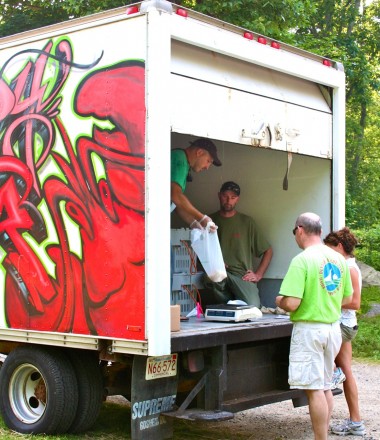
Which is why Scituate fisherman Larry Trowbridge [shown sitting in the truck] and partner (and former chef) Adam Fuller have started a small co-op of local fishermen who want to sell their fish directly to people.
With help –- mostly from one dedicated volunteer — the partners in March began making a weekly seafood delivery out of their refrigerated truck in Cohasset. All the fish they sell comes from day boats, so it’s never more than hours from the water.
“We’re tired of people controlling local food resources that local consumers haven’t been able to access,” said Trowbridge, who blames the loss of local control, in part, on excessive governmental regulation and the influence of large fish wholesalers.
The fledgling fish-selling business has been connecting with buyers via e-mail sent by Cohasset’s JoAnn Mirise, a young mother who’s passionate about sourcing high-quality local foods.
For several years, Mirise has been part of another informal food buying group comprised of about a dozen Cohasset families who share the work.The group’s bulk purchasing power allows them to buy a whole grass-fed cow, for instance, and gallons of maple syrup, bushels of organic cranberries, or pounds of grains and flours directly from a gristmill.
“It’s far cheaper to buy this way,” said Mirise.
Thus far, Mirise has been orchestrating the fish-buying effort online, sending out an e-mail blast on Wednesdays listing the fish choices for the week. Buyers e-mail back their orders, then pick them up from 4 to 6 p.m. on Friday afternoon – usually in Cohasset Village.
With people forwarding the e-mails to friends, the group of buyers is different, and growing, each week. This makes administering it harder than if it were a static group committed to regular buying.
“We are not a true CSF [community supported fishery] or a co-op — we don’t have a yearly membership or member-owned shares,” said Mirise. “The closest structure we could be considered is a buying club – a group of people with like-interest in a particular product – in this case, seafood.
“All the work we’re doing is necessary but it’s not sustainable because the group keeps getting bigger and bigger, so we’ll have to cap the numbers at some point.”
For now, Trowbridge and Fuller tack $2 onto each order in lieu of an annual membership fee — to help cover administrative costs.
“Woops, I forgot the add the $2,” Trowbridge said after one sale last Friday as he, Fuller, and Mirise coordinated various tasks to get a line of buyers their fish: checking paper orders; weighing and packing fish; computing total costs; making change; taking checks.
The partners, doing business under the name Snappy Lobster, also sell to many top-tier Boston restaurant chefs that Fuller knows from his days as executive chef of the city’s Great Bay seafood restaurant in the Hotel Commonwealth, which closed last year.
“As a chef, it’s almost impossible to get high-quality, fresh fish,” said Fuller. “I love food, that’s why I’m doing this.”
Together, the partners have been educating people about what’s in season and what’s fresh.
“Lobster and scallops are pretty much year round, and everything else fluctuates,” said Trowbridge, who traps lobsters in summer on his 31-foot boat Dilligaf and fishes from his father’s boat, Night Moves, in winter.
So, what was fresh last week?
Whole little mackerel, cod, scallops, yellowfin flounder, bluefin tuna, and lobster.
I bought cod and yellowfin flounder, filleted by Chef Fuller. (The cod, at $9.75 per pound, was $3 a pound cheaper than cod at a well-known fish purveyor in Hull.)
The slippery little flounder filets were wonderful seasoned simply with salt and pepper, dredged in flour, and quickly pan-fried in a butter and olive oil mix. The larger cod fillets were great baked.
I’m all in: I like the freshness of the fish, the cost, the business model. And there’s something perfectly right about being able to buy seafood that was caught where I live.
For more information, contact Trowbridge and Fuller through their website or call 781-635-0072.
Follow Joan Wilder on Twitter.
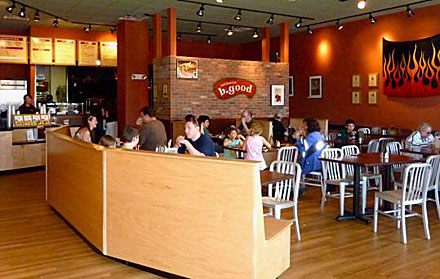
When the owners of b.good (“real food fast”) restaurant opened the first of their six Boston-area places in 2004, they started with a simple idea: Make fast-food favorites they could feel good about eating.
Six years later, that focus has turned b.good into the only South Shore fast-food chain that sells burgers made from grass- and grain-fed, hormone- and antibiotic-free, house-ground beef from regional family farms.
The company — which opened its sixth restaurant at Dedham’s Legacy Place in November and is scheduled to open a seventh at the Derby Street Shoppes in Hingham this month — made the change to all-natural beef in February.
Although the meat is more costly than conventional beef, b.good’s growth has given it the purchasing power to meet the minimum poundage per week required to buy from Pineland Farms, a collective of 104 family farms in northern New England and New York. That lowers the restaurant’s cost a bit, and b.good is also willing to take a hit on their profits per burger, to drive home a point that is important to the owners.
“We always thought that real food was food that was homemade by people, not factories, so we started out grinding our own beef, still do,” said Jon Olinto, who cofounded b.good with his childhood best friend, Anthony Ackil.
Then, as the partners learned more, their concept of “real food’’ extended deeper into the supply chain.
“We started thinking maybe it wasn’t real to raise cows in factories,” Olinto said. “Then, was it real to give them antibiotics and hormones?”
The answer — a deeply felt “no’’ — prompted the friends to start visiting small farms and meeting farmers.
“For us, it’s about knowing the person behind the food. If you know the farmer up in Maine, and know how he does business, that’s way more important to us than reading a label that says a meat is organic. That’s the kind of relationship we trust,” Olinto said.
Most factory farms, on the other hand, are vast, mechanized operations.
“Factory farms replace humans with technology and systems run by machines, not people. There’s no love, no transparency,” he said. “And when you buy a ground-beef burger from a mega-chain, you don’t know what you’re
getting, or who made it.”
B.good also purchases as many of its vegetables as possible from local farms or farmers the owners know. Poster-sized wall boards identify the farm and farmers who raised the day’s beef, as well as the produce, and they use quite a bit: potatoes and sweet potatoes for their (delicious) baked fries ($2.19/$2.49); lettuce and tomatoes for salads and on their sandwiches; and various veggies for their stir-fried crisp veggies ($2.79) and seasonal veggies ($2.79).
Although b.good’s fresh ground-turkey burgers and grilled chicken sandwiches are not sourced from free-range poultry, Ackil and Olinto hope to be able to find a farmer to supply those sometime soon.
“We’ve started with beef because if we can tell the story of a burger, we can raise awareness,” said Olinto.
The partners are so passionate about real fast food that every Tuesday, they grind 500 burgers, patty them up by hand, and take them to Brookline High School. They cut their costs sharply to fit into the school lunch program, allowing students to get a b.good burger for the same price as a school lunch.
The partners break even on this, but do it to spread the word to kids and parents about healthy fast foods. They’re hoping to bring the program into some South Shore schools, if they can make the right connections.
So, how’s the food?
Really good.
The burgers are great (I like the beef the best), and the menu is fun. You can choose one of four burgers — beef, turkey, veggie, or a grilled chicken breast — then mix and match toppings.
Among the six choices for embellishments are the West Side — avocado, cilantro, tomato, and chipotle salsa ($6.29); the Adopted Luke — mushrooms, caramelized onions, cheese, and barbecue sauce ($6.29); and the classic, Cousin Oliver — lettuce, tomato, onion, pickles, and a secret sauce ($5.99). I like them all.
The buns are good, too: toasted, seeded whole wheat, and they even offer a gluten-free bun (for an additional 90 cents) that I thought was pretty good.
The mango, raspberry, and strawberry-banana fruit shakes are better than smoothies at many places, their flavors brightly vivid. On a recent, second visit, I had a very good chicken salad with corn, black beans, hunks of ripe avocado, baby lettuce, and some great crunchy, toasted corn nuggets.
And I absolutely love that I can now get an inexpensive order of cooked vegetables out somewhere fast (it’s hard enough to get them not fast). The restaurant’s stir-fried veggies are a clean mix of broccoli, carrots, and red peppers that seem more steamed than stir-fried, which is fine with me.
B.good is an extremely welcome alternative to the fast-food burgers its founders loved as kids. I am happy and grateful to be able to eat at this place now — and to see fast food that is healthy (for humans, animals, and the planet) moving into the mainstream.
JOAN WILDER 
© Copyright 2010 Globe Newspaper Company.
]]>
 I’ve just eaten at the Chipotle Mexican Grill at the Derby Street Shoppes in Hingham for the third time since it opened Dec. 9, and I’m so excited about the place!
Normally, I’m not into chains, but I love that this one uses as much humanely raised and antibiotic- and hormone-free chicken, beef, and pork as it can get. The company also buys about 30 percent of its beans from organic sources, uses dairy from cows that were not injected with growth hormone, and is on a continuing mission to find the highest quality ingredients it can.
I also love that Steve Ells, the founder and CEO, is forthcoming about the status of the food the company buys.
At this point, according to Chipotle’s extensive website, all the pork the company uses is raised naturally — meaning that the animals are not confined in factories, not given antibiotics, and are free to roam — but only 50 percent of the beef is.
Ells opened the first Chipotle in Denver in 1993. According to the website, all he originally wanted to do was make great burritos and tacos with the best ingredients he could find.
It wasn’t until he’d become educated on the state of factory farming in 2001 that he began searching out more sustainably raised foods.
The company’s motto is “Food with Integrity,” which, according to Ells, includes foods that are unprocessed, family-farmed, sustainable, nutritious, naturally raised, hormone free, organic, or artisanal.
But that’s not all. Everybody I’ve spoken to who works at the restaurant seems to love it — go see for yourself.
I was drawn into the place by talking with Rob Jacobson, a friendly, informative guy working behind the prep counter on my first visit.
I’ve since spoken to six employees, and they’ve all raved about loving their jobs!
Chipotle is cafeteria style in that you stand in line and tell the servers what you want, and they make it in front of you.
On my first visit, the place was crowded enough that I had a few minutes in line near the prep area of the counter, where Jacobson was repeatedly rinsing an enormous pot of uncooked rice. I couldn’t help but ask how many times he was going to rinse it — four or five as it turns out — which started us talking.
While Jacobson worked the rice, he tried to engage the rest of the people in line around me.
“Why do you think I rinse it?” he asked. When the teenagers in front of me didn’t answer, I couldn’t help but pipe up.
“To get the starch out?” I said, as though I was in 7th grade.
“Exactly,” he answered, going on to rave about the restaurant’s foods.
On my most recent visit, a whole new crew was just as friendly and candid as Jacobson.
I was standing in the prep area again, deciding what to have, as the line moved around me. Two guys were working prep — Mark Elliott and Jae Ennis — and two others were assembling customers’ orders.
Elliott was shredding pork, and Ennis had just donned a steel mesh glove that must be worn when slicing.
“I would have sliced right through my fingers if I hadn’t had this on the other day,” said Ennis. I’ve already heard from another guy that the gloves cost about $85 and that people get fired if they don’t wear them.
“That’s good stuff,” a customer said to his friend as he nodded toward the pork Elliott was shredding.
“The carnitas?” said Elliot, picking up the guy’s comment. “It’s awesome!”
It’s a slow, post-holiday night, so I get to ask the workers, straight out, why they seem to like the place so much.
“It’s the people who work here, we have an awesome crew,” said Elliott. “I’ve worked in restaurants for 10 years, and this is the first job where I’ve looked forward to going to work.”
As Ennis busts Elliott about working that long in restaurants, I talked to service manager Jaime Keys.
“I love our mission as far as animal welfare; we’re striving for sustainable farming,” she said. “And the atmosphere is great.”
Keys talks about the company’s orientation process for new employees and its idea that everyone strive for “food, feel, and flow” — meaning that all three factors have to be right for the restaurant to be working well.
“We love our people to have personalities and to use them — everybody’s really friendly.”
I’ll say. And what a great thing for a chain of 870 restaurants to be raising awareness about striving to create a more sustainable food chain to improve the welfare of people, animals, and the land.
All right!
For more information on Chipotle, go to chipotle.com
“Fisherman bring them right in the backdoor,” said Dennis Dudley at Mullaney’s Harborside Fish Market in downtown Scituate.
The state’s commercial striped bass fishing season opened on July 12 this year and will close when its quota has been reached. That’s likely to be sometime within the next month. (from 7/29)
“Each week we have to report every fish we buy to the National Marine Fisheries,” said Joe Norton, who bought Mullaney’s in 2007 after working for its previous owner, Chris Mullaney, for 20 years.
“We take the temperature of the fish – it must be below 40 degrees, and we weigh and measure it,” said Norton.
Most of the stripped bass Norton gets are line caught.
The next most local seafood at Mullaney’s that comes directly from Scituate fisherman are its lobsters.
“We have about 10 to 15 regular guys who bring lobster in,” said Dudley. “We take whatever they have.”
Sometimes Norton buys whole cod and haddock and the rare halibut from Scituate fisherman, butchering them in the shop.
And Mullaney’s regularly gets oysters from Duxbury, and littlenecks and countnecks (small and smaller cohogs), and mussels from the Cape.
Procuring the thousands of pounds of seafood Norton sells at his two retail stores (there’s a second shop in Cohasset on 3A) and delivers to restaurants every day is a complicated catch-as-catch-can operation.
The oysters get dropped off at the Scituate store by the oyster diggers and the mussels and clams make their way to Mullaney’s when one of its trucks rendezvous with a Cape shellfish farmer somewhere along his delivery route.
But now here’s the funny thing: when you buy cod, haddock and sole (aka flounder) at Mullaney’s you may be getting fish that was hauled in at the Scituate town dock, or you may be getting fish from somewhere else in the region.
It works this way: Late at night local fisherman — most of whom grew up with Norton — bring their catches to the shop, label them, and stow them on ice in Norton’s refrigerated truck.
Then, somewhere between 4 and 5 a.m., Norton shows up and drives the truck to the Boston Fish Pier. There he drops off the fishermen’s catches at one of the big fish distributors (for a nominal cost per pound to the fisherman), and proceeds to shop. By the time he’s finished seeing which dealer has the best of each fish and making his purchases, the wholesaler has processed, i.e., butchered, the fish Norton delivered.
Since the Scituate fishermens’ catch gets mixed in with all the other cod, haddock, and sole that the distributor buys, Norton may in fact end up buying back some of the fish he just delivered. But you never know.
On his way home, Norton makes deliveries to a handful of regular Boston restaurant clients.
Back in Scituate, more individual orders (called in by phone the day before) are put together and two trucks head out to make more deliveries.
Of course Mullaney’s also carries many other types of fish — which come from various places via the big fish distributors in Boston. The swordfish and tuna, for instance, fly in from Canada, Hawaii, Paraguay, and Fiji. Halibut can come from more northern waters, and depending on what his customers want, Norton may have oysters from 10 or more places, including Maine and the ever popular Prince Edward Island (PEI).
But stripped bass is the local favorite right this minute. Here’s how Norton suggests cooking it:
Remove the skin (Mullaney’s will do it for you), sprinkle the fillets with salt and pepper, and sear on one side. After flipping them, add some chopped shallots and/or garlic to the skillet and a cup of wine. When the wine has reduced by half – about 10-12 minutes total – the dish will be ready.
I’m going to try it tonight.
]]>