 My mother’s brother, Louie, or Luigi, Rotello, like almost all his five siblings, married non-Italians. In my mother’s case, it was a Jew she wed, and in Uncle Luigi’s, it was a longtime Yankee whose ancestry goes back to the Mayflower. And Chris and Louie made a beautiful home together, what with his handy ways, great cooking, and gardening — and her sense of beauty. She always makes sure her many beautiful silver pieces, cutlery, and crystal are polished beautifully.
This is a picture of their annual Thanksgiving dinner table, as it was this year.
]]>
Wondering what would be special for holiday eats, I called one of my favorite chefs, Kevin Long, to see what he was doing.

I’ve always liked hearing about people who loved something when they were kids and kept loving it year in and year out and ended up turning it into something big and beautiful as adults.
That’s what Beth Veneto, aka Ginger Betty, did with a love of gingerbread she discovered when she was 10.
In college, studying hotel management, she convinced her boss at a doughnut shop in Hicksville, N.Y., to let her make gingerbread. She did the same thing at her job at a nearby country club where she fashioned Hanukah houses. After getting her degree and a job at the Marriott Marquis in Times Square, she quit the job and moved home to Quincy with no idea what to do. But through it all, she never stopped making gingerbread: When she worked for a South Shore caterer then an insurance company, she sold gingerbread houses to her customers.
 Today, Veneto runs what must be the most extensive gingerbread making shop in the Boston area. If you’re looking for a place to buy gingerbread houses, gingerbread house kits to decorate at home, ginger bread cookies or cookie kits, and all sorts of other sugary, spicy, and nice gingerbread constructions, then Ginger Betty is your girl.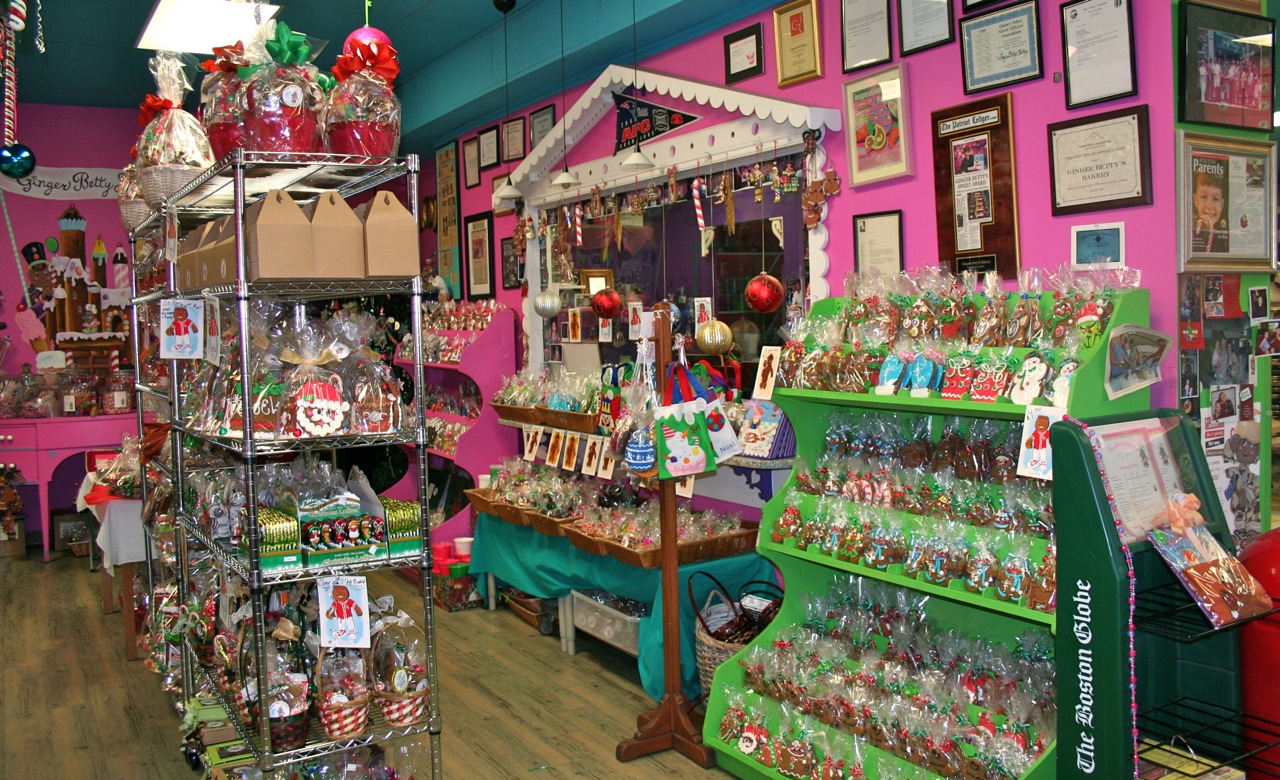
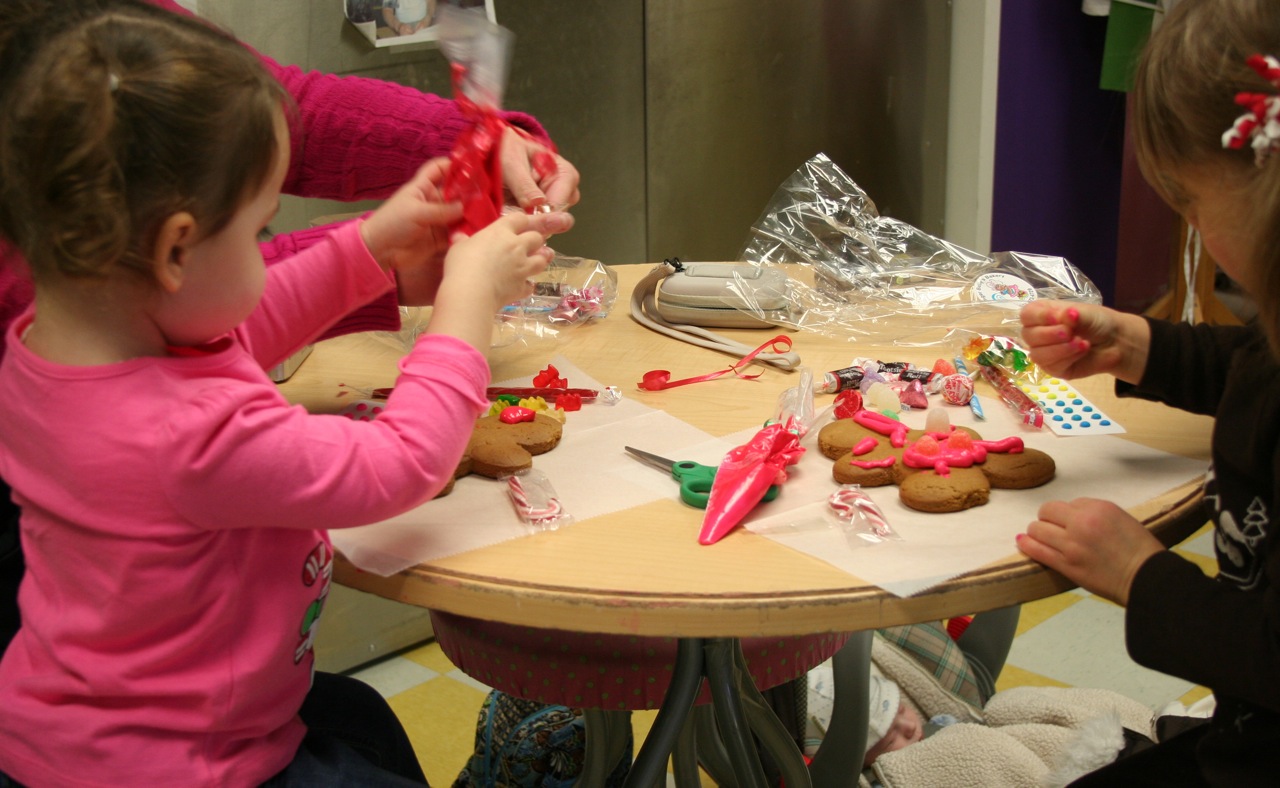
215 Samoset Ave., Quincy www.gingerbettys.com
I was at the market the other day and noticed two different women asking the butcher how to make a turkey. Which is funny since most of us make them every year yet somehow forget what to do. I used to be that way, but not anymore.
Here’s a tried and true recipe that results in succulent, seasoned dark meat, moist aromatic white meat, and crispy skin. I’m not a spectacular cook, but this is a spectacular turkey and I’d put it up against anything Martha Stewart could pull out of her oven.
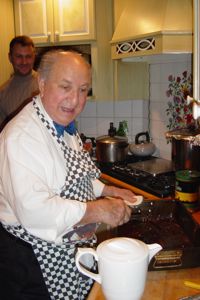
I got the recipe from one of the best cooks I know –- my Uncle Luigi [left], who knows a thing or two about poultry, having killed, plucked, and roasted his first chicken behind my grandparents’ Italian grocery store in Danbury, Conn., when he was eight.
I enjoy this turkey twice a year: at Uncle Luigi’s for Thanksgiving, and when I make it at home for Christmas.
The recipe requires a bit of work the day before you cook it – as well as an hour or so just before putting it in the oven – for stuffing, trussing, and buttering up the bird. Making the stuffing of your choice will take more time.
But the beauty of this method, aside from the taste, is that it requires no work at all once it’s in the oven. (Which gives you tons more time to kill yourself cooking other things – or to enjoy the day!)
A number of factors make this recipe work so beautifully. Salting the bird seasons the meat and helps keep it moist (and is much easier than brining). Water in the roasting pan, the loosely placed foil cover over the turkey, and the low oven temperature combine to create a self-basting environment. And, lastly, removing the cover near the end of the cooking time crisps the skin.
Uncle Luigi’s Turkey Recipe
Very important shopping note: Do not sail into a market and buy a frozen turkey the day before Thanksgiving. They take three to four days to thaw in the refrigerator. Almost all markets have fresh birds, so buy one of those or, if using a frozen bird, which is perfectly fine, be sure to give it plenty of time to defrost.
What you need
A 20-pound turkey, although any size turkey will work; just adjust the other ingredients.
1 cup salt
3/4 stick unsalted butter at room temperature
1/2 cup vegetable oil
A large roasting pan
A large V- or U-shaped rack to hold turkey inside pan
Cooking string
Extra wide aluminum foil
A simple meat thermometer if you’re inexperienced at determining when the turkey is done.
Wednesday:
1. Remove any giblets and wash the bird in the sink with running water, inside and out.
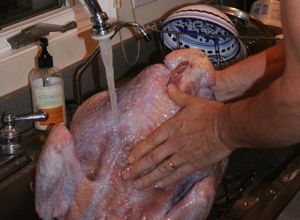 2. Rub 3/4 cup of granulated (regular grind) salt all over the bird, and spread another ¼ cup as evenly as you can inside it.
3. Set the salted bird in the refrigerator for three hours.
4. Rinse the bird in the sink, for five to 10 minutes. Just keep rinsing it, inside and out. Rinse, rinse, rinse. [at right]
5. Dry it with a clean cloth.
6. Prop it in the roasting pan “sitting up,” somehow, so liquid can drain out the center cavity (I set it on the V-shaped rack I later use to roast it) and refrigerate until cooking time, letting it dry. (Luigi hangs his in his cold shed, but I don’t.)
Thanksgiving day:
7. Stuff the turkey with your choice of stuffing and truss – this is a simple way to tie the bird so it cooks more evenly.
8. Preheat oven to 335 degrees.
9. Rub the vegetable oil all over the bird.
10. Rub the butter all over it, too.
11. Place the bird on its back on the V-shaped rack.
12. Pour 1 cup of water in the roasting pan. DO NOT FORGET THIS.
13. Fashion an extra-large sheet of aluminum foil (or two sheets crimped together to make a wide expanse) into a dome and place it lightly over the turkey, without tucking it in.
14. Place bird in oven, and cook 15-18 minutes per pound. (A 20-pound turkey should cook somewhere between five and six hours. This recipe is for a stuffed turkey; if you don’t use stuffing, research cooking times, which will be shorter.)
15. Two-thirds of the way into the average total cooking time, open the oven as quickly as possible and pull off the foil.
16. When the shorter estimated cooking time is up, test for doneness. A thermometer should read at least 165 degrees when inserted deep in the thigh. (The temperature will continue to rise as the turkey rests.)
17. Remove turkey from oven and let it rest for 30 minutes before carving.
18. Smile and give thanks when everyone raves about how delicious the turkey is!
Fabulous foods tantalize from the covers of magazines while the workplace and marketplace are filled with holiday treats.
There are platters of cookies at the hair dressers; food samples at the grocery store; pie at the neighbors’; holiday drinks at your local café; gingerbread at school functions; finger food at parties; food talk on the radio, on television, and among friends and family members. Food, food, food.
For some, this is a great celebratory experience. But for many, it can be very difficult.
If you have a problem with overeating, or eating poorly — and millions do — there’s no harder time than the five weeks between Thanksgiving and New Years. And even if you don’t normally have a problem, holidays are fraught with stressors that can push your eating habits into the red zone.
“This is a classic time of year for anxiety,” said Mark Mincolla, Ph.D., a well-known Cohasset-based nutritionist and natural health care practitioner. “Old memories, family connections, traveling — can all trigger emotion-based eating. Food and alcohol are first in line for self-medicating.”
Hey, I know that not everybody has a problem with overeating. Plenty of people aren’t bothered by it — either because they don’t overeat (through some natural or cultivated habit), or simply because if they do overeat it doesn’t bother them.
But thousands of others really suffer — plunging into cycles of self-hatred, guilt, and physical pain when they eat too much.
I love that Frank Bruni, the former New York Times food critic, quit his job and published a book about his struggles with food earlier this year. It was very brave of him and helped thousands to acknowledge a problem that still carries much shame with it — like alcoholism and drug addiction do.
I know a little about how difficult it can be to overeat. For a couple years after college, I used to get up every morning with a vague plan to eat well, then end up breaking my promise to myself. But I found a way through. Now, I’m one of the lucky ones (or the very blessed): through some miracle, I never overeat and can consequently really enjoy and love food. And because I changed, I know that other people can change, too.
But I don’t for an instant underestimate the tricky complex of factors involved with transforming one’s eating habits. Behind all the pretty frosting, food exerts as raw and animalistic a force on our psyches as anything. Its associations are many, its roots deep in our minds and bodies. Will alone generally won’t work at dismantling the problem any better than it would if the task were getting a wild animal to sit.
But, small, gentle changes might.
So, I have a suggestion for anyone looking for a way through the next few weeks.
All it involves is choosing one good little eating behavior and doing it every single day until New Year’s Day.
That’s all. You don’t have to give up or change anything else.
“Don’t make dramatic changes this time of year,” said Mincolla, who highly values balance. “Dramatic change is destabilizing.”
This is how the two-step process works:
Step One: Don’t force changes in any of your eating habits, holiday eating obligations, or eating problems between now and the New Year. Accept them and let them be. Eat what you want.
Step two: Choose one — just one — of the following eating-based actions and do it every day along with everything else you do.
Here are your four choices, most of which Mincolla suggested:
- Eat breakfast, no matter what.
According to Mincolla, eating breakfast keeps us stable and centered physically, emotionally, and psychologically. Numerous studies link missing breakfast with great increases in the incidence of obesity. If this is something you want to do but find hard, here are a couple quick and easy breakfasts:- Greek-style non-fat yogurt with fruit. (Mincolla says that this thick, strained yogurt has a greater ratio of protein to carbohydrates than regular yogurt.)
- Spiru-tein protein powder with plain Silk soy milk (or, my suggestion, non-fat milk.)
- One or two hard-boiled eggs with a slice of high-quality whole-grain bread and a piece of fruit (my suggestion).
- Fill each of two plastic bags with a quarter-cup of one or more of the following (raw or unsalted roasted) nuts and seeds, and eat them for morning and afternoon snacks: Almonds, sunflower seeds, pumpkin seeds, walnuts, or soy nuts. Aside from their protein, these nuts and seeds are high in tryptophan, which increases serotonin levels in the brain and promotes relaxation.
- Drink a cup of rooibus (red bush) tea every afternoon, or any of the non-caffeinated Yogi (or similar) brand teas. Sit quietly for 10 minutes while you sip.
- After dinner, eat a cup of this fruit dish, even if you’re going to eat dessert later: Fill a baking dish with a mixture of frozen berries, unsweetened canned peaches, and unsweetened canned pears. Sprinkle the mixture with cinnamon and some oatmeal and bake at 350 degrees for 50 minutes.
That’s it. Chose one action and do it every day until Jan. 1. Then see what you’ve got.
Taking small steps in the right direction, consistently, is a powerful way to build good habits than can, eventually, replace the old.
May you be aware of the love around you this holiday season and enjoy some good food!
Mark Mincolla, Santi Holistic Healing, 12 Parking Way, Cohasset, 02025; 781-383-3393
From the time I had my first apartment in college, my father would try to send me back to school with a case of tuna fish, even though I’d fight him off. And for years after I left home, my mother would regularly tell me how to roast a chicken.
“Joni, you know how to make a roast chicken, right?” she’d start, and although I’d impatiently snap, “Yes, Mom,” she’d continue right on instructing me.
It was always roast chicken, which must have been because chickens were cheap, simple to bake, and a great source of protein: if I could make a chicken, I’d always have something good to eat.
I guess she didn’t know what else she could do to care for me off on my own in a world beyond her reach.
I understand that now.
Food can speak volumes.
It was the only language I had one day last summer, when out of the blue, my first, serious, post-college boyfriend came to my house in Hull to have dinner with my husband and me.
When I got his phone message, I didn’t recognize his voice. But he’d said his name and the area code on the caller I.D. matched where he lives. I had followed his life from afar through a mutual friend, and knew that he’d suffered an unspeakable loss a while earlier. I knew that he’d left his law practice, bought a boat, and was on a month-long sail with a pal.
I called the number he left.
Our conversation was brief. He said he was on the North Shore on route to Hingham where some of his wife’s relatives lived. He said that if the wind was good, maybe we could have a cookout at their house that evening.
“Or, we could have it here,” I said, without thinking at all. We left it vague and hung up.
It was a Saturday, and my husband and I had just returned from a trip. I’d planned on doing very little that day, and suddenly I was maybe going to make dinner for a bunch of people.
But I couldn’t mobilize. I could not get myself to go to the store for food, even though I’d (sort of) offered to cook. I didn’t believe he was actually going to make it all that way (through the years or the nautical miles?) and be here for dinner. Besides, I thought, his relatives would most likely invite us over. He probably hadn’t even registered my faint invitation.
The only thing I was able to do as I waited to see if he was really coming, was make a big pot of brown rice.
Years before, when Sailor and I were together, we were vegetarians and ate lots of brown rice.
Do you know brown rice? Good, nourishing, full of fiber and B vitamins brown rice? It still occupies a central position as a basic staple in my world: sort of like, air, water, and brown rice.
I shucked several ears of corn and thought about how close we’d once been. How sweet and smart he was: how hurried I’d been to find my way to something big and important.
I broke a head of garlic apart and slowly minced a large pile of it, as I’d been doing for decades. I finely chopped carrots and thought about Sailor’s recent life. I couldn’t understand how people live through some of what we live through.
I stripped the kernels from the corn and sautéed them with the garlic and carrots, then added the mixture to the rice. With some soy sauce and toasted sesame oil for flavor, it was my old brown rice salad.
At five p.m., when I still hadn’t heard a thing I was so relieved — figuring that the evening was off. Then, at six, the sailor’s sister-in-law called from Hingham and somehow it ended up that everyone was headed to our house.
I raced to the store, got chicken (!), mesclun, and a watermelon, somehow managing to get everything together for grilling by the time I picked up the sailor and his mate at the A Street dock.
The relatives, my husband, and the sailor’s friend were a fun, talkative group that made any awkwardness easy. Sailor was as handsome as ever and seemed well — if somewhat dreamy and off on his own as though the sea had soothed a part of him away. He was hungry and ate a lot. Covertly, I watched his every mouthful, which included two big helpings of rice.
The food wasn’t great, but the brown rice, my delicious brown rice salad, saved me from feeling embarrassed by the otherwise mediocre meal. And it also served in another way, there in the center of the table. It was like a stand-in for Sailor and me, a stabilizing force, a ballast: holding who we were, what we’d become, and the present moment all in a big wooden bowl.
The rice was my mother’s roasting instructions, my father’s cases of tuna fish. I was helpless to stop life from hurting my old friend, but I could feed him.
I offered brown rice instead of the heart full of words I couldn’t utter – my sympathy over his daughter’s recent death.
I offered brown rice.
I offered brown rice.
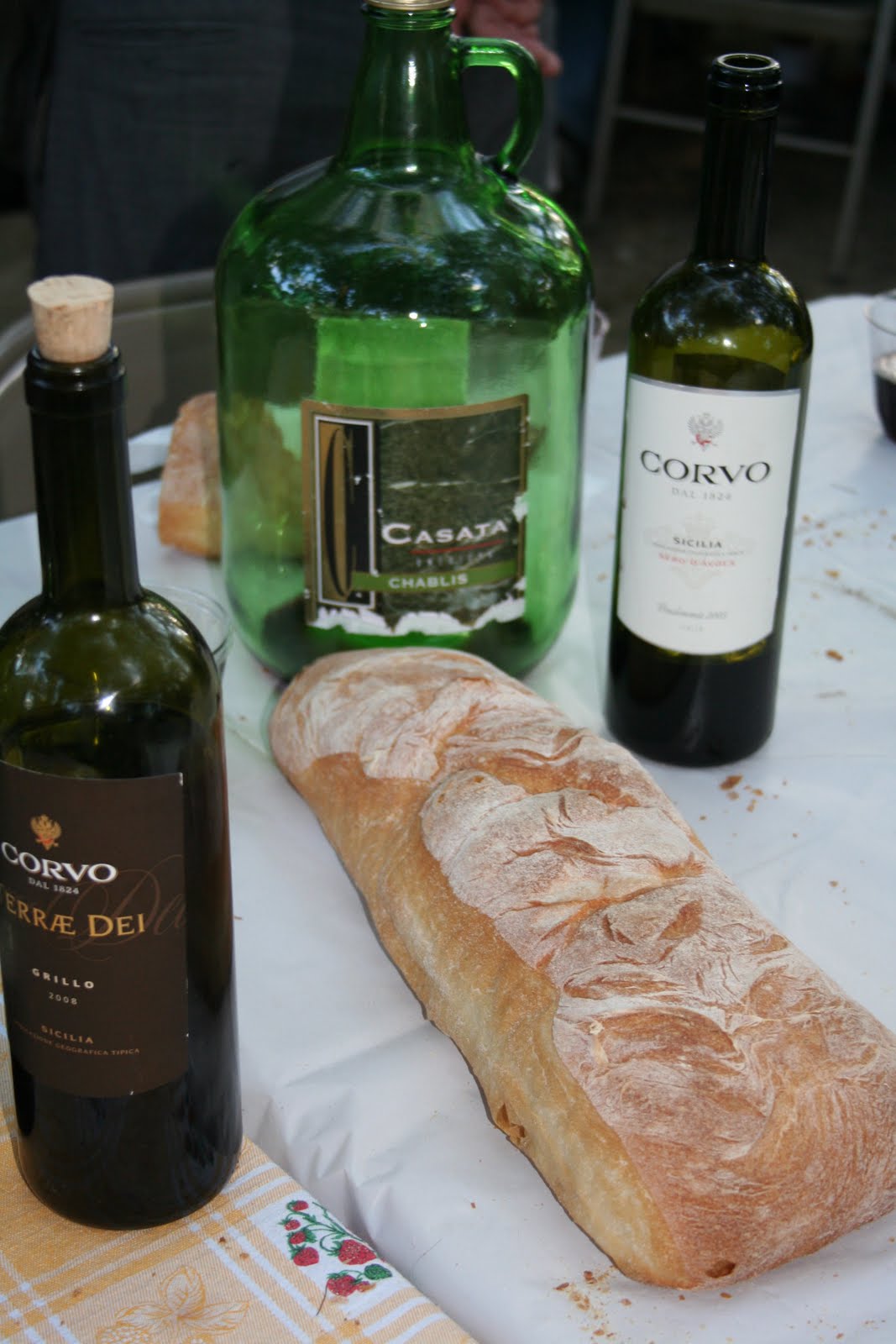 Last Sunday a small pine grove in Hingham erupted in picnic tables covered with food and hundreds of people.
The little-known annual celebration was the 51st local Festa della Madonna della Luce – the Feast of the Mother of Light.
After the procession reaches the park-like grove, at the dead end of the street, the Madonna is installed in a small open-air, stage-like building and a priest holds a mass in Italian. At one point in the mass, all the young children gather on the steps of the stage. As they sit, a woman tells the legend of the Mother of Light, the miracles she performed — her first was the saving of drowning boys — and how she came to be Palermiti’s patron. And the minute the story and the mass are over, the feast begins!