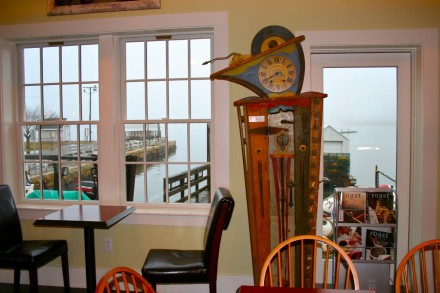
Say it’s a clear, sunny day.
Or, a cold one with light snow falling.
Hey, it could be raining or blowing a gale, it doesn’t matter: The water views from Hingham’s new Redeye Roasters Café & Espresso Lounge are beautiful.
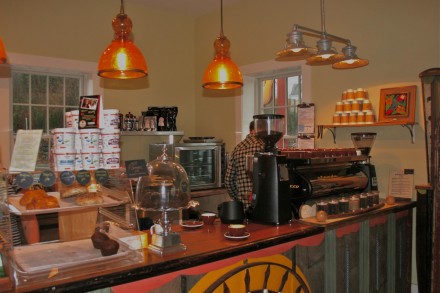
And so is the interior of the cozy new café. The space, which occupies two-thirds of the Bare Cove Marina building, is fitted out with repurposed old wood, pendant lighting, decorative found pieces, and giant burlap bags of coffee. On the far side of the windowed room sits the bright red roasting machine where owner Bob Weeks works his magic — turning what are actually the green seeds of a red fruit into the cherished thing we know as coffee.
The journey that led Weeks to the café, which opened Dec. 3, was a path with heart.
After losing his job at a top Boston ad agency in 2006, the art school graduate decided to focus on what he loved and expand his coffee-roasting hobby into an occupation. Incorporating as Redeye Roasters, he began selling beans to local businesses. A couple years later, he opened a café truck thinking he’d sell to travellers at the Greenbush commuter rail station. When that didn’t fly, (most arrived too late to buy coffee), the vision began to form: Open a real café.
After searching Hingham center and Square for more than a year, Weeks realized what he wanted.
“Everyday I’d pass the Bare Cove building and think, ‘I need to be right there,’” said Weeks. “Finally, one day I stopped at the marina… asked a guy if he knew who owned the place… got Nick Bonn’s name and number…and called him.”
After signing a lease with Bonn, Weeks began to gut the space in June. Much of the cafe, including the bar, was built by folk artist and furniture maker Rich Dunbrack, from Martha’s Vineyard, and captures the magical feeling that Weeks wanted.
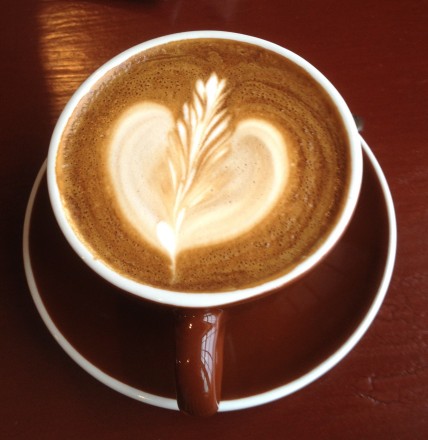
And the coffee? Frankly, I’ve been ruined by Redeye’s crazy good, creamy lattes (made with Hingham’s Hornstra Farms milk) and can’t seem to find a cup as tasty anywhere else. They’re always a bit of a unique event, too, topped with the South Shore’s only “coffee art:” pretty surface designs made by pouring steamed milk carefully over espresso. My other Redeye favorite is the cold-brewed iced coffee, aka a “toddy,” which, until now, were a once weekly summer pleasure procured from Weeks’ café truck at the Hingham Farmers market.
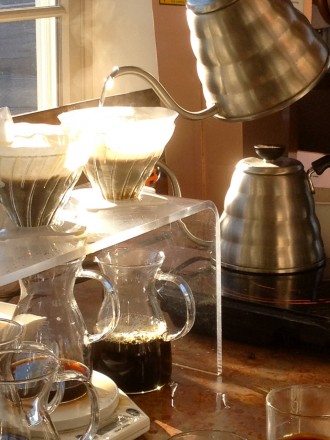
Along with various other espresso and hot drinks – which are all comparable in price to the corporate coffee chains — Redeye’s menu includes several daily brewed coffees; individually prepared filtered coffees called “pour overs;” and French pressed coffees. The café has an evolving pastry case that sometimes includes offerings from local bakers, and great gelatos and sorbet from Cold Fusion Gelato. Redeye also sells Somerville’s fine Mem teas, served in little porcelain pots, and a choice selection of cold drinks.
A self-admitted coffee geek, Weeks talks about the characteristics of coffee the way a sommelier talks about wine. He’s passionate about the science of roasting and exacting about extracting the best flavor possible from each particular bean. Some mornings, you’ll see the staff blind tasting a few different brews to see whether Weeks wants to carry them.
But if coffee science is the backbone of a café, its people are the soul, and Weeks has that covered, too. An easy-going guy, he’s assembled a smart, friendly staff that seem to love the place. Their warmth sets the tone for Redeye to be what a great café is: a welcoming place to take a break, shoot the breeze, consider the day, and sip something out of this world. Stepping into Redeye, you can leave your mind behind, come to your senses, and smell the coffee any day of the week — no matter what the weather is.
3 Otis St. (Route 3A), Hingham
Monday through Friday, 6 a.m. to 5 p.m.; Saturday, 7 a.m. to 5 p.m.; Sunday, 8 a.m. to 4 p.m.
781 740-2545
Accessible to the handicapped
Major credit cards accepted
]]>
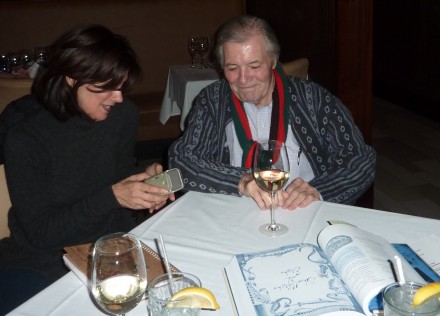 As Jacques Pépin made the rounds of the 120 guests attending the celebrity chef dinner at Hingham’s Summer Shack last Monday, guest after guest embraced the legendary chef – metaphorically or literally.
“We just love you!’’ said a woman as she held Pépin’s hand in both her own.
An exceedingly social creature, Pépin matched this outpouring of affection with the open-heartedness that characterizes all his work: the 21 books; decades of magazine articles; university and culinary school teaching; and the hundreds of PBS cooking shows that began long before anyone had even thought of the Food Network.
Among his vast accomplishments is a decidedly local one. Pépin and longtime friend Julia Child founded the country’s first master of liberal arts in gastronomy degree program at Boston University in 1993. The program combines cultural studies with the university’s Culinary Arts Program, which was founded by Child, Pépin, and Summer Shack owner-chef Jasper White.
“Jacques is the best teacher of technique in this country,’’ said Rebecca Alssid, director of BU’s Food and Wine program.
“I am more a teacher than a chef,’’ said Pépin, as a line of adoring fans waited to have him sign his new book, “Essential Pépin: 700 Recipes From My Life in Food,’’ before being seated for the one-time, $250 prix fixe dinner.
The book is illustrated with 300 of Pépin’s charming drawings – he’s been painting for 50 years. And rather than a simple collection of his greatest hits, many of his recipes have been simplified for this edition.
“I like to simplify,’’ said Pépin, who experiences cooking as an ever-changing pursuit that continually presents in new ways. White expressed a similar sentiment, likening the appeal of cooking’s infinite variety to the limitless music a composer can create with the same 12 notes.
In the process of revisiting decades of recipes for the new book, Pepin saw many of them differently than when he originally wrote them.
“I’d look at a recipe and say, ‘Why did I do that?’ And find a slightly simpler way.’ ’’

Jasper White, owner of Summer Shack, with Jacques Pépin, the first celebrity chef in his winter series.
According to the man many remember from his TV series “Julia and Jacques: Cooking at Home,’’ the freedom to forge new approaches emerges only after a cook has mastered his medium. For this, Pépin knows that repetition is the key.
“For the professional chef, you must repeat, repeat, repeat techniques until they become part of you, part of your DNA, and the knowledge is in your hands. Until then, you can’t concentrate on the texture of the dish, the flavors, the combinations,’’ he said.
Along with this emphasis on technique is Pépin’s equally strong insistence that respect for food and pleasure must accompany any good cooking experience.
“Young chefs who come to me and say they want to write books and create television shows will be disappointed because that is unlikely to happen. You have to love cooking, feel gratified feeding people – and then being a chef can be a nice life.’’
For people who don’t cook but want to learn, Pépin takes a page from Child’s book. “Do you have a friend that cooks? Ask if you can go to their house an hour ahead and watch them cook. By the second glass of wine, even if the chicken is burned a little bit, who cares? It really doesn’t matter that much. Relax. You are creating pleasure, you are supposed to have pleasure yourself. You have to look at cooking as a fun thing, then you get better at it.’’
While Pépin’s hundreds of shows and exquisitely detailed cookbook instructions offer a wealth of technique, technology has put a wondrous tool in the master teacher’s hands: The book comes with the three-hour DVD, “All the Techniques That Cooks Need to Know.’’
“I’m dean of studies at the French Culinary Institute for 25 years in New York and a teacher at BU for 30 years,’’ said Pépin. “All those schools are very expensive, and basically most of the techniques we teach are on this tape,’’ he said.
“With the tape you can watch it again, put it back, put it back, stop it – and then you can see, ‘I think his knife is a little more flat when he scraped the butter.’ This is invaluable.’’
Monday marked the first of Summer Shack’s second season of celebrity chef dinners. The general procedure has the visiting chefs teach their recipes to Summer Shack’s staff and cook the dinner with them.
In this case, White’s staff cooked Pépin’s menu. Over dessert – an ethereal frozen Grand Marnier soufflé – Pépin loudly clinked his glass to get everybody’s attention and praised White and his crew.
“They did it better than I could have,’’ said Pépin, eliciting a cheerful “no’’ from the crowd. White went on to applaud his friend and introduce his kitchen staff. Half the guests were standing and applauding while this warm exchange continued.
The meal began with a lovely amuse-bouche of molasses-glazed salmon and fennel salad on brown bread, accompanied by Grand Brut, Perrier-Jouët.
Next, was Pépin’s tender mushroom-stuffed escargots with a bright frisée salad, an old recipe from his days at Plaza Athénée in Paris. White did a brilliant job with Pépin’s lobster in artichoke hearts – a dish that required cooks to trim six cases of artichokes down to the luscious meat at their cores.
The main course was chicken ballotine with a turnip and potato purée sided with smoky turnip greens. A Pouilly-Fumé and a California pinot noir were poured freely.
Although White and Pépin can’t remember exactly when they met, they were both close friends with Child.
Pépin met her in 1961, when she “was totally unknown.’’
“Julia had sent her manuscript to a friend of mine – Helen McCall, editor of McCall’s in New York. When Helen asked me to look at it, I did, and we thought it was very good.
“Helen said, ‘Well, the woman is from California and she’s coming to New York next week, why don’t we cook for her? It’s a big woman with a terrible voice.’ That was Julia.’’
And that’s Jacques.
]]>
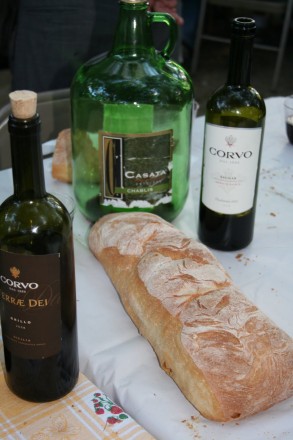
Today a small pine grove in Hingham erupted in picnic tables covered with food and hundreds of people.
The little-known annual celebration was the 51stlocal Festa della Madonna della Luce – the Feast of the Mother of Light.
After the procession reaches the park-like grove, at the dead end of the street, the Madonna is installed in a small open-air, stage-like building and a priest holds a mass in Italian. At one point in the mass, all the young children gather on the steps of the stage. As they sit, a woman tells the legend of the Mother of Light, the miracles she performed — her first was the saving of drowning boys — and how she came to be Palermiti’s patron. And the minute the story and the mass are over, the feast begins!
]]>