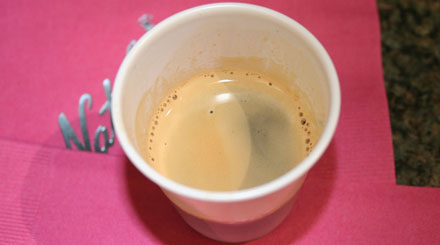
Taste is such a complex affair.
People perceive the flavors in a dish based not only on the balance of ingredients its cook has assembled, but with an emotional sensibility unique to each individual. Flavors ring bells, causing unconscious sense memories to zip around our mind-body like atomic-sized pinballs, affecting how we like the taste of something.
I’ve been fascinated by this for a while, but had been having it confirmed in my thinking last week while reading a great book, “The Flavor Bible,” by Karen Page and Andrew Dornenburg, and found myself at Natale’s men’s clothing store in Hanover with my husband.

After some time shopping around and talking with owner Nat Agostino [pictured], he offered us a coffee.
Agostino, as it turns out, is passionate about espresso, and I understand that because I’m ridiculously particular about coffee myself: I don’t like most coffee that comes my way, and if I don’t love it, I’d rather not have it.
Which is why I initially declined Agostino’s offer. But, then, when I saw the thick crema on the espresso he served my husband, I got interested.
My curiosity piqued, I had to know how he made it. Which is how I ended up in Agostino’s light-filled office, refusing his coffee a second time.
Why?

Because I saw that his beautiful electric (Alma brand) espresso machine uses coffee pods, and I was sure that pre-packaged pods could never produce a vivid cup of coffee. (I’ve tried dozens of pods to no avail.)
“I’m sorry. I don’t like the taste of coffee made from pods,” I told him. “So, no thank you.”
But Agostino was unfazed by my comment; reaffirmed that his Giusto coffee was the best; and stood ready to make me a cup.
But Calabrese, it seems, are not known to be hardheaded for nothing (Agostino was born in, and I’m descended from, the Southern Italian Province of Calabria): I did not want an espresso I wouldn’t like, so I said:
“You know why I won’t like the espresso and you do? Because taste isn’t based only on objective flavors, but on memories and emotions and experiences that affect what tastes good to us. You’re used to this coffee and it’s delicious to you, but I won’t like it.”
I felt comfortable with this man and I really said that to him, wagering that he’d be interested in the phenomenology of individual taste and find it fun to ponder. I knew, from our conversation, that he had traveled widely. And his magnificent store and personal gentility made me think he’d have something to say on the subject.
But, he didn’t acknowledge my words.
Instead, he continued to insist that his coffee was delicious, and that I should try it.
So, taken as I would be by anyone that passionate about coffee, I had a cup.
And he was right, it was delicious – a smooth, thick blend of bitter and sweet. Really, seriously great.
He was pleased.
“My philosophy is you give the best in life to people,” said Agostino. “When I make a cup of coffee, I make it with love. I really do.”
We spent quite a bit of time, then, talking about coffee. He told us that in 60 years, he’s never had so much as a single cup of American coffee. He remembered a particular, awful espresso he was served once in Paris at Charles de Gaulle Airport — and the best coffee he’d ever had in his life: a cup made by two guys in the street in Beirut, Lebanon.
Two days later, I stopped by the shop to take a photo of his coffee. While he was making it, I asked him, again, if he could understand my fascination with how each of us likes the flavor of different dishes – and coffees — based on unique experiences that affect our sense of taste.
And he said that he did understand – and went on with great humor and joy to recount how his friend, Angelo Sodano, makes Neapolitan coffee in a little pot on a hot plate, near the bathroom, in the back of his foreign cars store in Quincy, even though he also has an electric Alma machine Agostino gave him.
“I wonder why,” I said. “It must be because that’s what he’s used to, what tastes good to him.”
And then, Agostino gave me the gem I’d been after: the confirmation I’d been hoping to undercover in his experience.
“I agree with you,” he said. “I’ll tell you a story. As a young boy, we didn’t have money to buy coffee, but we grew orzo [barley] and my mother roasted it dark [in a frying pan over a wood fire] and ground it and made coffee with it and it was delicious. And that coffee that I told you I had in Beirut in the street from those two guys — the best coffee I ever drank in my life — it was exactly like my mother’s.”
So, wonder of wonderful story of stories: The coffee he remembers as the most delicious of his life reminded him of his mother’s grain coffee!
Bravo our mothers, our memories, and the love that lives in our taste buds.
Follow Joan Wilder on Twitter.
]]>One would eat hot dogs, but only with catsup, while it was mustard or nothing for another. Plain pasta for one, sauced for the other two. One of us liked only the yolks of eggs, another only the whites: buttered corn, plain corn. Until six, I wouldn’t touch cheese: after that, only American cheese, which in our house came to be known as Joni cheese.
Liver was the only constant – all three of us always hated it — but few other foods commanded our unified appreciation or aversion, and my mother was the keeper of all our preferences.
Not only did each of us have different likes and dislikes, they changed all the time. And it wasn’t simply that each kid added to her list of approved foods; we also stopped liking foods we’d previously liked for no apparent reason. Which made my mother, like mothers everywhere, crazy.
“Aren’t you going to have some?” she asked one night when I hadn’t touched the asparagus.
“No, Mom.”
“But you like asparagus,” she said eagerly.
“No, Mom, I hate it,” I said with an impatience that implied that there was something terribly wrong with her ability to remember the simplest things.
But my mother wasn’t misremembering, I’d just changed my mind about what I liked. Why? I don’t know, lots of unconscious reasons, I suppose, related to asserting independence, peer pressure, and coolness — issues my mother probably understood. She witnessed it all and held the knowledge of everything I liked, and didn’t like, all I denied, all I fought, all I saw and didn’t see, all the ways I changed and grew.
And she never stopped being happy to feed me and cook the foods I liked.
My father loved to feed us, too, but it wasn’t second nature to him to inventory our changing tastes the way it was with my mother.
I’ve come to think of the love of feeding others as mother love, because I see its purest form in mothers. Under ideal conditions, life creates life through mothers in love and, as part of the package, nature gives them a love of feeding their children. It’s the biological imperative hard-wired to food. After the birth itself (the coming into form from the formless), it’s love’s first action: Life has to be fed.
Regardless of how mothers deal with their children’s demands or how distorted life may be for some, mothers are genetically disposed to get pleasure from feeding their young.
Which is why my sister’s friend, Sandra, makes two types of fish when she makes fish for dinner, why she serves one daughter white meat boneless chicken, another soy chicken products, and only dark meat on the bone to her son.
“It can be a little annoying, but I’m so happy that everyone’s eating a good meal,” she said.
It’s been a while since my mother has been gone from this place, but I get and give the mother love when I eat with people I love. Sometimes, when my husband’s eating a dish I made, something happens to me physically. It’s rare and only happens when he’s very hungry and unselfconsciously digging in — often after midnight when he’s just gotten home from a trip or a long work night. As I sit with him, my arms start to really tickle and I become aware of how much I love him.
Don’t ask: I don’t know what this is, but I have to wiggle around and rub my arms briskly to get the tickling to stop. I mean, I guess it’s clear: I’m tickled to see him eat.
My mother never stopped loving to see us eat, either, even as adults. And when we grew up and went away, she and my father continued their mutual love of food and fed each other.
I have a memory of my mother I’ll never forget. It was a simple thing, a small moment.
She was visiting me on the Cape and my father was at home in Connecticut. It was summer, a beautiful, warm evening in Woods Hole, and she was lying on my bed on the phone with my father. At this point in their relationship, things weren’t so good. It was a quiet conversation, a checking in. I was in the kitchen, doing something, when I heard her ask him what he ate. Then, after some quiet, she said:
“Some good haddock from that fish market in Falmouth, baked potatoes, and a salad.”
Then, after some more silence, she spoke again.
“Yup, she ate with me.”
Follow Joan Wilder on Twitter.
From the time I had my first apartment in college, my father would try to send me back to school with a case of tuna fish, even though I’d fight him off. And for years after I left home, my mother would regularly tell me how to roast a chicken.
“Joni, you know how to make a roast chicken, right?” she’d start, and although I’d impatiently snap, “Yes, Mom,” she’d continue right on instructing me.
It was always roast chicken, which must have been because chickens were cheap, simple to bake, and a great source of protein: if I could make a chicken, I’d always have something good to eat.
I guess she didn’t know what else she could do to care for me off on my own in a world beyond her reach.
I understand that now.
Food can speak volumes.
It was the only language I had one day last summer, when out of the blue, my first, serious, post-college boyfriend came to my house in Hull to have dinner with my husband and me.
When I got his phone message, I didn’t recognize his voice. But he’d said his name and the area code on the caller I.D. matched where he lives. I had followed his life from afar through a mutual friend, and knew that he’d suffered an unspeakable loss a while earlier. I knew that he’d left his law practice, bought a boat, and was on a month-long sail with a pal.
I called the number he left.
Our conversation was brief. He said he was on the North Shore on route to Hingham where some of his wife’s relatives lived. He said that if the wind was good, maybe we could have a cookout at their house that evening.
“Or, we could have it here,” I said, without thinking at all. We left it vague and hung up.
It was a Saturday, and my husband and I had just returned from a trip. I’d planned on doing very little that day, and suddenly I was maybe going to make dinner for a bunch of people.
But I couldn’t mobilize. I could not get myself to go to the store for food, even though I’d (sort of) offered to cook. I didn’t believe he was actually going to make it all that way (through the years or the nautical miles?) and be here for dinner. Besides, I thought, his relatives would most likely invite us over. He probably hadn’t even registered my faint invitation.
The only thing I was able to do as I waited to see if he was really coming, was make a big pot of brown rice.
Years before, when Sailor and I were together, we were vegetarians and ate lots of brown rice.
Do you know brown rice? Good, nourishing, full of fiber and B vitamins brown rice? It still occupies a central position as a basic staple in my world: sort of like, air, water, and brown rice.
I shucked several ears of corn and thought about how close we’d once been. How sweet and smart he was: how hurried I’d been to find my way to something big and important.
I broke a head of garlic apart and slowly minced a large pile of it, as I’d been doing for decades. I finely chopped carrots and thought about Sailor’s recent life. I couldn’t understand how people live through some of what we live through.
I stripped the kernels from the corn and sautéed them with the garlic and carrots, then added the mixture to the rice. With some soy sauce and toasted sesame oil for flavor, it was my old brown rice salad.
At five p.m., when I still hadn’t heard a thing I was so relieved — figuring that the evening was off. Then, at six, the sailor’s sister-in-law called from Hingham and somehow it ended up that everyone was headed to our house.
I raced to the store, got chicken (!), mesclun, and a watermelon, somehow managing to get everything together for grilling by the time I picked up the sailor and his mate at the A Street dock.
The relatives, my husband, and the sailor’s friend were a fun, talkative group that made any awkwardness easy. Sailor was as handsome as ever and seemed well — if somewhat dreamy and off on his own as though the sea had soothed a part of him away. He was hungry and ate a lot. Covertly, I watched his every mouthful, which included two big helpings of rice.
The food wasn’t great, but the brown rice, my delicious brown rice salad, saved me from feeling embarrassed by the otherwise mediocre meal. And it also served in another way, there in the center of the table. It was like a stand-in for Sailor and me, a stabilizing force, a ballast: holding who we were, what we’d become, and the present moment all in a big wooden bowl.
The rice was my mother’s roasting instructions, my father’s cases of tuna fish. I was helpless to stop life from hurting my old friend, but I could feed him.
I offered brown rice instead of the heart full of words I couldn’t utter – my sympathy over his daughter’s recent death.
I offered brown rice.
I offered brown rice.
 Last week, I found some delicious pasta sauce at Trader Joe’s for cheap. Because it cost three times less than my previous reigning favorite ready-made marinara, I bought eight jars. Some people cherish their Manolo Blahniks, cars, and iPods, but I treasure food. Oh, I love beautiful things, but the fact that they can’t be eaten puts them lower on my list of life’s riches. A well-stocked kitchen, on the other hand, makes me feel like a wealthy woman.