The Summer House at Just Right Farm
It’s hard to think of the South Shore without conjuring endless beaches. But a bit inland and south the area opens into vast fields, bogs, and woods that stretch into deep countryside.
How surprising to find fine dining in an area like this, then again, how appropriate to eat where food is grown.
This is the idea behind Kimberly and Mark Russo’s new farm-to-table dinners – staged at their Plympton farm in an elegant, screened-in summerhouse 20 paces from their kitchen.
In case you’ve missed this phenomenon, family farms across the country have been hosting dinners in their fields, barns, and kitchens for a while now. The meals are prix fixe, single seating events that feature locally sourced foods, many of which are grown on the farm.
Since buying the 10-acre Just Right Farm in 2004, the Russo’s have been restoring the old place to reflect their belief in weaving simple rural ways back into contemporary life. They’ve built a large organic garden; a workshop where Kimberly makes furniture; a labyrinth for contemplative walking where Mark holds retreats; a restaurant caliber kitchen; and most recently, the stand-alone screen house.
Mark, a veterinarian, helps host the Friday and Saturday evening dinners but they are clearly Kimberly’s baby. Working with one other cook – caterer Elaine Murphy who this year closed her True Blue BBQ stand in Kingston — Kim devises each week’s menu from her garden and what’s available from area – and regional – farms.
“We don’t go to the grocery store,” says Kimberly, who has owned two small restaurants and worked in the industry all her adult life.
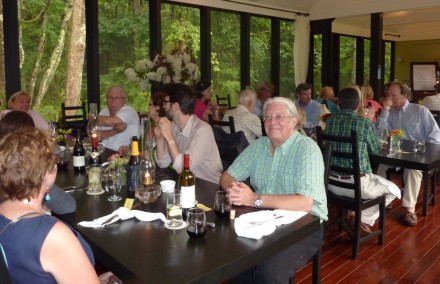
There is nothing in the screened-in dining room that is not both utilitarian and beautiful. Kimberly built the three, 10-foot wooden tables that seat a total of 24 guests for each five-course dinner ($100 per person). Made from ash, they are stained black and set with tall sparkling gas lanterns, flowers, small salt and pepper cellers, and simple white porcelain plate ware. Three handmade sideboards of rough-hewn wood and iron pipe — left over from the kitchen renovation — easily hold towering flower arrangements and various family-style side dishes. Ceiling fans keep the air moving and a rich mahogany floor shines darkly. Only the billowing white drapes gathered in the corners are for show alone: Who would want to block out the surrounding woods?
One side is better than the next
Eating vegetables that Kimberly grew – and cooked – at a table she made, in a building she designed, makes a statement.
Sitting eight to a table promotes a fun communal experience, but the seating is so spacious it’s perfectly comfortable to be private if you’d prefer. The service is marked by a similar balance of availability and reserve. Kimberly greets guests before dinner with a quick talk about the place, introduces the servers thoughtfully, then retreats to her kitchen. Throughout the meal, either a server or Mark introduces every dish, explaining where the foods were sourced.
In this the inaugural season of 16 weekends, Kimberly and company have their act together. Minutes after the 7 p.m. start time and Kimberly’s welcome, the servers deliver a taste from the chef – the tiniest, exquisite amuse bouche: a square of feta cheese (Falls Village, Conn.) from goats at a farm the couple knows well and tiny bites of roasted cherry tomato and eggplant from the garden.
The first course follows effortlessly despite a torrential downpour that only makes things cozier: delicious briny wild blue mussels (Jonesboro, Maine) atop a lovely linguini in cream sauce.
A vividly scarlet chilled beet soup with a dollop of crème fraiche comes next: beautiful and delicious.
It’s a homey touch to offer a pristine white bowl of brightly colored pickled veggies on the sideboard next to loaves of bread from Plymouth’s wood-fired Hearth bakery. I take spoonfuls of sweet onion, uncoiling in small bites, and my neighbor takes turnips. And the simplest thing is to die for: rosemary-flavored butter!
Course three is a composed salad on a narrow plate that makes the most of Just Right’s farm garden: There are long, thin ribbons of cucumber arranged in curls; red, yellow, and roasted tomatoes in all their ripe glory; fingerling potatoes, as small as grapes, sitting on a smear of aioli, and the babiest of carrots, cut lengthwise, looking like perfect candies in the soft light.
“Intermezzo,” says our server, as she comes around with an unexpected scoop of perfumey green tea and mint sorbet to refresh the palate.
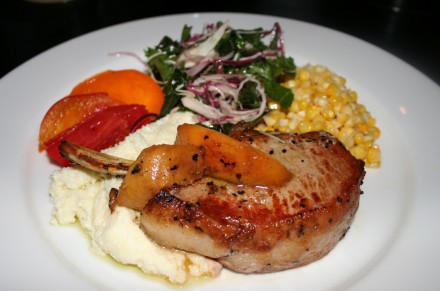
The main course is bountiful. A pan seared pork rib chop (Radham, N.Y.), topped with slices of grilled rosemary peaches (Plympton), lies over a pile of outstanding grits with feta that has people who say they don’t like grits swooning. The plate is full of sides, one better than the next: slices of heirloom tomatoes; a fabulous kale and cabbage slaw dressed with a bit of smoky bacon fat; and sweet corn cut from the cob.
Guests linger over a fluffy, perfectly sweet and sour round of lemon mascarpone topped with candied orange rind and sided with some syrupy blueberries (Dummerston, Vt.) and two of the best shortcake cookies ever. Coffee (Newton) in French presses appears on the sideboards as Kimberly comes into the dining room again. After introducing Murphy as the woman “to blame if you liked the cooking,” she goes from person to person offering slivers of a second dessert: a wonderful dark chocolate tart. Too much!
Don’t miss this place.
140 Palmer Rd., Plympton Friday and Saturday evenings at 7 p.m., from June 15 to Sept. 29, by reservations only 781 936-5330 justrightfarm.com Accessible to the handicapped Major credit cards accepted
]]>
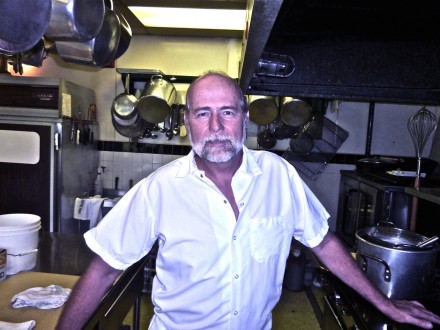
I’m standing in the large kitchen at Hingham’s Glastonbury Abbey talking to its head cook, John Gauley, when Father Tom, one of the monastery’s 12 Benedictine monks, pops in. I’m glad because although I’m here to talk about the food Gauley makes, I don’t know what monks actually do and now I can ask.
Father Tom, who is a priest as well as a monk, has been at the abbey for 42 years, and Gauley, who lives in Cohasset, for 24.
Father Tom explains that among their other duties, the monks gather daily for Vigils at 6:30 a.m., Lauds 75 minutes later, a noon Mass, Vespers at dusk, and evening Compline.
“We spend a long time in prayer,” he says.
“Not long enough,” says Gauley, who has a quip for every word Father Tom utters.
The monk laughs easily, then tells me about the brothers’ three vows: stability, conversion of life, and obedience.
“See, they have to tolerate me, it’s one of their vows,” says Gauley, who considers himself a Pagan.
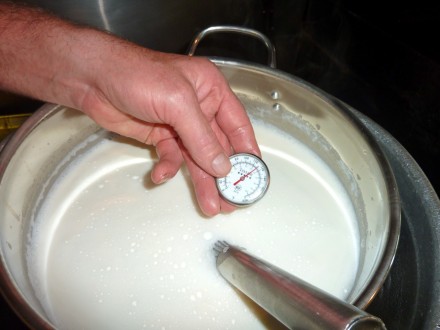
As the cook checks the temperature of a pot of goat milk on the stove (he’s making cheese), I ask Father Tom, out of Gauley’s earshot, how his cooking is.
“Monks from other monasteries want to stay here because of the food,” he answers. “We are very fortunate to have him.”
“Blessed,” corrects Gauley, who, apparently, has very good hearing.
In this case, the cook’s jest hits the mark: I think blessed is the right word.
Gauley loves what he does, and goes above and beyond: He bakes fresh bread daily from a sour dough starter he keeps in a bucket in the walk-in (focaccia, oatmeal cranberry, multigrain); has been making his own honey for nearly two decades (300 pounds last year); and has begun, this year, to produce fresh chevre from the milk of the small herd of Nubian goats he began raising two years ago.
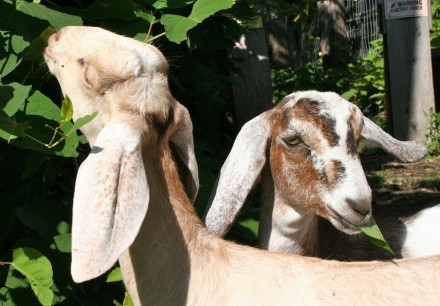
In all, there are five buildings on the magnificent 60-plus acre site, including a conference center which hosts hundreds of group meetings throughout the year. Along with the monk’s meals, Gauley, and his assistant, Ben Laney, cook for these events as well.
Not only that, but Gauley donates his time to prepare the Sunday Supper the Abbey provides for anyone needing a meal on the last Sunday of the month. Gauley also cooks a main course once a month that the monks take to Father Bill’s homeless shelter. And – when there’s extra – he sells his honey in the Abbey bookstore.
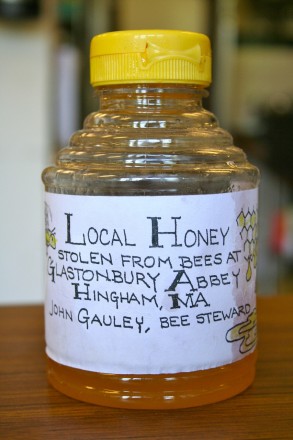
Seeing how Gauley runs the kitchen with dedication, routine, and a sense of service, I comment to Father Tom that Gauley is, in fact, rather monk-like himself.
“He is,” says Father Tom. “We’ve tried to get him to join the community, but he’s anti-this, and anti-that. We love him anyway — and his cooking. Although I wish he wouldn’t forget things: he makes these delicious things then forgets how he did it.”
Which is how Gauley likes to cook. Less by rote than by feel and daily inspiration. The goat cheese, however, requires very exacting measures quite unlike his usual creative approach.
“It has to be pasteurized in a water bath to 160 degrees and cooled to 90 degrees… cheese is a lot more complicated than I thought,” says Gauley, who’s become quite expert on both cheese making and goat husbandry. It’s clear he likes the challenge, though, and his various chevres (one is herb-covered) are delicious: creamy, mild, and slightly zingy.
“This has been a learning year for the cheese,” he says.
Gauley’s eight goats live in a series of shacks and pens on an idyllic woodsy, rocky hillside 100-plus yards from the kitchen. He’s milking only one this season – Abby. Milked twice daily, she provides about three quarts a day. With this, Gauley makes cheese once a week, getting about four pounds from what is about five gallons.
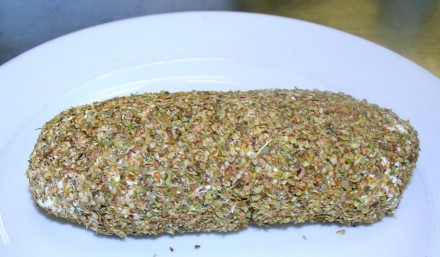
The kitchen is the warm center of the monastery, with monks and volunteers running in and out of it delivering the big dishes Gauley cooks – or simply serving their brothers at table daily. It’s a nourishing, nurturing shelter of a place: a lively, light-filled room in the monastery adjacent to the bookstore and the rectory.
When I ask Father Tom if he has a favorite dish of Gauley’s, it is Gauley who answers.
“It’s a raw vegetable salad,” he says.
“Actually, it is,” says Father Tom. “I love that.”
]]>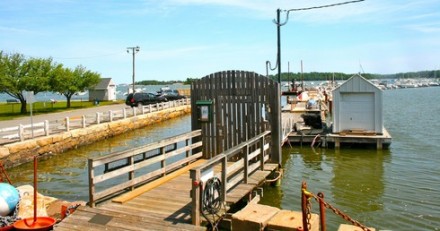 Being a café lover of the first order (there’s not much I enjoy more than hanging at a great café), I am thrilled out of my mind that Hingham resident Bob Weeks, of Redeye Roasters, is planning to open a café in the Bare Cove Marina building, across from Stars Restaurant, on Hingham Harbor.
You may know Weeks from the hand-roasted coffee he sells at several local shops or from the great coffee he serves from his colorful coffee truck at the Hingham Farmers Market. The new café-to-be — Redeye Roasters Coffee and Espresso Lounge — will occupy 1,000 square feet of the side of the marina building toward the Hingham Bathing Beach, while the other side will serve as storage for marine activities. [See the view below] “We’re putting windows on the water side, so very soon you’ll be able to have a coffee and look at the boats and water,” said Weeks, who hopes to open by late August or early September.
Weeks, who launched Redeye Roasters after leaving his advertising job in 2006, plans to offer all types of coffee drinks, teas, pastries, gelato, and affogato. (He may be in the market for a local baker to supply the shop, so if you’re that person, check him out.)
In Plymouth, the historic building where the wonderful Martha’s Stone Soup restaurant (cq) used to be is set to open on June 23 as a restaurant serving classic American fare.
Rye Tavern is the newest baby of partners Christopher Tocchio andKristian Deyesso, owners of Plymouth’s Union Fish Seafood & Raw Bar; Boston’s Church Restaurant & Nightclub; and The Regal Beagle in Brookline.
The owners have gutted the building, known as the Wright Tavern, built in 1792, and created seating for about 50, which includes some patio dining, said Brandon Babiarz, executive chef of Union Fish. The menu will be small and have a farm-to-table, seasonal focus inspired by the garden on the property.
It’s great that these guys are renovating and restoring this special, remote venue at the intersection of Old Tavern Trail and Old Sandwich Road in Pinehills. The restaurant will be open at 5 p.m. daily for dinner.
The former Cafe Ona (and before that Cafe Calabria) at 443 Nantasket Ave. in Hull is now Lynda’s Restaurant – a breakfast and lunch place owned by Joe DiVito, who owns Weinberg’s Bakery just up the road. The restaurant, which is open daily from 7 a.m. to 2 p.m., serves breakfast all the time as well as lunch from 11 a.m. to 2 p.m.
Among the many standard American breakfast and lunch dishes are some Italian favorites. Lynda’s also serves espresso drinks, Hornstra dairy’s local milk and chocolate milk, and soymilk. Daily specials are posted on the restaurant’s Facebook page.
DiVito has been able to secure customer parking in the Knights of Columbus lot across the street from the restaurant, something the site’s former incarnations didn’t have.
Chef Paul Wahlberg and company are planning to open a casual burger, hot dog, and frappe type restaurant adjacent to the chef’s fine dining restaurant, Alma Nove, at the Hingham Shipyard late this summer, according to Wahlberg’s publicist, Mindy Valone, at Boston’s CM Communications.
Although Wahlberg spoke at length to a local paper last month about his plans and inspiration for the new place, he’s now unavailable for comment, so we’ve been unable to confirm anything more than the basics.
Wahlberg opened Alma Nove last summer with partners that include brothers Mark (movie guy) and Donnie (music and movie guy).
A new burger place, Wild Willy’s Burgers, is planning to open later this month at 588 Washington St., not far from the Fore River Bridge. The restaurant is part of a small chain – there are six others spread among Massachusetts, Maine, and New Hampshire.
The new place is owned by husband and wife Paul and Ruth Bennett.According to the restaurant’s Facebook page, Wild Willy’s will be open daily from 11 a.m. (noon on Sundays) until 9 p.m. (8 p.m. on Sundays). For info about possible employment, call 617- 472-9453, or stop by the restaurant.
The Quincy Farmers Market, which opens on June 24, will be selling Massachusetts wines for the first time this season.
According to Janet Little, market manager, state legislation was passed last year that allows the sale of Commonwealth farm wines at farmers markets. The city of Quincy this month licensed the farmers market to hold wine tastings and sales.
The market, which is open from 11:30 a.m. to 5:30 p.m. on Fridays, will feature wines from one of four Commonwealth wineries each week. The participating wineries are Coastal Vineyards of South Dartmouth; Westport Rivers of Westport; Zoll Cellars of Shrewsbury, and Turtle Creek of Lincoln.
]]>
 Here they come again: colorful farmers markets that spring up in the middle of nowhere like nomadic villages, filling parks and parking lots with local foods and goods and shoppers.
Mere hours after they appear, the carnival-like, action packed scenes dissolve into nothingness like mirages only to reappear the following week, same time, same place — rain or shine.
Although most of the markets on the South Shore won’t open until June, Holbrook’s opens this weekend, Hingham circled its white tents [above] for this year’s opening day last Saturday.
According to Hingham Market Manager Bill Marshall, an average of 1,000 people shopped Hingham’s Saturday, 10 a.m. to 2 p.m. market last year and he expects “another banner year this year.”
Happily, spring’s intermittent sunshine showed up for opening day and so did several of the market’s new sellers. Among them I was thrilled to see Foxboro Cheese Co; Cape Cod Original, selling chowders and more; and Vermont Heritage Grazers with a freezer full of pasture-raised pork.
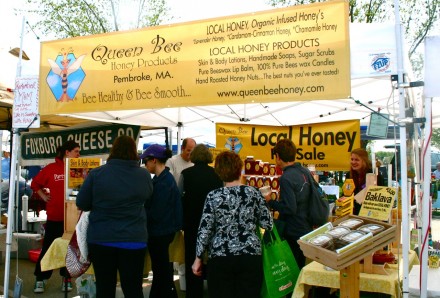
Old favorites were there, too, with bells on: Queen Bee [left] with its great honey;L. Sweets Bakerywith its Italian cookies; Nella Pastaand its gorgeous homemade ravioli; the wonderful Mediterranean foods from To Dine For, which, incidentally, sell a great little homemade bagel-like pastry with a hunk of cheese for snacking that goes so nicely with a cup of individually brewed coffee from Redeye Roasters’colorful cafe on wheels.
Turns out, there are a lot more farmers markets in the area than I knew. Here is a verified list (I talked to someone at each market) of all the markets in the area, where they are, when they open, and their weekly hours.
- Braintree Farmers Market, 1 JFK Memorial Dr. Opening day: Saturday, June 11. Hours: 9 a.m. to 1 p.m.
- Cohasset Farmers Market, Cohasset Commons, 41 Highland Ave. Opening day: Thursday, June 16. Hours: 2 to 6 p.m.
- Dedham Farmers Market, downtown parking lot between High Street and Eastern Avenue. Opening day: Wednesday, June 15. Hours: noon to 6 p.m.
- Duxbury Farmers Market, outside the Tarkiln Community Center, Route 53. Opening day: Thursday, June 30. Hours: 1:30 to 5:30 p.m.
- Hingham Farmers Market, Hingham Bathing Beach parking lot, Route 3A. Opening day, Saturday, May 7. Hours: 10 a.m. to 2 p.m.
- Holbrook Farmers Market, Union Street Lanes parking lot at 231 Union St. Opening day: Saturday, May 14 (this weekend!). Hours: 9 a.m. to 2 p.m.
- Marshfield Farmer’s Market, Marshfield Fairgrounds, Route 3A. Opening day, Friday, June 3. Hours: 2 to 6 p.m.
- Milton Farmers Market, Wharf Street, Milton Village. Opening day, Thursday, June 16. Hours: 1 to 6 p.m.
- Norwood Farmers Market, 615 Washington St., behind the Apollo restaurant. Opening day, Tuesday, June 21. Hours: 1 to 6 p.m.
- Pembroke Farmers Market, Town Green. Opening day, Saturday, July 9. Hours: 9 a.m. to noon.
- Plymouth Farmers Market, there are two: One is held at Stephens Field, 132R Sandwich St. Opening day: Thursday, June 16. Hours: 2:30 to 6:30 p.m. The second market is held on the Courthouse Green. Opening day: Saturday, June 18. Hours: 9:30 a.m. to 1:30 p.m.
- Scituate Farmers Market, North Scituate Village at the intersection of Country Way and Henry Bailey Turner Road. Opening day: Wednesday, June 15. Hours: 3 to 7 p.m.
- Quincy Farmers Market, downtown Quincy in the John Hancock municipal parking lot, across from the courthouse. Opening day: Friday, June 24. Hours: 11:30 a.m. to 5:30 p.m.
- Walpole Farmers Market, Town Common on Main Street. Opening day: Wednesday, June 15. Hours: 2 to 6:30 p.m.
- Weymouth Farmers Market: Town Hall parking lot, 75 Middle St. Opening day: Saturday, June 25. Hours: 9 a.m. to 1 p.m.
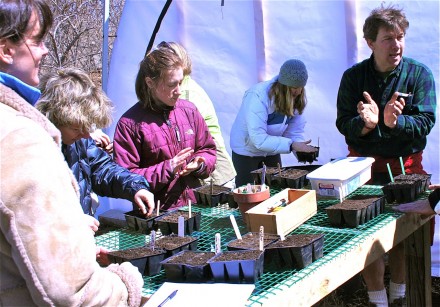
A dozen people gathered in the cold sunlight at Holly Hill Farm in Cohasset last Saturday for an organic gardening workshop. Happily, it was also opening day for the summer farm stand. And, although there wasn’t much for sale yet, what there was, was great: leeks, sunchokes, and spinach.
I jumped at the chance to buy a bag of spinach after picking a leaf in one of the greenhouses. The plants had been planted in the fall, gone dormant in the winter, and begun growing again in the warmth of the spring greenhouse [below]. It shocked me, that spinach. It was very sweet with a lemony flavor and tender body.
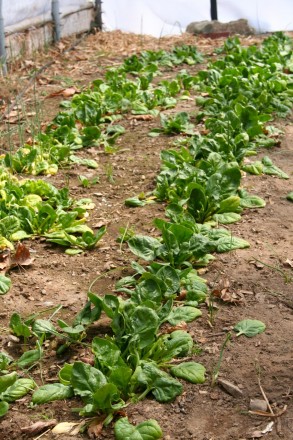
At home, after the workshop, I immediately made a spinach salad. I had expected to give it a quick sauté for dinner, but this spinach was too fresh and vital to touch with any kind of heat.
Holly Hill is both a for-profit organic farm and a non-profit educational organization. The workshop was led by the organization’s director of education, Jon Belber [above], who was wearing shorts while almost everyone else was cold.
Some of the participants were veteran gardeners, a few total newcomers. In the course of two hours, Belber gave an overview of the tasks involved with growing vegetables: preparing soil, composting, growing seedlings indoors or sowing seeds directly into the ground, crop rotation, deep root watering, and fertilizers. All the while, he and farm Director Cindy Prentice talked about the health benefits of organic gardening.
“The environment’s going to thank you [for gardening organically], future generations are going to thank you, things you can’t see are going to thank you,” said Belber.
A blue-tinged celery plant standing in a saucer of water with blue food coloring gave workshop participants a striking example of how plants incorporate toxins from the water and soil around them.
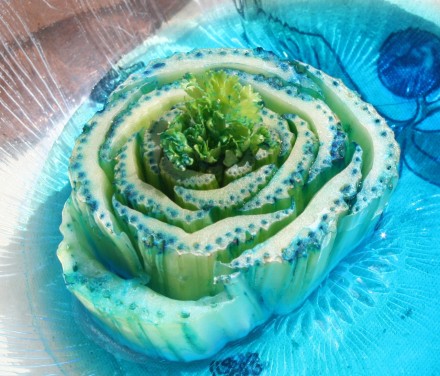
Celery is considered the most vulnerable vegetable to pesticides and synthetic fertilizers. Some plants are better able to resist incorporating chemicals in their tissue than others. It was good to be reminded, at the workshop, that this information is out there in the form of lists — the Dirty Dozen and the Clean 15. (The two lists are available as a free iPhone app; just search for “dirty dozen.”)
Belber, who has won awards for his gardening with area school children, is passionate about the farm and its produce. He talks about and treats the plants with tenderness.
As he juggles speaking to the group and sifting compost or filling a six-pack with soil, he unconsciously picks off tiny twigs with the practiced touch of a parent gently straightening a child’s hair. When he hands out red Russian kale seeds or the feather-light slivers that are lettuce seeds, he carries them with great care.
Often Belber teaches what the plants need by comparing them to children or people.
Explaining how to harden off seedlings raised inside, he says to cover them when it’s cold, uncover them during warmer days, or bring them inside at night. Entering a greenhouse filled with the farm’s earliest seedlings, he points out that the wood stove has to burn around the clock to keep the baby plants warm enough to survive.
“We look at the wind and temperature… when we’re cold, we put on a coat,” said Belber.
Belber’s teaching is powerful not only because of his knowledge, but because he embodies a reverence for the farm that is palpable.
“You can see why people think of gardening as spiritual,” whispered one pretty blond workshop participant as we stood over a sea of seedlings.
For those who want to keep things simple, peas, spinach, and kale seeds are hardy enough to be planted directly in the ground now. In a couple weeks (mid to late April) lettuce and beets should be good to go. And, in late May, when it’s warm enough for everything to be planted, people can buy seedlings at the farm’s annual plant sale.
Belber will be at the sale: he’ll be the guy wearing shorts.
“Yup, I took them out on the first day of spring,” said Belber. “That’s it, I’ll be wearing them until November.”
For more information on all farm activities, including the next gardening workshop on April 30, visit http://www.hollyhillfarm.org or just stop by the farm at 236 Jerusalem Rd., Cohasset: everyone’s always welcome.
Follow Joan Wilder on Twitter.
]]> If Josie the cow cared, she could lift her big speckled head and see Patriots fans, tiny as ants, in the top tiers of Gillette Stadium. But the pretty speckled milk cow only has eyes for the grass.
And I only have eyes for the raw milk and cheeses that Terri Lawton – a tenth generation farmer – produces from Josie and the rest of her herd of about 24 grass-fed Ayrshire cows at the Lawton Family Farm in Foxborough.
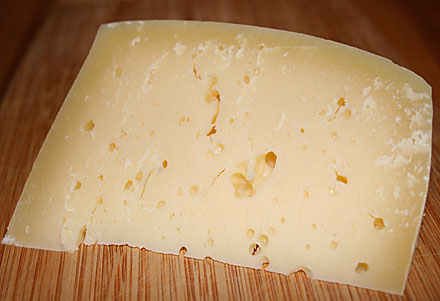
Lawton and her crew make two types of cheese. One is a raw Asiago-style, and the other a soft, creamy fromage blanc that comes plain or flavored with chives, lemon honey, and tomato basil.
It’s not that surprising that Lawton could come up with two such successful cheeses (her lemon honey fromage blanc took the silver at the Eastern States Exposition in ‘09) after being in the cheese-making business less than two years. Not when you consider her pedigree.
After growing up on the farm that has been in her family since 1732, she graduated from Purdue University in 2002 with a double major in agribusiness and agricultural communications. Following college, she spent a couple years as a dairy inspector for the Massachusetts Department of Agriculture, and a couple more working with kids. Then, in 2006, it came to her.
“I loved cows and I wanted to work with them,” said Lawton.
But being well-educated on farming — in school, life, and on the job (she’d visit more than 100 farms as a dairy inspector) — she knew she had to find a way out of the “economic slavery” that the expectation of cheap food and government subsidies force on farmers.
“I didn’t want to be a price taker,” said Lawton. “If it cost 2x to make, I didn’t want to have to sell it for 1x. Selling raw milk — then the cheese, was a way around that.”
In Massachusetts, it’s legal to sell raw milk only at certified farms where it’s produced.
But Lawton’s milk and Asiago cheese aren’t outstanding just because they’re delicious and raw (the fromage blanc is heated and thus not raw), but because they’re made from the milk of grass-fed cows free of antibiotics and growth hormones.
A growing number of studies show that milk and meat from cows raised on a diet of grass is rich in a number of super health-giving substances, including CLA (conjugated linoleic acid), beta-carotene, Vitamin E, and Omega-3 essential fatty acids.
Lawton wants her customers to know what they’re getting and holds orientations three mornings a week. At one session last week, mother and daughter Michelle and Krystn Gustafson wanted to know what was different about raw milk.
“The main difference is it has all the enzymes, lactase being one of them,” said Lawton.
Which is why many people who are lactose-intolerant have no problem with raw milk: Lactase is the enzyme that breaks down lactose, or milk sugar, into something digestible.
Pasteurization (which heats milk to high temperatures) kills any harmful bacteria that could grow in milk that was handled carelessly and often comes from sickly cows treated and fed poorly. Unfortunately, it also kills many of the co-occurring nutrients that make it so good for people.
Lawton takes safety seriously. Her certified milking operation – and milk – is inspected monthly by the Department of Agriculture. And she’s well-educated on keeping her herd healthy and running a highly sanitary operation. She milks twice a day, and the white liquid goes directly from her cows into refrigerated vats.
“I’m okay with the regulations – it’s good to hold people accountable,” said Lawton.
Lawton and cheese maker Melissa Gagne make about 100 pounds of cheese each week, with the help of Terri’s parents, Nancy and Ed Lawton. The cheeses are available in the barn refrigerator. Milk, however, has to be ordered a day ahead. The old barn store also sells some frozen grass-fed beef and veal (when it’s available), locally made hot dogs from her meat, organ meats, and bones for stock.
I’ve been gorging on the milk and the two cheeses for the past week, thrilled to be able to buy such delicious food from a farmer I know.
I’ve mixed the fromage blanc into a plate of linguini with pesto, turning it into a quick and good creamy dish. I’ve spread it on toast and used it like mayonnaise to moisten a sandwich.
It doesn’t take any imagination to eat the Asiago: just bite into a hunk [at left]. I’ve also grated it on pasta. Delicious, satisfying, proteinous, and filling.
I know science continuously changes its findings, but I believe the studies that show grass-fed, raw milk products to be extremely nutritious – reversing the common belief that whole milk and cheese harden the arteries. They’re whole, natural foods from healthy animals that get to eat grass the way cows have always done – and that seems right to me.
I’m grateful to the Lawtons for doing what they do — theirs is the last dairy farm in Norfolk County — and the only nearby place I know of where I can buy raw milk.
And much appreciation to Josie!
Prices range from $3 for a half-gallon of milk to $8 for 8 ounces of fromage blanc. Foxboro Cheese Co. at Lawton Family Farm, 70 North St., Foxborough. For information on other places to purchase the cheese, call 508-543-6460. www.lawtonsfamilyfarm.com.
]]>But Beaulieu is a local man — from Fairhaven — a livestock and produce farmer who calls his cattle by name and says that when he does, they come.
And I believe that because when he speaks, I trust him.
If you’re trying to find good meat in today’s factory-farm-dominated marketplace, your best bet is to find a farmer you trust who raised the animals you’re eating.
Forget most of the buzzwords, they’re not going to steer you right.
Organic? It doesn’t mean much in reference to meat — certification is too complicated and costly for most small family farms.
Free-range? Not so helpful either: Factory chickens raised in football field-sized quarters can be labeled free-range if there’s a single small yard off the vast building they’re packed into. Even the important terms pasture- and grass-fed can be misleading since meat from animals designated as grass-fed can be fed grass most of their lives then stuffed with grains for the last few months to fatten them up.
Best, then, to find farms and farmers you can visit, talk to, name, call, or otherwise reach.
Which is exactly what motivated about 70 people to brave the heat of an old meeting hall in Kingston late last month to hear from several speakers, including four area livestock farmers.
“Local Meat: Benefits, Choices, Challenges, and Cooking” was the sixth in a series of programs on the phenomenon of eating locally sponsored by edible South Shore magazine and the Kingston Public Library. The series has been so popular it has outgrown the library and moved to the larger Beal Building.
The gathering felt a bit like an underground group of black marketeers organizing the procurement of an illegal substance. But meat from humanely raised, locally grown, well-fed animals isn’t illegal, of course; it’s just hard to find anymore.
A bit of background: Cows are ruminants and have evolved to eat a diet of at least 90 percent grass and a little grain. Factory farms, where most of our meat has been raised since the ‘60s, reverse that equation, feeding cattle about 90 percent grain, corn mostly, which makes them both fat (the goal for big business) and often sick, requiring that they be treated with antibiotics.
A growing number of studies show that the meat from cattle raised on a natural, predominantly grass diet is high in a number of very nutritious substances, including beta-carotene, vitamin E, and omega-3 essential fatty acids. Because of all this (and much, much more), a growing number of people want to support and eat meat from local farms.
Beaulieu’s operation is small — he raises about 40 animals at a time on his 27 acres, but not as small as Patrick Roll’s 5-acre West Elm Farm in Pembroke, where he raises rabbit, chicken, and lamb.
All the farmers who addressed the crowd raise their animals without the use of antibiotics or growth hormones in free-range or other comfortable, natural environments.
“Our pigs are doing what pigs should be doing, they’re sniffling around in the woods, eating chestnuts and acorns,” said Meaghan Swetish, who lives in Scituate but works with her father and brother who run Brown Boar Farm in Wells, Vt.
Like the vast majority of small farmers today, Swetish uses e-mail to take orders from people for Brown Boar Farm’s once-monthly delivery to Cohasset. And, like most local farmers, Swetish sells her pork and beef at farmers markets (in Vermont).
I was amazed at the crowd. They were a group who, for the most part, consume meat differently than main stream America has for the past 50 years – preferring to eat smaller amounts but of the highest quality.
I admired their knowledge and will to question issues surrounding even the hardest challenges to local livestock farmers — including the dearth of small-scale, humane, regional slaughterhouses in New England. Most farmers drive their animals an hour or more when the time has come.
“I spend half my life in my truck,” said Beaulieu, who takes a couple cows at a time to slaughter.
Experts say that transporting animals with others they know greatly relieves their stress. As does a nice holding pen, with water and food, upon arrival at the slaughterhouse.
Many say animals are adaptable and very in the moment. So humane slaughter is paramount. Slaughter isn’t just slaughter: It can be accomplished with minimum pain – or not.
“We go to Eagle Bridge slaughter house in New York,” said Swetish. “It’s a humane slaughter house and it makes a big difference to the animals and to the taste of the meat.”
Funny?
Not really.
Hard to think about?
Definitely.
Yet even if you’re a vegetarian who eats dairy, your dollars are going to support factory farming — unless you buy products from animals raised, and milked, on smaller family-run farms.
It’s up to you.
For more information on local farmers and farming see:
www.ediblecommunities.com/southshore;
Plato’s Harvest, Middleborough, http://platosharvest.wordpress.com; Brown Board Farm, Wells, Vt., http://brownboarfarm.com; West Elm Farm, Pembroke, http://www.westelmfarm.com; or contact Joe Beaulieu at J. H. Beaulieu Livestock and Produce Farm, Fairhaven, at allnaturalbeef@comcast.net.
Recent news that some of Whole Foods frozen vegetables are grown in China (though clearly labeled as such) has highlighted the problem. And the loop-holey laws regulating which products can be designated as organic only makes matters worse.
Further exacerbating the issue are big problems in our factory farms and food distribution chains, tight budgets, and the overwhelming volume of information required to spend your food dollars wisely.
That’s a lot to contemplate before you even reach over your cereal bowl for a banana (or not!).
But, consider this: organic can be as simple as sowing a seed in soil and growing a plant: as simple as buying some produce from the farm where it’s grown.
Cohasset’s Holly Hill Farm is a good place to see how to raise fruits and vegetables without the use of pesticides. It’s a good place to demystify your conception of organic and bring it on home – a good place to buy organically grown broccoli or carrots, potatoes or kale. In fact, as a thriving for-profit organic farm with a non-profit educational component open to the public from dawn to dusk, it’s a local treasure.
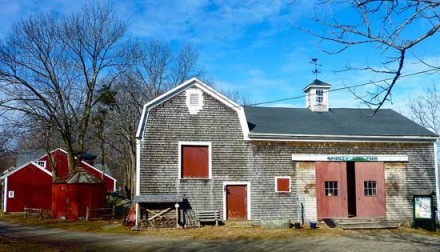
The old barnyard looks much the same as it must have 100 or even 200 years ago. Two dogs run free, a cat sidles around, and old structures — patched together with the make-do methods of farmers everywhere (like the greenhouse door shown here) – hold a busy farmful of chickens, goats, horses, and rabbits.
 The seasonal farm stand, with its honor-system cash box, is housed in the old barn, circa 1785. And the fields and woods, salt marshes and cart paths bear the echo of the generations who have walked and worked this land unchanged.
Today, however, there are computers with information-rich Internet connections on office desks in the old farmhouse. And tractors. And such paradoxically high-tech, low-tech materials as plastic, from which inexpensive greenhouses can be built, and gardening fabric that extends growing seasons by keeping plants warm.
“Organic farming is a lot more knowledge-based today,” said Ben Wolbach, who manages Holly Hill with his wife, Hannah.
Just listening to the Wolbachs talk, you hear the fundamentals: crop rotation, succession planting, composting, using pulverized sea creatures or particular bacteria to deter or kill pests. And the work, the hours, the love that goes into the growing.
“The biggest thing is observation,” said Ben. “We’re in our fields every day.”
Every day from March until December, that is. Still, the farm staff is plenty busy in winter, too, planning the season.
This week, the farmers will light the old wood stove in their big greenhouse and start planting the year’s seedlings. Once that starts, they have to keep the fire burning around the clock until the vegetables can be planted in the fields.
“It’s like having a baby to care for, we can’t go out without planning,” said Ben.
The actual fruits of the farmers’ work are sold in season at the farm daily and at the Cohasset Farmers market.
The intellectual fruit, the knowledge, is an open book to hundreds of area students who use the farm as a classroom each year through the farm’s educational program. Holly Hill’s award-winning farmer-teacher, Jon Belber, has extended the farm’s reach by building gardens at schools in Scituate, Cohasset, and Hingham. Planting and growing, little kids become interested in vegetables they might not otherwise consider.
“When they’ve grown it, they’ll often eat it,” said Belber.
And, eating is, of course, at the root of it all.
“Ben and I don’t buy vegetables,” said Hannah, who keeps a freezer full and extends the season by growing greens in the greenhouses.
I visited the farm twice late last month. I went back a second time because I couldn’t quite believe what I’d seen the first: a row of spinach plants (below) in the ground in an unheated greenhouse, growing in February.

Holly Hill is in the unlikeliest of places for a farm – Jerusalem Road, renowned for its strip of oceanside mansions. The land has been passed down through five generations of the White family, who saved it from development through a conservation restriction.
In 1998, Jean and Frank White moved in full-time and started up the farm’s current incarnation as a commercial farming and educational enterprise.
After a brief illness, Frank passed on in September. Jean is very active with both farming and administrative tasks. She writes a beautiful column in the farm’s newsletter and knows a thing or two about cooking vegetables. A new director, Cindy Prentice, has stepped in to help carry Frank’s vision for the farm forward.
Of Holly Hill’s 140 acres, 10 are growing fields, 10 have structures, and 120 are forest, salt marsh, ponds, and streams. The land, saved forever as the Cornelia and Richardson White Woods, is open to visitors from 7 a.m. to 7 p.m., daily.
236 Jerusalem Rd. Cohasset, MA 02025; www.hollyhillfarm.org
Did you hear about the oysters from Duxbury who grew up to be beer?
True story.
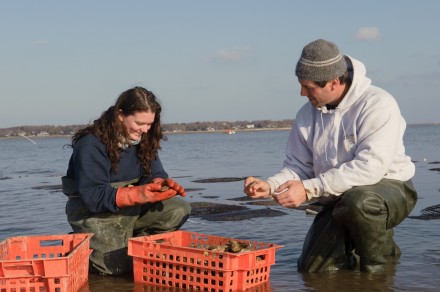
One hundred and eighty bivalves, reared from tiny “seeds” in Duxbury Bay, were harvested on Jan. 21 and driven to the Harpoon Brewery in Boston’s Seaport district.
By all accounts, Tame succeeded with Harpoon’s 100 Barrel Series Island Creek Oyster Stout, bottled on Feb. 5.
Using oysters to make stout is not unheard-of, but it is rare. The idea for an Island Creek Oyster-Harpoon offering wafted into the stratosphere out of the relationship between Bennett, a couple other Island Creek farmers, and a group of brewers from Harpoon.
On occasion, the group gets together to shoot the breeze, drink stout, and eat oysters. And, well, you can imagine the ideas that come from that.
“We fell in love with stout as going really well with oysters,” said Bennett.
“As a style of beer, oyster stout can have oysters put in during the brewing process or it might just be brewed to pair nicely with oysters,” said Tame, who spent several months in the late summer and fall making 10-gallon test batches to develop her recipe.
“It’s a unique beer, there’s definitely nothing like it out there on the market right now,” she said.
 The local, artisanal nature of Bennett’s oyster farming and Harpoon’s small brewery make this joint venture, limited-edition oyster stout an especially sweet Boston-area offering.
Bennett starts his oysters every May from teeny oysters (500,000 to a pound), called seeds, that are placed on fine screens in tanks attached to a dock. After about six weeks, when they’re nearly half an inch, they’re moved into mesh bags that are held on wire shelves in wire boxes placed on the floor of the bay. When the tide is low, the boxes are exposed to the air, and the farmers can scrub the bags of oysters to keep the growing bivalves clean.
Six to eight weeks later, by the end of August, when they’ve grown to an inch or more, they’re put directly on the bottom of the bay where they grow for at least another year.
“We call them free-range oysters at that point,” Bennett joked. Today, Island Creek Oyster has about 30 farmers with leases in the bay for a total cultivated area of 50 acres out of the bay’s 10,000.
Although the same species of oyster is used from Nova Scotia to the Gulf of Mexico, each area’s oysters are unique. Just as wines take their characteristics from such environmental factors as soil, sunlight, and humidity, oysters take theirs from salinity, minerality, water temperature, depth, and the local algae they feed on.
Beer depends on a similar (though man-made) alchemy of particular malts, hops, and other ingredients added during the brewing process.
In the first stage of the process, crushed malts are steeped in water to produce sugars. “I tried to choose malts that would complement a briny salty character and not overpower it,” said Tame, whose recipe included chocolate rye malt, black malt, and roasted barley.
After the malts have done their thing, the solids are removed and the liquid is transferred to a kettle for the next stage of the process, known as the boil. Hops are added during the boil — at various precise moments in the hour-long procedure — to produce desire aromas and flavors. The oyster bodies were added half way through the boil.
“The oyster protein dispersed in the beer and that protein enriches mouth feel and body, and helps promote head retention” as well as overall flavor, said Tame.
And just what is the flavor and aroma of this winter’s Harpoon 100 Barrel Island Creek Oyster Stout?
“It has roasted notes, with chocolate, caramel…a biscuity flavor. It has a smooth mouth feel and I’d say it’s lighter than I expected,” said Tame. “It’s extremely tasty.”
The Harpoon 100 Barrel Series Island Creek Oyster Stout is widely available at package stores that carry specialty craft beer products. Typically, Harpoon’s 100 Barrel series beers last about three months on the market before they run out.
Follow Joan Wilder on Twitter.
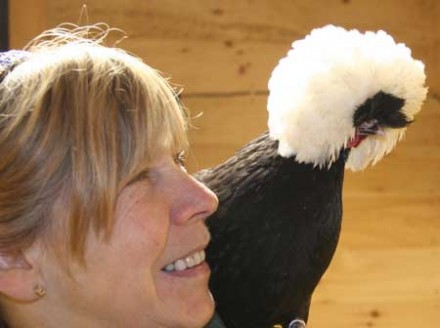
My neighbor (two-houses-over) says she hates my other (three-houses-over) neighbor’s rooster, but I don’t thinks she really does.
I’ve been asking around for the past week to see if keeping chickens is becoming as popular here as it is in other suburban parts of the country, and I’d say the answer to that is a resounding yes.
Just a few inquires have led to my connecting with, or hearing about, at least a dozen area chicken keepers. The most surprising thing is that all of them, except one man, said they loved their chickens like pets: pets that turn kitchen scraps into delicious eggs.
And while chicken owners gush about what they love about keeping chickens, they also want people to understand the commitment and work involved. Chickens live about 10 years – some even longer – so chicken keepers warn against getting a few chicks in the spring (Scituate’s Fitts Mill has them) without thinking it through.
“It’s like a marriage or getting a dog, you have to make sure you’re going to keep them,” said Norwell’s Candy Clark, who has about 50 chickens.
And there is the problem of the poor roosters, who sometimes bother neighbors with their crowing. Most people report solving that issue, though, by keeping them inside their coops until a decent hour of the morning.
Letting chickens out in the morning and putting them inside their coops at night are among the daily roster of chores that chicken keeping requires. Feeding is daily, too, of course: most people use chicken feed and kitchen scraps. And, depending on your coop arrangement (a friend of a friend moves his coop around his yard so the manure can fertilize his lawn), and how particular you are, you have to clean the coop periodically.
Then, too, no matter how simply or elaborately you house your flock — Hingham’s Bill Marshall is keeping his new birds in his greenhouse for now – it’s essential to protect them from predators, from above and below.
Most people have their coop attached to an outside run that has to be covered with, you guessed it, chicken wire or netting. And, to prevent raccoons, possums, skunk, and other woodland creatures from burrowing under your coop, it’s best to install more wire deep into the ground along its foundation.
And what you get from all this are very fresh, cruelty-free eggs — a phenomenally healthy food that is a complete protein. You also get a great source of garden manure that feeds your vegetables.
But those are just the tangible benefits.
Talking with people who have chickens, it’s clear that the intangibles are at least as important to chicken keepers.
“We just love chickens, they’re wonderful little animals, loyal and friendly. It’s not cost-effective, you just have to enjoy it,” said Clark, who still misses one of her favorite chickens, who died in 2001.
“She followed me everywhere and did tricks.”
But it isn’t just their pet qualities that make chickens so popular. Part of what people seem to love about them stems from a reassuring sense of inclusion in a cycle of life that living with chickens imparts. Keepers see their edible kitchen waste turned into eggs they can eat, and compost that feeds their garden vegetables, by these happy little creatures that demand very little.
The following is an inexact recipe (play with amounts) for a very easy egg dish that Clark makes Christmas mornings. The whole thing can be assembled in a baking dish the night before then cooked in the morning. It’s a strata – a kind of very delicious crustless quiche with bread in it, although Clark doesn’t call it that.
1-2 lbs. sausage, preferably pork
6-8 slices of bread, torn
8-10 eggs
about 3/4 c. milk
about 1/4 teaspoon dry mustard
about 1-2 cups grated cheddar cheese
salt and pepper to taste
- Saute sausage and drain it
- Lightly spray a 13 x 9 casserole pan
- Line the pan with the bread
- Sprinkle sausage on top of the bread
- Beat eggs with milk, salt, pepper, and mustard
- Pour the egg mixture over bread and sausage
- Top with shredded cheese
Clark assembles the whole dish the night before Christmas, covers it with plastic wrap, and refrigerates it. In the morning, she preheats the oven to 350, and bakes for about 45 minutes.
]]>