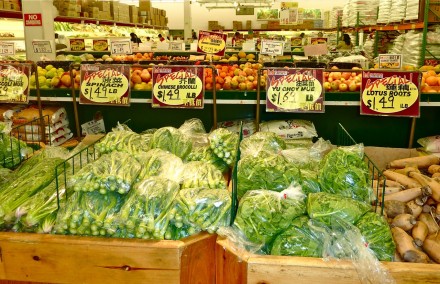
 So many cuisines, so many foods unique to each, so many items labeled with words I can’t read!
Few places are more packed with these mysteries than Quincy’s Kam Man – probably the most extensive Asian market in New England.
“It’s the largest in Boston, and Boston’s the largest city in New England, so I’m pretty confident it’s the largest in New England,” said Quincy resident Wan Wu, 64, Kam Man’s general manager and part-owner.
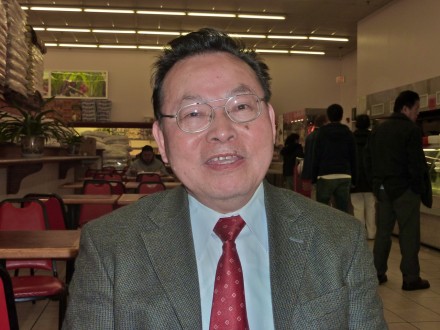
The supermarket is one of four Kam Man stores in the little dynasty founded in 1971 by Wan’s brother, Wellman Wu, in Manhattan. That first store – Kam Man Food Products — is still there on Canal Street in the heart of New York’s Chinatown.
There are also two Kam Mans in New Jersey, where Wellman lives. Additionally, a new Kam Man will open in Queens, N.Y., in about six months, and the brothers have just bought Super 88 Asian market in Dorchester, which will be their sixth Kam Man.
And, although the labels and the ingredients may need translation, taste transcends all: you don’t need words to know that something’s delicious.
Kam Man’s hot prepared foods section is a good way to dip into some of the mostly Cantonese-style dishes its chef makes daily. The foods are served cafeteria style: you get your choice of three main courses from an array of dishes – along with rice and a cup of light soup — for $7.50. “Heads on?” said the woman behind the hot bar when I was choosing my lunch a few weeks ago. She was referring to little, deep-fried fish – sardines I think — and although her English was limited, she wanted to make sure I knew what I was getting.
Along with the hot foods is a barbeque section with delicious ribs, ducks, and even whole pigs.
Most of Kam Man’s 80 full-time and 30 part-time Quincy employees don’t speak much English – which makes it almost impossible for English speakers to learn about items while shopping.
Wan understands this, and is hoping to implement something to help the store’s non-Asian shoppers become more familiar with the cuisine. “We’re thinking of starting a store tour on a regular basis… or a brochure or handout,” he said.
 Among the tens of thousands of grocery items in the store (including an enormous collection of Asian beers), approximately 50 percent are Chinese and the rest a mix of Vietnamese, Filipino, Thai, Japanese, and a smattering of other international foods, including American. (That doesn’t mean the products all originate in those countries: almost everything in the fabulous fresh produce section, for instance, is domestic.)
Wan estimates that 80 percent of the Quincy store’s customers are Asian, the vast majority of whom are Chinese. The remaining 20 percent are largely Caucasian.
“According to the latest census, 24 percent of Quincy’s population is Asian and of that 24 percent, 13 percent are Chinese,” said Wan.
The Wu brothers were born in Shanghai and moved to Hong Kong with their family when Wan was 10, and his brother 14. Wan came to the U.S. in 1966 where he earned a bachelor’s degree from the University of Rhode Island and a Ph.D. in chemical engineering from Lehigh University. Wellman followed his brother a few years later, forgoing schooling and diving right into business.
“He’s the entrepreneur,” said Wan, who was a research scientist at Monsanto in Springfield for 25 years before joining his brother in business for the opening of the Quincy store in 2003.
The site, a former Bradlee’s, is a small indoor mall with about 15 independent Asian storefronts (a ginseng shop, a Vietnamese deli, a travel agent, a clothing store) situated between Kam Man’s two big parts: its enormous grocery and its large home goods store. Together the two parts comprise about 60,000 square feet.
The housewares department reminds me of an old American five and dime — like a Woolworth’s — with a little bit of everything: cookware, dishes, cosmetics, hardware, clothing, shoes, electronics, furniture, bamboo plants, guitars, and much more. It’s a really fun place to wander.
The space is being renovated now, and by mid-summer the grocery and housewares will be connected, with the independent stores remaining.
And, what does Kam Man mean? “Kam” is Chinese for golden and “man” means gate, but Wan thinks the original Manhattan store was named after the small island of Kam Man, off mainland China. The island was, according to Wan, the site of the only battle the Chinese nationalists won in the civil war with the Chinese Communists in the late ‘40s.
“It’s quite well known,” said Wan.
Follow Joan Wilder on Twitter.
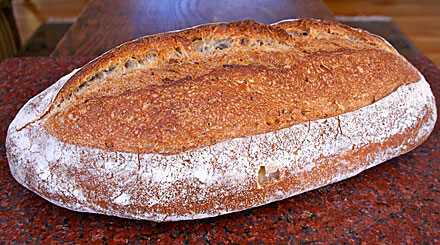
A remarkable old world bread bakery opened on the South Shore a couple months ago and I don’t know which is more amazing – the bread or the oven where it’s baked.
Peter Nyberg’s new wood-fired stone oven in Plymouth is a custom, 60-ton version of the wood-fired stone ovens that have become so popular (mostly for pizza making) in recent years.
But, Nyberg isn’t making pizza.
His Hearth bakery is turning out more than 1,000 loaves of a naturally leavened Country French bread daily – the way it was done centuries ago.
The operation and scale of the oven are hard to grasp.
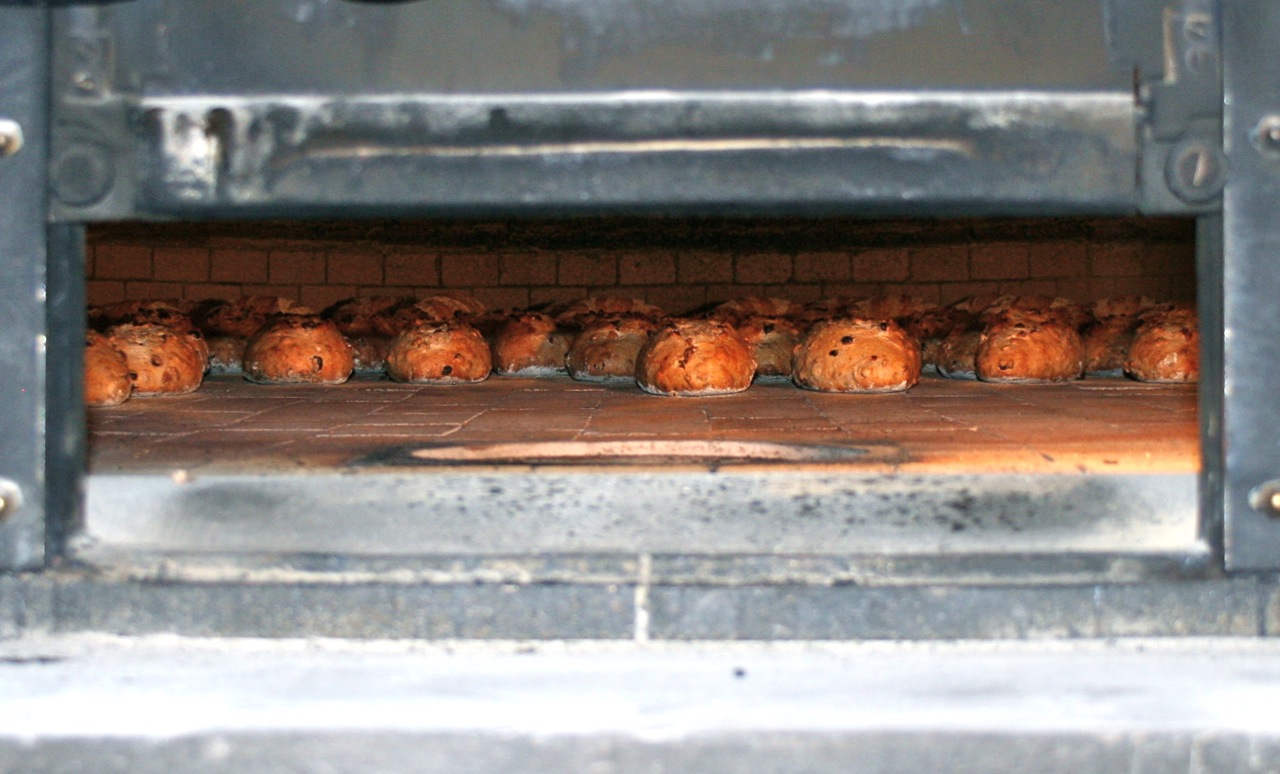 Its interior, cave-like baking chamber is about 12 feet in diameter and can accommodate more than 100 loaves.
An oven-full bakes in about 18-20 minutes at a temperature of 460-490 degrees, one batch after another. It takes one baker about the same amount of time to load a batch of uncooked loaves onto a very long wooden peel, slash their tops, and slide them into the hot cave. And to remove them? That’s faster: maybe eight backbreaking minutes of pulling the (pound and a half) loaves onto the peel and sliding them out of the oven and onto a beautiful wooden rack.
Meanwhile, Nyberg stone grinds his custom blend of mostly organic, heritage grains, mixes, proofs, hand-weighs, and forms doughs in synchronized time, batch after batch.
“We can produce over 2,000 pounds a day, that’s a decent capacity,” said Nyberg, who employs a second full-time baker.
The operation is a unique study in simplicity and precision.
 Nearly every tool and piece of equipment in the bakery – and every procedure — has been custom designed to move an exact volume of dough (enough for one oven’s worth of loaves) through the stages of bread making.
“We’ve finally got it down to a science,” said Nyberg, who broke ground on the mammoth oven in June and baked his first loaf in October.
Every day, sometime around 10 a.m., after a night of baking, Nyberg starts a big wood fire on the floor of the oven. It burns until late afternoon, at which point the embers are spread out, allowing the heat to soak into the oven’s enormous thermal mass. Around 8 p.m., a second fire is built in a firebox chamber beneath the floor of the oven that will be maintained throughout the cooking hours. At midnight, the oven floor is swept clean of its embers, and baking begins.
Nyberg, 41, has been taken with bread baking for more than 20 years. He’s baked at numerous restaurants and bakeries, worked as a consultant, and is an adjunct baking instructor in the College of Culinary Arts at Johnson & Wales University. When he began toying with the idea of opening a bakery last year, he knew what he was after.
“I wanted simplicity and as few mechanicals as possible,” said Nyberg, who has replaced automated techniques (like proof retarders, baguette molders, and bread dividers) with elegantly conceived procedures designed to streamline handmade bread baking.
Eschewing such techniques in favor of small batch baking allows for the daily grinding of heritage grains; long fermentation times; and the use of natural leavening. These processes, and the high heat of the wood-fired oven, result in an alchemy that allows the grains to retain their nutritional values and flavor.
 I visited Nyberg at 7 a.m., on Christmas Eve day, toward the end of a long night of baking.
We talked as he took a batch of loaves out of the oven; put water into an iron bucket that fits into a hole on the oven floor; and loaded up another hundred doughs.
“Feel that? Feel the humidity?” he said, inviting me to touch the wooden handle of the 15-foot bakers peel he’d just pulled from the oven.
And I do, I feel that it’s moist.
Although Nyberg’s main focus is making his Country French bread, customers have convinced him to produce others, so he’s now also making a lovely rosemary loaf and a fruit and nut on Fridays and Saturdays.
 And, I like both those loaves, but I love the Country French. It’s an uncommon bread and satisfies in an uncommon way – almost as though it were a different food than bread. And I don’t mean that it’s heavy, it’s not. It’s actually light, with a very airy, moist crumb, and a crust that bites back: a crust that demands respect! After eating it for a week, other breads began to seem lightweight and lacking to me.
The bakery, which is open everyday for sales, also delivers daily to several South Shore stores, including Hingham’s Fruit Center. Call to see if there’s one near you.
Hearth Wood Fired Bread bakery is open for retail sales Monday through Saturday, 9 a.m. to 6 p.m., and Sundays, 10 a.m. to 3 p.m. The country French is $4.25. 123-2 Camelot Drive, Plymouth, 774-773-9388. www.hearthwfb.com
]]>
Although Boston can feel far from the beaches and woods of the South Shore, in truth it’s close – it’s our city — and its cultural richness flavors our lives.
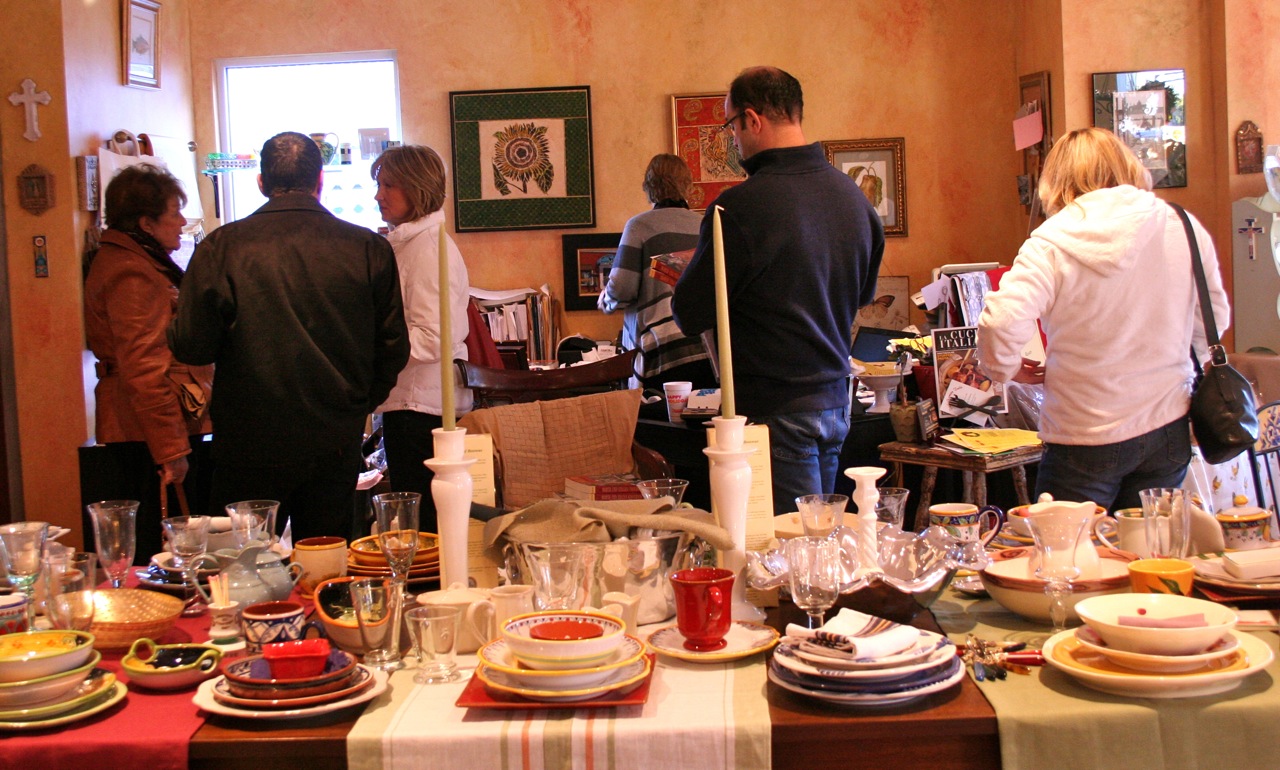
An emissary from the culinary Mecca of the city — the North End — on Sunday visited Scituate’s Roman Table, where a crowd lined up to buy her classic “The North End Italian Cookbook.” The event was one of many food-based gatherings that Roman Table owner Cynthia Gallo Casey of Norwell has hosted since opening her specialty foods and tableware shop in June.
“I love this cookbook,” said Bea Green of Scituate to author and cooking teacher Marguerite DiMino Buonopane. “I have to tell you, I learned to cook from my mother, but she didn’t write anything down. I found half her recipes in your book.”
Green’s experience reflects that of many others whose parents or relatives from Italy created dishes from memory. Cooks that can’t tell you how many cups of x, y, or z they used; how many minutes they sautéed or braised this or that: how long into a process they added additional ingredients. Cooks that cook by feel and smell and sight.
 Others at Sunday’s event had similar stories, including Buonopane. Her cookbook consists of the recipes she learned from her mother, as well as many she developed herself over a lifetime of cooking at home in the North End. In order to capture and record each of her mother’s recipes, she had to hover over her while she cooked, watching every move she made.
“ ‘All right, Ma,’ I’d say,” Buonopane told the crowd. “‘Don’t do a thing without telling me what you’re doing. How high is the temperature? How long do you cook it?’ Then, I’d see her covering a pot without mentioning it! How did I know – do I put the cover on, do I take it off? And I’d tell her again, ‘Don’t do anything without telling me!’”
When I opened Buonopane’s cookbook, I immediately found several of my mother’s recipes (beans and potatoes; braciole just like she made it; dandelion greens; steamed stuffed artichokes). Now, what’s interesting about this is that my mother’s family comes from Calabria in Southern Italy, whereas the family of Buonopane’s mother, and her cooking tradition, comes from Rome. And Green told me that she thinks the recipes in Buonopane’s book are largely Sicilian, where her family is from.
So, this is what I’m guessing: That some of Buonopane’s recipes share ingredients and techniques common to poor Italian immigrants to America. The recipes are thus recognizable by the children (or grandchildren) of Italian immigrants as the cuisine of their ancestors’ region. But their unifying similarities actually arise from a use-what-you-have principle that depends largely on less costly ingredients — legumes, small amounts of meat and cheaper cuts, some precious Parmesan, stale bread, and whichever vegetables were available. Food writer Ike DeLorenzo has coined this style The Cuisine of Necessity.
 Buonopane’s recipes include many more sophisticated dishes, but there is a baseline here that’s worth mentioning.
The lifelong North End resident began her journey toward cookbook author by giving cooking classes and holding fund-raising lunches at the former North End Union, a settlement house on Parmenter Street.
Buonopane (whose name literally means good bread in Italian), worked as an administrator at the settlement house for 19 years, staging cooking events in her free time. Eventually, in 1975, her cooking had become so well loved locally, the Globe Pequot Press asked her to write a cookbook. The current version is the fifth revision of that original.
The Roman Table, which opened in June, is a gorgeous shop filled with choice European cooking and tableware, and a collection of high-quality specialty food items, including 30 (mostly olive) oils and balsamic vinegars.
Casey has outfitted the space with a kitchen in the rear and a large wooden tale, making it a wonderful venue for hosting small cooking classes, food tastings, demonstrations, and author events like Buonopane’s.
 I can’t tell whether what I did last weekend was clever or ridiculous.
Inspired (obsessed?) by a recent revelatory and mouthwatering encounter cooking pizza in a friend’s wood-fired brick oven, I got to wondering if pizza could be cooked on a gas grill and come out better than what I can make on a pizza stone in my oven.
Hey, I know that gas grills have nothing of the raw, elemental appeal of a wood-fired brick oven. But I don’t have a brick oven, and I do have a gas grill.
So I went to the wizard — Zee In-tair-net — and read postings from several people who grill pizza on gas grills using a two-part method: They cook one side of the dough on the grill, remove it, and cover the cooked side with the topping. They then grill it again, raw side down.
But, I didn’t want to do it that way.
I wanted to grill a pizza, topping and all, in one maneuver to capture some of the magic that happens inside a brick oven.
Meanwhile, the conviction that I could do this was inflamed by what I’d recently learned about the principles of cooking, specifically, the conduction and radiation of heat, from Alton Brown’s great book, “I’m Just Here for the Food.”
So I understood that bricks in a brick oven absorb the heat the fire emits. They suck up such a tremendous amount of heat, in fact, that it can take hours for an oven to reach the desired temperature (usually around 700 degrees). But, once it reaches the target temperature, the stones act as heat sinks, holding and slowly radiating the heat — even though the front of a wood-fired brick oven is always open. Wouldn’t stones work well for holding a high temperature in a gas grill when the lid has to be lifted?
My first thought was to use a pizza stone in my Weber, but I figured that the stone would get so hot, that the pizza’s bottom would burn before the top could get cooked. I also realized that a single pizza stone wouldn’t be large enough to hold the heat once the lid was lifted.
 What I needed, clearly, was a little heat-absorbing, heat-radiating cave inside my grill.
Back to Google for a tenth search, where I found some real inspiration: a guy who did just what I wanted to do! And, although his grill was bigger and had a few key advantages, it was exciting to see how he’d packed it with firebricks and made a gorgeous pizza in just a few minutes. (Check it out here.)
Never mind that his grill has a burner in the rear that heats the box (thus allowing food to be grilled using the indirect method), his example was enough to keep me going. (Indirect grilling is grilling on a surface without flames directly beneath it.)
Again to the web, where I found that Quincy’s TLC Supply, a masonry yard, had firebricks in stock. The guys there were nice, explained that regular bricks and stone crack under high heat, and sold me 10 firebricks for $17.
At home, I assembled a small cave [at left] inside my Weber using firebricks and a pizza stone, and baked a couple 7-inch pizzas. The first was burnt to a crisp when I checked it at after three minutes. The second cooked pretty nicely in 90 seconds, but the oven was too small, so I assembled another.
For this one, I used a metal oven rack to support the top layer of bricks on the next cave [below].

Throughout, I kept notes on temperatures (600 degrees as registered on the Weber’s thermometer); the status of burners on and off; cooking times; and number of lid liftings. I also kept dough weight, size, and toppings the same on seven of the nine pizzas I made.
So, how’d it work?
I couldn’t get a spectacular or consistent result.
Most of the pies came out good [one of the more successful efforts shown here], better than I can make in my oven, but I couldn’t be sure the next one would be the same. And they tended to burn on the bottom before the top could get browned prettily. The best I could do was make a good pizza with a crust that was a tiny bit too tough on the very bottom to be great.
I think that if I had a large gas grill with burners arranged so one side could be turned off and one on (allowing for indirect grilling) I could nail a great pie. I’d build the brick cave on one side; bring the oven to its highest temperature; turn off the burners on the side under the brick cave; and cook the pizza in three to five minutes. (I’d also add a bit of wood to the fire to lend a smoky flavor.)
So.
 I still want a wood-fired brick oven, but don’t want to spend the $3,000, or more, that they cost.
Maybe, I can build one myself with help from edible South Shore Food Editor Paul Marcoux of Plymouth, who made hers for $30 in materials! After this past weekend, I can kind of conceive of it. And, until then, when I really want a pizza, I’ll probably pile the bricks in my Weber and make one.
(For a look at an insane brick oven a guy in California made out of a Weber kettle grill you will never forget, check this out.
And to see the mother of all wood-fired brick ovens, go to Bertucci’s on Derby Street in Hingham or Franklin Street in Braintree. Their ovens are gorgeous and enormous and you can watch pizzas bubble up and cook in minutes.)
]]>