“Doing this, you start to really appreciate what you’re buying and selling and what farmers do to produce their foods,” said Perry. Cushing, a home cook, created the menu with chefs Phillip Caramello and Chris Monteiro, then began the search for local provisions.
Boston Globe photo by John Tlumacki
Free-range chicken, eggs, and grass-fed beef come from Feather Brook Farm in Raynham. Produce, from several places, including Norwell Farms, Lipinski’s Farm in Hanson, Norton’s Second Nature Farm, and Stillman’s Farm in Lunenburg. Cheeses and yogurt come from Narragansett Creamery in Providence. A friend delivers maple syrup from Wheeler Farm, in Wilmington, Vt., lowering the cost of this pricey commodity a bit. Their coffee comes from Hingham’s Redeye Roasters, their milk from Hingham’s Hornstra Farms. And on and on it goes.
THE LOCALE
Because locally sourced, often organically grown, humanely raised food is much more costly than factory-farmed products, farm-to-table restaurants are often either high-end, gorgeously decorated places or rustic spots with crafty, handmade interior design elements. But Cream Etc is a clean, brightly lit, sparsely decorated rectangle, adjacent to Cream ice-cream shop, on Route 18. Walking in off the street, you’d never guess that the eggs you’re about to order are from Arthur Largey, a nearby farmer who, according to Perry, “cares about the animals he’s raising from beginning to end.” Nor would you expect that the lettuce in your salad was picked that morning. Perry and Cushing renovated the space before opening, installing wooden floors, a shiny tin ceiling, subway tile in the open kitchen, and stone in the bathrooms. It’s a great blank slate but lacks atmosphere. If we’re lucky enough to have Cream Etc succeed and stick around, I’m guessing its interior design will evolve.
ON THE MENU
Whether or not you’re interested in where ingredients are sourced, the food we had on two recent visits was very good. The all-day menu has lots of breakfast and lunch choices, so you can have a grilled chicken sandwich at 8 a.m. or pancakes for lunch, if you want.
The home-style dishes are familiar, but sometimes have a twist. Chicken confit hash with poached eggs ($9.95) comes with sautéed green beans as well as the house breakfast potatoes – a combo of white and sweet fried potatoes with onion – fabulous. Some pancakes and waffles can be ordered with a choice of apple and walnut or blueberry compote. The egg white omelet ($8.95) is sided with sautéed veggies or goat cheese, and the Italian eggs Benedict ($9.95) comes with prosciutto, hollandaise, and pesto.
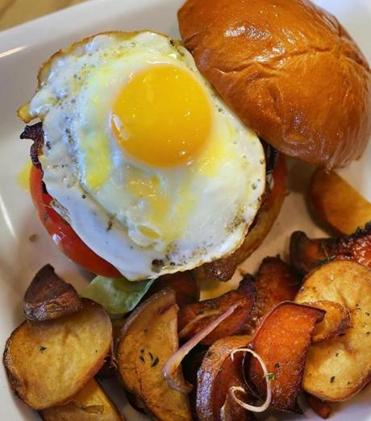
Eggs any style, bacon, breakfast potatoes, and toast ($8.95) is a big plate of delicious. The brioche French toast is divinely served with a little glass pitcher of Vermont maple syrup ($6.95). The decadent breakfast burger ($12.95) is worth every penny: a grass-fed patty (perfectly cooked) is topped with cheese, bacon, and a fried egg that spills its yoke like a sauce at the first bite. It’s sided with tomato (they’re still farm fresh this time of year), Boston lettuce, and the house breakfast potatoes.
I love this place: I hope it makes it.
Cream Etc, 1209 Bedford St. (Route 18), Abington, 781-982-9400
]]>
Say it’s a clear, sunny day.
Or, a cold one with light snow falling.
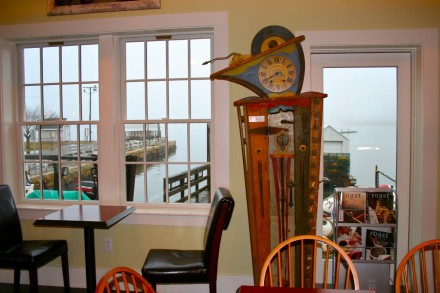
Hey, it could be raining or blowing a gale, it doesn’t matter: The water views from Hingham’s new Redeye Roasters Café & Espresso Lounge are beautiful.
And so is the interior of the cozy new café. The space, which occupies two-thirds of the Bare Cove Marina building, is fitted out with repurposed old wood, pendant lighting, decorative found pieces, and giant burlap bags of coffee. On the far side of the windowed room sits the bright red roasting machine where owner Bob Weeks works his magic — turning what are actually the green seeds of a red fruit into the cherished thing we know as coffee.
The journey that led Weeks to the café, which opened Dec. 3, was a path with heart.
After losing his job at a top Boston ad agency in 2006, the art school graduate decided to focus on what he loved and expand his coffee-roasting hobby into an occupation. Incorporating as Redeye Roasters, he began selling beans to local businesses. A couple years later, he opened a café truck thinking he’d sell to travellers at the Greenbush commuter rail station. When that didn’t fly, (most arrived too late to buy coffee), the vision began to form: Open a real café.
After searching Hingham center and Square for more than a year, Weeks realized what he wanted.
“Everyday I’d pass the Bare Cove building and think, ‘I need to be right there,’” said Weeks. “Finally, one day I stopped at the marina… asked a guy if he knew who owned the place… got Nick Bonn’s name and number…and called him.”
After signing a lease with Bonn, Weeks began to gut the space in June. Much of the cafe, including the bar, was built by folk artist and furniture maker Rich Dunbrack, from Martha’s Vineyard, and captures the magical feeling that Weeks wanted.
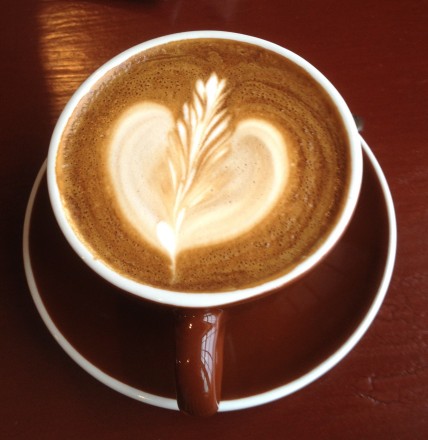
And the coffee? Frankly, I’ve been ruined by Redeye’s crazy good, creamy lattes (made with Hingham’s Hornstra Farms milk) and can’t seem to find a cup as tasty anywhere else. They’re always a bit of a unique event, too, topped with the South Shore’s only “coffee art:” pretty surface designs made by pouring steamed milk carefully over espresso. My other Redeye favorite is the cold-brewed iced coffee, aka a “toddy,” which, until now, were a once weekly summer pleasure procured from Weeks’ café truck at the Hingham Farmers market.
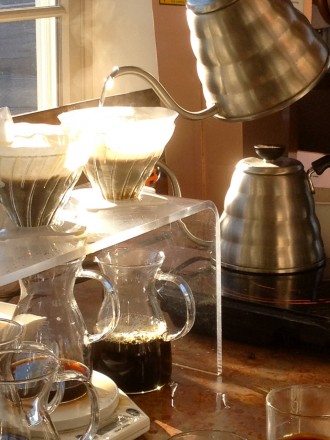
Along with various other espresso and hot drinks – which are all comparable in price to the corporate coffee chains — Redeye’s menu includes several daily brewed coffees; individually prepared filtered coffees called “pour overs;” and French pressed coffees. The café has an evolving pastry case that sometimes includes offerings from local bakers, and great gelatos and sorbet from Cold Fusion Gelato. Redeye also sells Somerville’s fine Mem teas, served in little porcelain pots, and a choice selection of cold drinks.
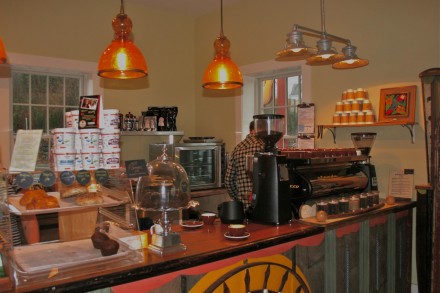
A self-admitted coffee geek, Weeks talks about the characteristics of coffee the way a sommelier talks about wine. He’s passionate about the science of roasting and exacting about extracting the best flavor possible from each particular bean. Some mornings, you’ll see the staff blind tasting a few different brews to see whether Weeks wants to carry them.
But if coffee science is the backbone of a café, its people are the soul, and Weeks has that covered, too. An easy-going guy, he’s assembled a smart, friendly staff that seem to love the place. Their warmth sets the tone for Redeye to be what a great café is: a welcoming place to take a break, shoot the breeze, consider the day, and sip something out of this world. Stepping into Redeye, you can leave your mind behind, come to your senses, and smell the coffee any day of the week — no matter what the weather is.
3 Otis St. (Route 3A), Hingham
Monday through Friday, 6 a.m. to 5 p.m.; Saturday, 7 a.m. to 5 p.m.; Sunday, 8 a.m. to 4 p.m.
781 740-2545
Accessible to the handicapped
Major credit cards accepted
]]>
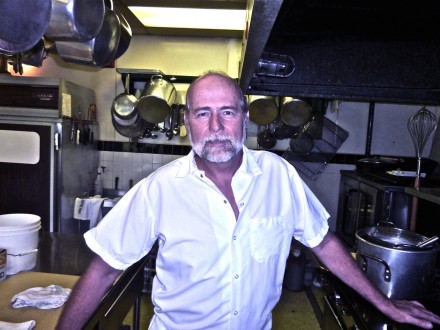
I’m standing in the large kitchen at Hingham’s Glastonbury Abbey talking to its head cook, John Gauley, when Father Tom, one of the monastery’s 12 Benedictine monks, pops in. I’m glad because although I’m here to talk about the food Gauley makes, I don’t know what monks actually do and now I can ask.
Father Tom, who is a priest as well as a monk, has been at the abbey for 42 years, and Gauley, who lives in Cohasset, for 24.
Father Tom explains that among their other duties, the monks gather daily for Vigils at 6:30 a.m., Lauds 75 minutes later, a noon Mass, Vespers at dusk, and evening Compline.
“We spend a long time in prayer,” he says.
“Not long enough,” says Gauley, who has a quip for every word Father Tom utters.
The monk laughs easily, then tells me about the brothers’ three vows: stability, conversion of life, and obedience.
“See, they have to tolerate me, it’s one of their vows,” says Gauley, who considers himself a Pagan.
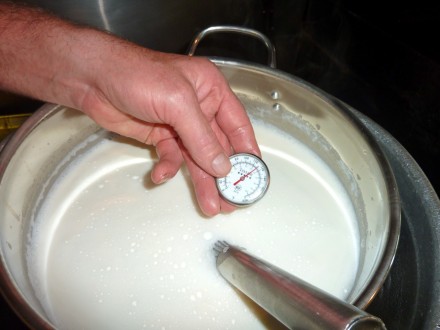
As the cook checks the temperature of a pot of goat milk on the stove (he’s making cheese), I ask Father Tom, out of Gauley’s earshot, how his cooking is.
“Monks from other monasteries want to stay here because of the food,” he answers. “We are very fortunate to have him.”
“Blessed,” corrects Gauley, who, apparently, has very good hearing.
In this case, the cook’s jest hits the mark: I think blessed is the right word.
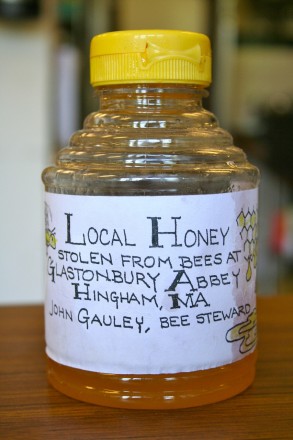
Gauley loves what he does, and goes above and beyond: He bakes fresh bread daily from a sour dough starter he keeps in a bucket in the walk-in (focaccia, oatmeal cranberry, multigrain); has been making his own honey for nearly two decades (300 pounds last year); and has begun, this year, to produce fresh chevre from the milk of the small herd of Nubian goats he began raising two years ago.

In all, there are five buildings on the magnificent 60-plus acre site, including a conference center which hosts hundreds of group meetings throughout the year. Along with the monk’s meals, Gauley, and his assistant, Ben Laney, cook for these events as well.
Not only that, but Gauley donates his time to prepare the Sunday Supper the Abbey provides for anyone needing a meal on the last Sunday of the month. Gauley also cooks a main course once a month that the monks take to Father Bill’s homeless shelter. And – when there’s extra – he sells his honey in the Abbey bookstore.
Seeing how Gauley runs the kitchen with dedication, routine, and a sense of service, I comment to Father Tom that Gauley is, in fact, rather monk-like himself.
“He is,” says Father Tom. “We’ve tried to get him to join the community, but he’s anti-this, and anti-that. We love him anyway — and his cooking. Although I wish he wouldn’t forget things: he makes these delicious things then forgets how he did it.”
Which is how Gauley likes to cook. Less by rote than by feel and daily inspiration. The goat cheese, however, requires very exacting measures quite unlike his usual creative approach.
“It has to be pasteurized in a water bath to 160 degrees and cooled to 90 degrees… cheese is a lot more complicated than I thought,” says Gauley, who’s become quite expert on both cheese making and goat husbandry. It’s clear he likes the challenge, though, and his various chevres (one is herb-covered) are delicious: creamy, mild, and slightly zingy.
“This has been a learning year for the cheese,” he says.
Gauley’s eight goats live in a series of shacks and pens on an idyllic woodsy, rocky hillside 100-plus yards from the kitchen. He’s milking only one this season – Abby. Milked twice daily, she provides about three quarts a day. With this, Gauley makes cheese once a week, getting about four pounds from what is about five gallons.
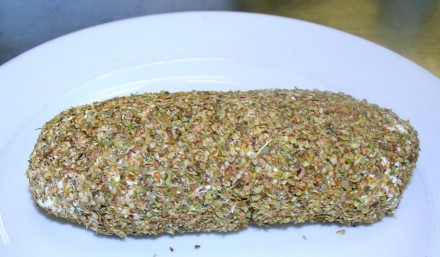
The kitchen is the warm center of the monastery, with monks and volunteers running in and out of it delivering the big dishes Gauley cooks – or simply serving their brothers at table daily. It’s a nourishing, nurturing shelter of a place: a lively, light-filled room in the monastery adjacent to the bookstore and the rectory.
When I ask Father Tom if he has a favorite dish of Gauley’s, it is Gauley who answers.
“It’s a raw vegetable salad,” he says.
“Actually, it is,” says Father Tom. “I love that.”
]]>
You have to pity the poor hot dog.
Not since… I don’t know what… has something been so loved and hated at the same time.
Millions of Americans absolutely adore this virtual symbol of the quintessential American holiday yet denigrate them, and themselves, for eating them.
So, being an inveterate hotdog lover who’s devoured quite a few since the Fourth of July, I’m here to testify to the honorable culinary tradition from which they spring (in case you don’t know).
Hotdogs, members of the sausage family, are a type of preparation known as emulsified forcemeat and are related to such respected delicacies as pate, mortadella, and bratwurst — as well as many a lovely stuffing used in a number of foods.
Emulsified forcemeats are made by emulsifying lean meat, salt, water, and fat into a fine puree in the big bowl of a chopping machine. Ice is actually used, rather than water, since friction from the chopping causes heat, and the meat mixture must remain colder than 60 degrees or the fat will separate from the protein (think water and oil).
Even though I’ve long since gotten wise to the amazing fact that the South Shore seems to have at least one of every type of great culinary creator, I was still surprised to find that we have a master sausage maker!
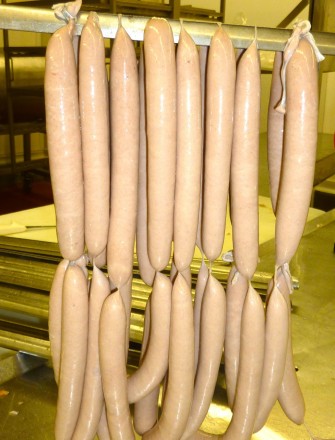
Hingham native and resident Dave Nosiglia, owner of the Smokehouse retail store in Norwell, manufactures about 70 types of sausage and smoked specialty meats at his small processing plant in Mattapan, including a fantastic classic hotdog he calls a wiener. Nosiglia learned his trade in Germany where he apprenticed for three years soon after graduating from high school in the late ‘70s.
Nosiglia’s hot dogs are an emulsification of lean hindquarter beef, water, and fresh ground pork fat (not some sort of processed lard, in case that’s what you’re imaging). Salt and spices (including white pepper, paprika, nutmeg, and all spice) are also added to the mix, which is then shaped inside natural casings, cooked in a hot smoker, and cooled.
“It’s like making a bread dough — then after they’re cooked, they’re like bread,” said Nosiglia about his hot dogs.
I didn’t quite get this until I watched him make his wieners.
The hotdogs are made in an enormous chopper that has a bowl that rotates as the mixture works — a lot like dough in a Kitchen Aid. The beef, ice, and spices are added to the chopper first and processed for several minutes before the fat is added. Sodium nitrite – a curing, preserving agent – is also added. If you don’t like the idea of nitrites, Nosiglia also makes an organic wiener in which a costly freeze-dried celery juice powder is used in its place.
As the meat “dough” gets close to being the right consistency, the sausage maker pokes it repeatedly to see how it’s coming (like you would a bread dough). At one point, near the end, after adding a bit more ice, he shuts off the machine and it’s done.
From there, the mixture is transferred to another machine that forces it through a die into a long length of natural casing. Workers, then, somehow twist and twirl the casing to create individual links. And, finally, after a large stainless rack is filled with wieners, the whole thing is rolled into the smoker, which looks a bit like a walk in refrigerator, where they get smoked in beechwood and cooked for about three hours.
Nosiglia sells his wieners and many of his meat specialties wholesale throughout New England. His only retail outlet is in Norwell, although Mary and Robert Gonsalves, who love Smokehouse products, sometimes sell them at their wonderful shop, Bloomy Rind, in Hingham Square.
“I would fight for the hotdog – I love good hotdogs,” said Gonsalves, getting right into it when I stopped into his shop a couple days ago raving on about the wieners from the Smokehouse. Gonsalves, a graduate of the Culinary Institute of America and a brilliant chef, was the executive chef of Todd English’s celebrity restaurant empire for 12 years, and knows whereof he speaks.
So, while there are indeed crummy hot dogs out there, a good one is a thing of beauty and a preparation that takes skill to do well.
So pity the hot dog no more but give it its rightful due.
Hear! Hear!
]]>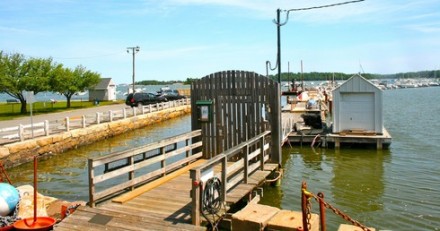 Being a café lover of the first order (there’s not much I enjoy more than hanging at a great café), I am thrilled out of my mind that Hingham resident Bob Weeks, of Redeye Roasters, is planning to open a café in the Bare Cove Marina building, across from Stars Restaurant, on Hingham Harbor.
You may know Weeks from the hand-roasted coffee he sells at several local shops or from the great coffee he serves from his colorful coffee truck at the Hingham Farmers Market. The new café-to-be — Redeye Roasters Coffee and Espresso Lounge — will occupy 1,000 square feet of the side of the marina building toward the Hingham Bathing Beach, while the other side will serve as storage for marine activities. [See the view below] “We’re putting windows on the water side, so very soon you’ll be able to have a coffee and look at the boats and water,” said Weeks, who hopes to open by late August or early September.
Weeks, who launched Redeye Roasters after leaving his advertising job in 2006, plans to offer all types of coffee drinks, teas, pastries, gelato, and affogato. (He may be in the market for a local baker to supply the shop, so if you’re that person, check him out.)
In Plymouth, the historic building where the wonderful Martha’s Stone Soup restaurant (cq) used to be is set to open on June 23 as a restaurant serving classic American fare.
Rye Tavern is the newest baby of partners Christopher Tocchio andKristian Deyesso, owners of Plymouth’s Union Fish Seafood & Raw Bar; Boston’s Church Restaurant & Nightclub; and The Regal Beagle in Brookline.
The owners have gutted the building, known as the Wright Tavern, built in 1792, and created seating for about 50, which includes some patio dining, said Brandon Babiarz, executive chef of Union Fish. The menu will be small and have a farm-to-table, seasonal focus inspired by the garden on the property.
It’s great that these guys are renovating and restoring this special, remote venue at the intersection of Old Tavern Trail and Old Sandwich Road in Pinehills. The restaurant will be open at 5 p.m. daily for dinner.
The former Cafe Ona (and before that Cafe Calabria) at 443 Nantasket Ave. in Hull is now Lynda’s Restaurant – a breakfast and lunch place owned by Joe DiVito, who owns Weinberg’s Bakery just up the road. The restaurant, which is open daily from 7 a.m. to 2 p.m., serves breakfast all the time as well as lunch from 11 a.m. to 2 p.m.
Among the many standard American breakfast and lunch dishes are some Italian favorites. Lynda’s also serves espresso drinks, Hornstra dairy’s local milk and chocolate milk, and soymilk. Daily specials are posted on the restaurant’s Facebook page.
DiVito has been able to secure customer parking in the Knights of Columbus lot across the street from the restaurant, something the site’s former incarnations didn’t have.
Chef Paul Wahlberg and company are planning to open a casual burger, hot dog, and frappe type restaurant adjacent to the chef’s fine dining restaurant, Alma Nove, at the Hingham Shipyard late this summer, according to Wahlberg’s publicist, Mindy Valone, at Boston’s CM Communications.
Although Wahlberg spoke at length to a local paper last month about his plans and inspiration for the new place, he’s now unavailable for comment, so we’ve been unable to confirm anything more than the basics.
Wahlberg opened Alma Nove last summer with partners that include brothers Mark (movie guy) and Donnie (music and movie guy).
A new burger place, Wild Willy’s Burgers, is planning to open later this month at 588 Washington St., not far from the Fore River Bridge. The restaurant is part of a small chain – there are six others spread among Massachusetts, Maine, and New Hampshire.
The new place is owned by husband and wife Paul and Ruth Bennett.According to the restaurant’s Facebook page, Wild Willy’s will be open daily from 11 a.m. (noon on Sundays) until 9 p.m. (8 p.m. on Sundays). For info about possible employment, call 617- 472-9453, or stop by the restaurant.
The Quincy Farmers Market, which opens on June 24, will be selling Massachusetts wines for the first time this season.
According to Janet Little, market manager, state legislation was passed last year that allows the sale of Commonwealth farm wines at farmers markets. The city of Quincy this month licensed the farmers market to hold wine tastings and sales.
The market, which is open from 11:30 a.m. to 5:30 p.m. on Fridays, will feature wines from one of four Commonwealth wineries each week. The participating wineries are Coastal Vineyards of South Dartmouth; Westport Rivers of Westport; Zoll Cellars of Shrewsbury, and Turtle Creek of Lincoln.
]]>
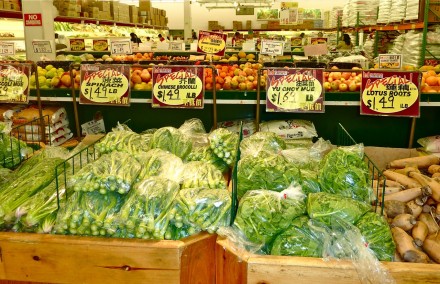 So many cuisines, so many foods unique to each, so many items labeled with words I can’t read!
Few places are more packed with these mysteries than Quincy’s Kam Man – probably the most extensive Asian market in New England.
“It’s the largest in Boston, and Boston’s the largest city in New England, so I’m pretty confident it’s the largest in New England,” said Quincy resident Wan Wu, 64, Kam Man’s general manager and part-owner.
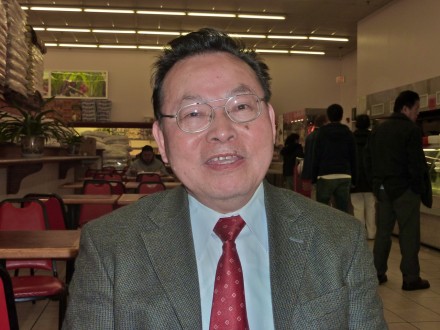
The supermarket is one of four Kam Man stores in the little dynasty founded in 1971 by Wan’s brother, Wellman Wu, in Manhattan. That first store – Kam Man Food Products — is still there on Canal Street in the heart of New York’s Chinatown.
There are also two Kam Mans in New Jersey, where Wellman lives. Additionally, a new Kam Man will open in Queens, N.Y., in about six months, and the brothers have just bought Super 88 Asian market in Dorchester, which will be their sixth Kam Man.
And, although the labels and the ingredients may need translation, taste transcends all: you don’t need words to know that something’s delicious.
Kam Man’s hot prepared foods section is a good way to dip into some of the mostly Cantonese-style dishes its chef makes daily. The foods are served cafeteria style: you get your choice of three main courses from an array of dishes – along with rice and a cup of light soup — for $7.50. “Heads on?” said the woman behind the hot bar when I was choosing my lunch a few weeks ago. She was referring to little, deep-fried fish – sardines I think — and although her English was limited, she wanted to make sure I knew what I was getting.
Along with the hot foods is a barbeque section with delicious ribs, ducks, and even whole pigs.
Most of Kam Man’s 80 full-time and 30 part-time Quincy employees don’t speak much English – which makes it almost impossible for English speakers to learn about items while shopping.
Wan understands this, and is hoping to implement something to help the store’s non-Asian shoppers become more familiar with the cuisine. “We’re thinking of starting a store tour on a regular basis… or a brochure or handout,” he said.
 Among the tens of thousands of grocery items in the store (including an enormous collection of Asian beers), approximately 50 percent are Chinese and the rest a mix of Vietnamese, Filipino, Thai, Japanese, and a smattering of other international foods, including American. (That doesn’t mean the products all originate in those countries: almost everything in the fabulous fresh produce section, for instance, is domestic.)
Wan estimates that 80 percent of the Quincy store’s customers are Asian, the vast majority of whom are Chinese. The remaining 20 percent are largely Caucasian.
“According to the latest census, 24 percent of Quincy’s population is Asian and of that 24 percent, 13 percent are Chinese,” said Wan.
The Wu brothers were born in Shanghai and moved to Hong Kong with their family when Wan was 10, and his brother 14. Wan came to the U.S. in 1966 where he earned a bachelor’s degree from the University of Rhode Island and a Ph.D. in chemical engineering from Lehigh University. Wellman followed his brother a few years later, forgoing schooling and diving right into business.
“He’s the entrepreneur,” said Wan, who was a research scientist at Monsanto in Springfield for 25 years before joining his brother in business for the opening of the Quincy store in 2003.
The site, a former Bradlee’s, is a small indoor mall with about 15 independent Asian storefronts (a ginseng shop, a Vietnamese deli, a travel agent, a clothing store) situated between Kam Man’s two big parts: its enormous grocery and its large home goods store. Together the two parts comprise about 60,000 square feet.
The housewares department reminds me of an old American five and dime — like a Woolworth’s — with a little bit of everything: cookware, dishes, cosmetics, hardware, clothing, shoes, electronics, furniture, bamboo plants, guitars, and much more. It’s a really fun place to wander.
The space is being renovated now, and by mid-summer the grocery and housewares will be connected, with the independent stores remaining.
And, what does Kam Man mean? “Kam” is Chinese for golden and “man” means gate, but Wan thinks the original Manhattan store was named after the small island of Kam Man, off mainland China. The island was, according to Wan, the site of the only battle the Chinese nationalists won in the civil war with the Chinese Communists in the late ‘40s.
“It’s quite well known,” said Wan.
Follow Joan Wilder on Twitter.
 Here they come again: colorful farmers markets that spring up in the middle of nowhere like nomadic villages, filling parks and parking lots with local foods and goods and shoppers.
Mere hours after they appear, the carnival-like, action packed scenes dissolve into nothingness like mirages only to reappear the following week, same time, same place — rain or shine.
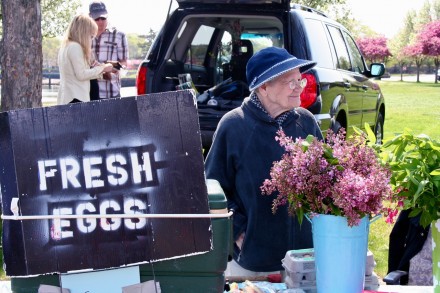
Although most of the markets on the South Shore won’t open until June, Holbrook’s opens this weekend, Hingham circled its white tents [above] for this year’s opening day last Saturday.
According to Hingham Market Manager Bill Marshall, an average of 1,000 people shopped Hingham’s Saturday, 10 a.m. to 2 p.m. market last year and he expects “another banner year this year.”
Happily, spring’s intermittent sunshine showed up for opening day and so did several of the market’s new sellers. Among them I was thrilled to see Foxboro Cheese Co; Cape Cod Original, selling chowders and more; and Vermont Heritage Grazers with a freezer full of pasture-raised pork.
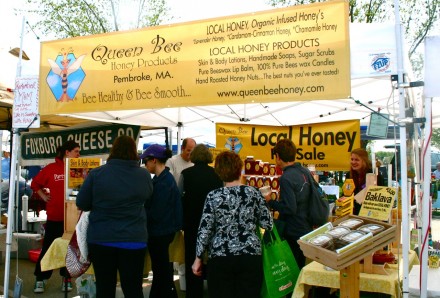
Old favorites were there, too, with bells on: Queen Bee [left] with its great honey;L. Sweets Bakerywith its Italian cookies; Nella Pastaand its gorgeous homemade ravioli; the wonderful Mediterranean foods from To Dine For, which, incidentally, sell a great little homemade bagel-like pastry with a hunk of cheese for snacking that goes so nicely with a cup of individually brewed coffee from Redeye Roasters’colorful cafe on wheels.
Turns out, there are a lot more farmers markets in the area than I knew. Here is a verified list (I talked to someone at each market) of all the markets in the area, where they are, when they open, and their weekly hours.
- Braintree Farmers Market, 1 JFK Memorial Dr. Opening day: Saturday, June 11. Hours: 9 a.m. to 1 p.m.
- Cohasset Farmers Market, Cohasset Commons, 41 Highland Ave. Opening day: Thursday, June 16. Hours: 2 to 6 p.m.
- Dedham Farmers Market, downtown parking lot between High Street and Eastern Avenue. Opening day: Wednesday, June 15. Hours: noon to 6 p.m.
- Duxbury Farmers Market, outside the Tarkiln Community Center, Route 53. Opening day: Thursday, June 30. Hours: 1:30 to 5:30 p.m.
- Hingham Farmers Market, Hingham Bathing Beach parking lot, Route 3A. Opening day, Saturday, May 7. Hours: 10 a.m. to 2 p.m.
- Holbrook Farmers Market, Union Street Lanes parking lot at 231 Union St. Opening day: Saturday, May 14 (this weekend!). Hours: 9 a.m. to 2 p.m.
- Marshfield Farmer’s Market, Marshfield Fairgrounds, Route 3A. Opening day, Friday, June 3. Hours: 2 to 6 p.m.
- Milton Farmers Market, Wharf Street, Milton Village. Opening day, Thursday, June 16. Hours: 1 to 6 p.m.
- Norwood Farmers Market, 615 Washington St., behind the Apollo restaurant. Opening day, Tuesday, June 21. Hours: 1 to 6 p.m.
- Pembroke Farmers Market, Town Green. Opening day, Saturday, July 9. Hours: 9 a.m. to noon.
- Plymouth Farmers Market, there are two: One is held at Stephens Field, 132R Sandwich St. Opening day: Thursday, June 16. Hours: 2:30 to 6:30 p.m. The second market is held on the Courthouse Green. Opening day: Saturday, June 18. Hours: 9:30 a.m. to 1:30 p.m.
- Scituate Farmers Market, North Scituate Village at the intersection of Country Way and Henry Bailey Turner Road. Opening day: Wednesday, June 15. Hours: 3 to 7 p.m.
- Quincy Farmers Market, downtown Quincy in the John Hancock municipal parking lot, across from the courthouse. Opening day: Friday, June 24. Hours: 11:30 a.m. to 5:30 p.m.
- Walpole Farmers Market, Town Common on Main Street. Opening day: Wednesday, June 15. Hours: 2 to 6:30 p.m.
- Weymouth Farmers Market: Town Hall parking lot, 75 Middle St. Opening day: Saturday, June 25. Hours: 9 a.m. to 1 p.m.
The program seems to be that we must eat to keep up our strength, keep up our spirits, and generally keep all the wheels turning. God forbid we should be hungry for any length of time!
 Which is why the Alfredo Aiello Italian Foods retail shop in Norwell makes trays of Sicilian-style pizza daily.
“You can’t be hungry in an Italian place!” said owner Rosina Aiello, 78, whose business comprises a 20,000-square-foot pasta manufacturing plant in Quincy and three South Shore retail stores.
“People would be shopping and we didn’t have anything for them to eat,” said Lino Aiello, operation’s manager and Rosina’s son. “They’d be getting pasta to take home to cook, and they were hungry. So they’d grab a slice. It has become very popular. It’s not a money-maker [at $1.49 a slice], it’s just there.”
The fact that Alfredo’s produces 5,000 to 8,000 pounds of pasta and Italian food a day, for wholesale and retail sales in New England, is hard to believe after visiting the plant.
The environment is extremely familial, relaxed, and comfortable. Old-fashioned-looking machines mix, roll, and stamp out tortellini, say, four at time (click, click, click) onto a narrow conveyor belt. The company’s dozens of delicious fresh pasta cuts and prepared Italian dishes are made by only 20 or so employees.
 On a recent visit, Rosina was working the lasagna-making line with about eight others, many of whom spoke Italian, and all of whom were wearing white hair caps. I happened to visit midday, and at the stroke of noon, everyone stopped their work and retired for lunch.
Rosina emigrated from Italy at the age of 13, and met her husband, Alfredo, 10 years later in the North End, where her family lived. The young couple married, moved to
Worcester, and started their business there in 1966. Three years later, they moved to the current location at 122 Water St. (“I missed my family in the North End,” said Rosina.) Although the couple met in Boston, they were both born in the tiny Southern Italy village of Palermiti. Alfredo passed away last August, at 82.
 In the very beginning, Rosina made the pasta and Alfredo went out and sold it. “It would take me a whole day to make one tray of tortellini like that,” said Rosina, pointing to a drying rack of the pasta.
Later, the Aiellos opened a small storefront in the Quincy plant for retail sales. Then, in 1996, they closed the storefront and opened a stand-alone retail store a couple blocks away, on Franklin Street, while also expanding the plant. (Oddly, the retail shop is right around the corner from Alfredo’s Restaurant, but the two businesses have no connection.)
In 2003, the Aiellos opened their Norwell store, and last year added their newest retail outlet in Canton.
The Norwell store, a few hundred yards from Queen Anne’s corner, is a lively, colorful shop with customers streaming in and out. Along with hundreds of the company’s refrigerated fresh pasta, sauces, and frozen Italian dinners, it stocks all kinds of beautiful imported Italian products.
 Alfredo also has a deli case for fresh sandwiches now (which it didn’t have when it first began offering its pizza for hungry shoppers). And, behind the checkout counter are fresh breads from bakeries in Boston’s North End and Federal Hill in Providence. Those bakeries now deliver the scali, a soft Italian sliced white; the bastone, a hard crusted, long loaf with a dense center; and the spukies, or sub rolls, but they haven’t always.
“In the ‘70s and ‘80s, we’d go into the North End to pick up the bread,” said Lino, who has spent his life in the business. “The sub rolls were called spukies there. And in those bakeries, even today, there’s always a tray of pizza.”
Alfredo’s pastas can be found locally in a number of stores, including: The Fruit Center in Hingham and Milton; Trucchi’s in Abington; Foodie’s Market in Duxbury; Whole Foods in Hingham and Dedham; and Roxie’s of Quincy. For more information on Alfredo’s hundreds of fresh made pasta, sauces, and frozen Italian entrees, visit the company’s website or call 781 878-2500.
]]>The South Shore seems to have at least a really great one of everything, food-wise, as well as many firsts, bests, and authentic ones-of-a-kind. I, who fantasize about covering the food scene in Boston, L.A. or NYC, keep finding more and more people here doing beautiful things with food.

Take Pastry Chef Kerri Lynch-Delaney [left] and her great cupcake bakery, Babycakes, on Beale Street in Quincy.
Truth be told, I’ve barely given a thought to cupcakes since I was little and Hostess two-packs were a treasure in my hot little hands. I did know they’d become a popular trend, but I didn’t know why. Then, a visit to Babycakes changed all that.
“Welcome to my little drama,” said Lynch-Delaney last week as she chatted with customers (many by name) and I delighted over the (real) whipped cream center in her signature cupcake, the Babycake, a dark chocolate, ganache-covered version of my childhood love, the Hostess cupcake.
As I tasted my way through several other cupcakes, a steady parade of people came into the bakery either to buy their favorites or to seek advice on a special order for an upcoming event.
Although Lynch-Delaney’s husband and parents thought she was crazy to open a dedicated cupcake shop, the pastry chef has done well right from the start, four years ago.
Why?
 Because her cupcakes are delicious gourmet cakes made daily, from scratch, with whole, local ingredients. We’re talking at least a couple dozen different flavors, frosted with ganache, butter cream, or whipped cream icing — many of which are filled with creamy or gooey centers or covered with a little something extra.
Then, too, there’s the inherent fun factor of really good cupcakes. From listening to her customers, it’s clear that people love choosing their own treat from among a bunch of delicious options and having a piece of great cake for so little money.
The most expensive cupcake Lynch-Delaney sells is her delicious French toast ($2.75). The rest of her menu of cupcakes and daily special flavors are either $1.50 or $2.25. Amazingly inexpensive.
Before opening Babycakes, Lynch-Delaney spent 10 years at her craft, starting with a pastry course at Cambridge School of Culinary Arts then working at several top Boston restaurants.
It takes a little digging to uncover the link between Lynch-Delaney and Boston culinary royalty: Chef Barbara Lynch (one of the country’s most acclaimed chefs — think No. 9 Park and the new, stratospheric Menton, among others) is her aunt.
Not wanting to ride on her family connections, Lynch-Delaney worked at No. 9 Park for a year following culinary school, then left to spend two years as pastry chef at the Quincy Marriott. Following that, she returned to No. 9 Park for a longer stint — as assistant pastry chef under Pastry Chef Kerry Manning.
“Working under Kerry was the best thing that ever happened to me,” said Lynch-Delaney.
 The pastry chef tells each customer that the cupcakes need to be refrigerated but taste best when eaten at room temperature. And she’s so right: the flavor of sweets is much fuller when they’re warm. I tried 10 of her cupcakes, and loved them all.
I loved the mix of hot pepper and dark chocolate in the Mexican hot chocolate – and its cinnamon whipped cream frosting. The lemon coconut was a standout, too, inspired by “the lemon semifreddo with coconut on top I learned working for Barbara,” said Lynch-Delaney, referring to her aunt. I can also vouch for the Boston creme (with its vanilla pastry cream center), the carrot, the turtle [shown above], and the chocolate caramel.
Lynch-Delaney not only shares a talent for food with her aunt, but some of the irreverence Chef Lynch is known for. She laughs and teases with customers, offers coffee, credit (“don’t worry about it, pay me later”), and provides a little something perfectly sweet, just for one.
]]>
A remarkable old world bread bakery opened on the South Shore a couple months ago and I don’t know which is more amazing – the bread or the oven where it’s baked.
Peter Nyberg’s new wood-fired stone oven in Plymouth is a custom, 60-ton version of the wood-fired stone ovens that have become so popular (mostly for pizza making) in recent years.
But, Nyberg isn’t making pizza.
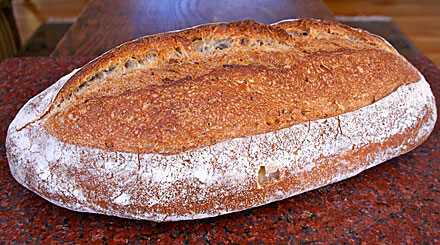
His Hearth bakery is turning out more than 1,000 loaves of a naturally leavened Country French bread daily – the way it was done centuries ago.
The operation and scale of the oven are hard to grasp.
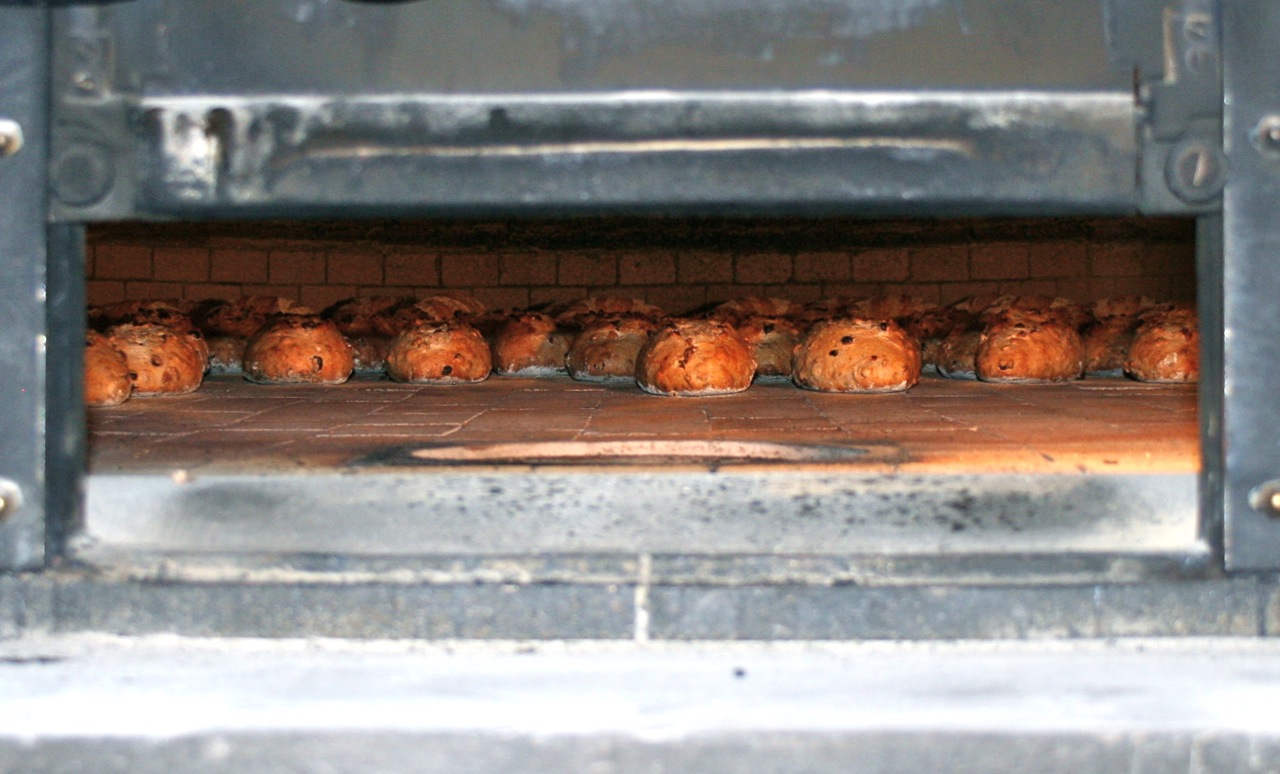 Its interior, cave-like baking chamber is about 12 feet in diameter and can accommodate more than 100 loaves.
An oven-full bakes in about 18-20 minutes at a temperature of 460-490 degrees, one batch after another. It takes one baker about the same amount of time to load a batch of uncooked loaves onto a very long wooden peel, slash their tops, and slide them into the hot cave. And to remove them? That’s faster: maybe eight backbreaking minutes of pulling the (pound and a half) loaves onto the peel and sliding them out of the oven and onto a beautiful wooden rack.
Meanwhile, Nyberg stone grinds his custom blend of mostly organic, heritage grains, mixes, proofs, hand-weighs, and forms doughs in synchronized time, batch after batch.
“We can produce over 2,000 pounds a day, that’s a decent capacity,” said Nyberg, who employs a second full-time baker.
The operation is a unique study in simplicity and precision.
 Nearly every tool and piece of equipment in the bakery – and every procedure — has been custom designed to move an exact volume of dough (enough for one oven’s worth of loaves) through the stages of bread making.
“We’ve finally got it down to a science,” said Nyberg, who broke ground on the mammoth oven in June and baked his first loaf in October.
Every day, sometime around 10 a.m., after a night of baking, Nyberg starts a big wood fire on the floor of the oven. It burns until late afternoon, at which point the embers are spread out, allowing the heat to soak into the oven’s enormous thermal mass. Around 8 p.m., a second fire is built in a firebox chamber beneath the floor of the oven that will be maintained throughout the cooking hours. At midnight, the oven floor is swept clean of its embers, and baking begins.
Nyberg, 41, has been taken with bread baking for more than 20 years. He’s baked at numerous restaurants and bakeries, worked as a consultant, and is an adjunct baking instructor in the College of Culinary Arts at Johnson & Wales University. When he began toying with the idea of opening a bakery last year, he knew what he was after.
“I wanted simplicity and as few mechanicals as possible,” said Nyberg, who has replaced automated techniques (like proof retarders, baguette molders, and bread dividers) with elegantly conceived procedures designed to streamline handmade bread baking.
Eschewing such techniques in favor of small batch baking allows for the daily grinding of heritage grains; long fermentation times; and the use of natural leavening. These processes, and the high heat of the wood-fired oven, result in an alchemy that allows the grains to retain their nutritional values and flavor.
 I visited Nyberg at 7 a.m., on Christmas Eve day, toward the end of a long night of baking.
We talked as he took a batch of loaves out of the oven; put water into an iron bucket that fits into a hole on the oven floor; and loaded up another hundred doughs.
“Feel that? Feel the humidity?” he said, inviting me to touch the wooden handle of the 15-foot bakers peel he’d just pulled from the oven.
And I do, I feel that it’s moist.
Although Nyberg’s main focus is making his Country French bread, customers have convinced him to produce others, so he’s now also making a lovely rosemary loaf and a fruit and nut on Fridays and Saturdays.
 And, I like both those loaves, but I love the Country French. It’s an uncommon bread and satisfies in an uncommon way – almost as though it were a different food than bread. And I don’t mean that it’s heavy, it’s not. It’s actually light, with a very airy, moist crumb, and a crust that bites back: a crust that demands respect! After eating it for a week, other breads began to seem lightweight and lacking to me.
The bakery, which is open everyday for sales, also delivers daily to several South Shore stores, including Hingham’s Fruit Center. Call to see if there’s one near you.
Hearth Wood Fired Bread bakery is open for retail sales Monday through Saturday, 9 a.m. to 6 p.m., and Sundays, 10 a.m. to 3 p.m. The country French is $4.25. 123-2 Camelot Drive, Plymouth, 774-773-9388. www.hearthwfb.com
]]>